When Mark told me he wanted a divorce, it was an ordinary night in Portland—rain tapping gently against the windows, the microwave humming as it reheated dinner, and that quiet rhythm of routine. I was still in my scrubs from the hospital, exhausted but clinging to small comforts: our houseplants, the smell of garlic from takeout, his voice echoing softly in the kitchen. Then he said four words that shattered my world.
“I’m leaving,” he said. “For Emily.”
Emily—my younger sister.
At first, I thought I’d misheard. I waited for him to laugh it off, to explain, to say anything that could make it make sense. But his face remained calm, steady, the kind of calm that comes from having rehearsed devastation a thousand times.
He didn’t soften it. He didn’t offer excuses. He simply said he loved her and wanted to marry her.
I didn’t scream. I didn’t cry. Years of nursing had trained me to remain still in the presence of pain. But stillness is survival, not strength.
Within a month, I packed my life into boxes marked with blue tape and moved into a small apartment across town. My parents were horrified, unsure how to take sides. My mother said, trembling, “At least he’s staying in the family,” as though that were any comfort. My father offered nothing but silence—the only mercy he could manage.
Emily sent a wedding invitation months later. I didn’t go. I pictured them exchanging vows under soft Oregon sunlight, at some winery surrounded by eucalyptus, and the thought made my chest ache.
In my new apartment, I discovered what quiet really sounded like. No footsteps, no laughter, no shared grocery lists stuck to the fridge. I worked too much, slept too little, kept moving, because stillness meant facing memories. My days at the hospital were filled with other people’s crises—blood pressure drops, family goodbyes, the metallic smell of antiseptic that never left my hands. Their chaos steadied me in a strange way.
Then, one morning, a wave of nausea hit me without explanation. I bought a pregnancy test on the way home, the cashier’s casual smile making the moment feel unreal. Two pink lines.
I sat on the edge of the bathtub, the world tilting around me.
Pregnant.
The timing confirmed what I already feared—it had happened before the marriage ended but after Mark’s confession. His child. My secret.
I told no one—not him, not Emily. I called my friend Rosa instead, who brought rotisserie chicken and lime soda, sat quietly on my couch, and said nothing. Sometimes silence is the kindest language.
I kept the baby.
Jacob was born on a gray February morning that couldn’t decide between snow and rain. His first cries seemed to claim the world for him. When I held him, warmth sank into my bones like sunlight I hadn’t felt in years. I named him Jacob—no one to honor, only a fresh start.
For four years, it was just us. Nights at work, stolen sleep, and small routines—oatmeal for breakfast, park walks, bedtime stories. Jacob said “truck” before “mama,” and his laughter filled rooms like sunlight. I told no one who his father was.
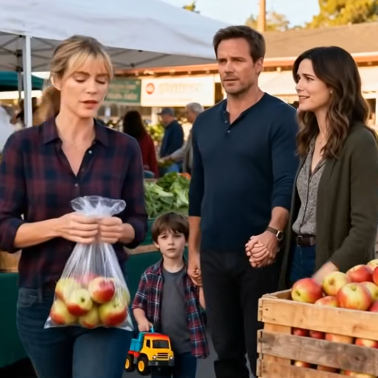
Then one autumn afternoon at the farmers’ market, the air scented with cider and roasted corn, Jacob clung to my leg, pointing at pumpkins, when a familiar voice called my name.
“Claire?”
Mark stood before me. His hair shorter, his face older, but his eyes—the same. Emily was beside him, radiant in the way people who believe they’ve won always are.
“Hi,” I said, voice steady.
Jacob peeked from behind me, toy truck in hand. Mark’s gaze froze on him. He didn’t need to ask. The resemblance was undeniable.
“Who is he?” he whispered.
I could have lied. I didn’t.
“He’s my son,” I said.
Emily’s laugh was sharp, too loud for the sudden silence. “Your son?” she faltered.
“Yes,” I interrupted. “He’s yours.”
Emily’s expression collapsed. She walked away, leaving Mark pale and shaken.
“Why didn’t you tell me?” he asked.
“Because you’d already left,” I said. “I wasn’t going to make a child live in your chaos.”
I left before he could respond.
The weeks that followed were a slow siege. He appeared near my apartment—not threatening, just present. Letters, emails, voicemails. Each one said the same thing: Please. Let me know him.
I ignored him, then I didn’t. I called a lawyer. Paperwork had the comfort of certainty when emotions were unreliable. Boundaries were set: supervised visits, public spaces, no unannounced appearances. He agreed without protest.
The first time he saw Jacob again was at a park by the river. No toys, no gifts—just a man trying not to break something fragile. Jacob eyed him cautiously.
“Hey, buddy,” Mark said softly. “Cool truck.”
Jacob didn’t answer at first. But when Mark asked to push him on the swing, he nodded. Laughter followed—not forced, not fake, but real.
He came every week after that. Rain or shine, early or late, he arrived. He learned Jacob’s favorite snack, the song that made him dance, the bedtime story he always asked for twice. He didn’t ask for forgiveness. He didn’t play the hero. He simply stayed.
Emily left him not long after. My mother called, her voice thick with guilt. I didn’t celebrate. I didn’t need to.
Over time, routine became rhythm. Saturdays at the park, birthdays shared, photos exchanged in a parenting app. I watched Mark grow into the kind of father I never imagined—patient, careful, humbled. I didn’t make it easy. I didn’t make it hard. I made it possible.
Jacob grew, asking questions about why his parents lived apart, why his aunt didn’t visit, why his dad sometimes looked sad. I answered honestly: “Adults make mistakes. What matters is what they do next.”
He accepted it like a truth as simple as gravity.
Years passed. Bitterness thinned into something almost tender. We shared soccer games, concerts, and occasional coffee on neutral ground. He never asked for a second chance at “us,” and I never offered one. Some things, once broken, don’t need repair—they need repurposing.
When Jacob turned ten, Mark took him to Seattle for a week. Photos came of them by the Space Needle, Jacob grinning, sunlight catching his hair. I stared longer than I meant to.
Peace doesn’t arrive with fanfare. It settles quietly, like rain finding rhythm on a roof.
The last time Mark and I spoke alone, leaving Jacob’s school recital on a cold Portland night:
“Thank you,” he said suddenly.
“For what?”
“For not making me the villain in his story.”
“You did that yourself,” I said. Softer: “But you’re trying to change the ending. That counts.”
He nodded, eyes glassy, and for the first time since that night in the kitchen, I saw him not as the man who wrecked my life—but as a man trying to make amends, one honest act at a time.
Forgiveness didn’t arrive in a ceremony. It came quietly, in fragments—through our son’s laughter, the way Mark tied his shoes before running after him in the park. I forgave him not because he deserved it, but because carrying the past was heavier than letting it go.
Jacob once asked if his father and I were friends.
“Something like that,” I said.
He thought. “Maybe you’re family.”
“Yes,” I told him. “Maybe we are.”
And that, I learned, is peace. Not the reunion of what’s broken—but the calm acceptance that love, even after ruin, can build new rooms inside the wreckage and call them home.