I have never been the type of woman to believe in fate, luck, or the alignment of stars. My life was a carefully constructed architecture of data and certainty, a world in which numbers told the truth and emotions were messy variables I could barely comprehend. As a financial analyst, I thrived on spreadsheets, quarterly projections, and the cold reassurance of performance metrics. To me, everything had a formula, an order, a way to be predicted, controlled, and optimized. Love, marriage, and relationships were anomalies in my worldview, unpredictable equations I approached with caution. And yet, looking back on the wreckage of my past, I realize that even the most meticulously planned lives can collapse in an instant, torn apart by a single evening, a single conversation, a single act of cruelty disguised as normalcy. If someone had told me that a disastrous anniversary dinner would be the moment that unraveled everything and yet became the catalyst for my liberation, I would have dismissed it as statistically impossible, an outlier in a life that prided itself on minimizing risk.
My relationship with Peter had begun in a way that now seems almost hallucinatory. It was gentle, tentative, a slow unfolding of charm and attentiveness that lulled me into thinking the world of romance could fit within the predictable parameters I trusted. We met at a dinner party I had almost skipped—a minor obligation I had considered neglecting—and yet fate, or chance, inserted him into my orbit. I was late, distracted, stressed, and utterly unprepared for a conversation that would captivate me. Peter had the rare ability to calm anxiety, to make me feel seen without demanding a performance. He laughed at my quirks instead of criticizing them, remembered the smallest details about my preferences, and offered the kind of steady, patient attention I had long thought impossible to find. For months, he embodied the ideal partner: thoughtful notes left on mirrors, remembering my coffee order perfectly, and showing a level of attentiveness that, in retrospect, was almost performative in its perfection. When he proposed in the park where we had our first date, I said yes without hesitation, convinced I had found a man who could love me and respect my independence at the same time.
The first warning sign appeared with Helen, his mother. From the moment I met her, I felt the invisible gravity of her influence. Helen was a woman of impeccable polish and unyielding strength, a matriarch whose voice carried both velvet smoothness and an icy undercurrent. Her presence was suffocating, a subtle reminder that Peter had been nurtured under her dominance. It wasn’t immediately obvious, but I gradually realized that their bond was less about affection and more about control. She had raised him alone, and the boyish tendencies he never shed became chains tethering him to her will. Peter never resisted; he laughed at her overbearing behavior, deflecting its weight onto me, and I, in my naivete, tried to convince myself that Helen’s intensity was a product of loneliness, not a warning of the life that awaited me.
After the wedding, the man I had once thought I knew began to evaporate before my eyes. The attentive partner, the man who celebrated my successes and championed my ambitions, was replaced by someone entirely different. A man who expected perfection from me without reciprocating in any meaningful way. The home, once a shared space, became my responsibility alone. Meals, cleaning, and emotional labor were no longer shared—they were mine to manage as if my career and exhaustion were irrelevant. Peter often cited his mother as the model of ideal womanhood, reminding me with an almost religious devotion to Helen’s example: a woman who never worked, kept a flawless home, and dutifully served the men around her. I was the primary earner in our household, the architect of our financial stability, but in Peter’s worldview, that accomplishment was irrelevant. What mattered was the domestic standard set decades earlier by his mother, a standard I could never meet in his eyes.
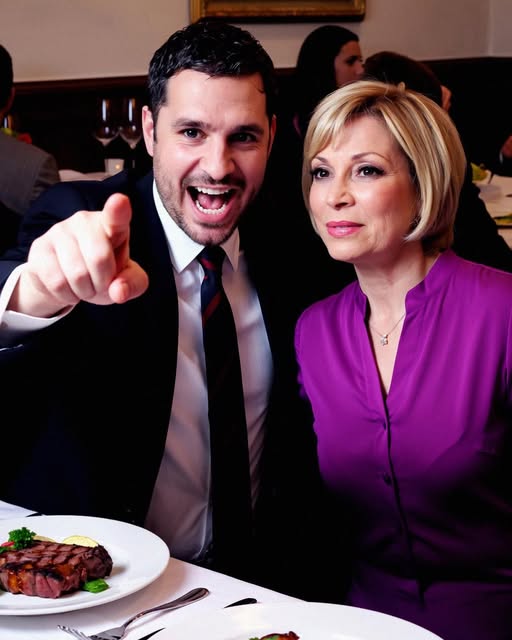
By our second anniversary, the marriage was gasping for air. When Peter told me he had made reservations at an upscale restaurant, I clung to the flicker of hope that maybe, just maybe, the man I had married could remember the tenderness of the early days. I spent hours preparing, curling my hair, and carefully selecting a navy dress I knew he liked. I wanted the night to be an antidote to the erosion of intimacy we had suffered, a chance to revive the connection that had once seemed unshakable. But the moment we arrived, my optimism was crushed. Helen was already seated, occupying our reserved booth with a smug, expectant smile that set the tone for the evening.
The dinner was a meticulous study in humiliation. Every exchange, every glance between Helen and Peter, was designed to render me invisible. When I attempted to engage, my words were ignored or met with derision. The final, unbearable moment arrived when I ordered a shrimp salad. Peter erupted, accusing me of selfishness and inconsideration because his mother was allergic to shellfish—a critical detail he had neglected to mention. His voice carried through the restaurant, sharp, cutting, and imbued with contempt. He chastised me for “always making everything about myself,” and commanded, in front of a room of strangers, that I leave. The shame was physical, a burning sensation that spread from my cheeks to the pit of my stomach. I wanted to vanish, to disappear from the gaze of everyone who witnessed the cruelty.
As I turned toward the exit, a voice interrupted the spiraling humiliation: “Elizabeth? Is that you?” Standing a few feet away was William, a figure from my past I hadn’t seen in over a decade. Calm, measured, and entirely unflappable, he assessed the scene with a quiet authority. Peter, still red-faced and defensive, demanded to know who William was, why he was interfering, and insinuated some vague impropriety. But William, with steady eyes and unshakable composure, cut through the chaos. He addressed Peter’s outburst directly, noting the public humiliation he had inflicted, and offered me the simple kindness of acknowledgment, respect, and protection. In that moment, I realized that the world did not have to be cruel, that there were men who could be strong without being violent or demeaning.
I left the restaurant with nothing but the clothes I was wearing and a clarity I had never experienced before. William followed at a distance, offering a presence rather than demands, a safe harbor rather than judgment. He gave me his number “just in case,” and as I disappeared into the night in a taxi, I felt a strange shift in my spirit. The years of smallness, of bending and accommodating and sacrificing my sense of self, began to peel away. I felt the contours of my autonomy returning, and with it, the recognition that I deserved better than a life under Peter’s shadow.
When Peter returned home, he was still consumed by outrage, oblivious to the damage he had caused. Helen, predictably, had already ensured his comfort with a perfectly cooked meal, dismissing the evening as if my pain were insignificant. That night, I confronted the truth: I was done. Done with the cleaning, done with enduring gaslighting, done with a life dictated by the whims of a man who glorified his mother’s domination. The divorce proceedings were messy and charged with tension, but I had tools Peter and Helen hadn’t anticipated. William, as the restaurant owner, preserved video evidence of the abuse and humiliation. Coupled with witness testimony from staff, the proof allowed the legal process to unfold efficiently, securing my freedom from a toxic marriage.
I didn’t rush into a new relationship. I spent months rebuilding, rediscovering Elizabeth—the woman who existed independently of marriage, maternal expectations, or social performance. William was patient, never imposing, always present as a friend first, a quiet anchor in the turbulence of my life. We shared casual lunches, discussions of career aspirations, and reflections on our pasts. Gradually, I came to understand what partnership could truly look like: equal, respectful, supportive, and fundamentally kind. Household chores became shared responsibilities, and professional achievements were celebrated rather than resented.
In time, friendship evolved into love—a love that was quiet, grounded, and real. When William proposed, there was no spectacle, no ostentatious display. We were barefoot in a kitchen with rain falling outside, amidst the ordinary mess of life—laundry, coffee, and the hum of domestic normalcy. He asked me to build a life with him, not a perfect life, but one that was messy, beautiful, and enduring. In that moment, I realized that my former marriage had prepared me to recognize what I truly deserved: a partner who valued me fully, for all that I am.
Looking back on that anniversary dinner, I no longer see shame or humiliation. I see a turning point, a night when the story I had been living—the one dictated by fear, obligation, and subservience—ended. The public embarrassment that once seemed unbearable became a catalyst for liberation. I walked out of the restaurant, not just from Peter and Helen, but from the constraints that had defined my life for too long. I emerged into a world where I am seen, respected, and loved for exactly who I am. The spreadsheets of my life finally balance—not in the cold precision of numbers, but in the deep, unpredictable satisfaction of freedom, self-respect, and true happiness.