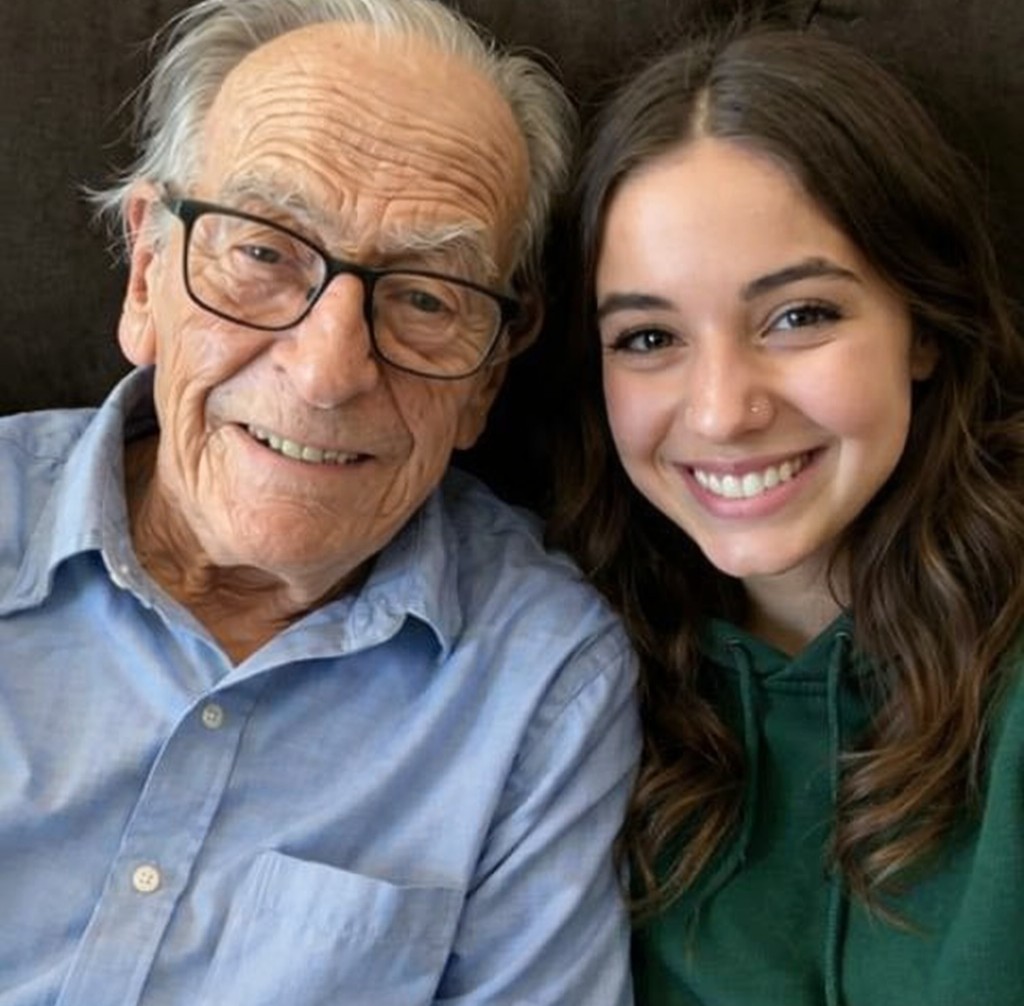
The architecture of a human life is often built upon the silent sacrifices of others, but few are as complete or as quietly impactful as those made by my grandfather, Bram. Two weeks after we laid him to rest in the cold Ohio earth, I received a phone call that would shatter every belief I had about our existence. A calm, clinical voice from the local bank delivered a sentence that hit me like a physical blow: “Winslow, your grandfather wasn’t who you thought he was.”
My story truly began when I was six years old, on the night everything turned gray. An accident claimed both of my parents in an instant, leaving me adrift in a sea of muffled adult voices and the terrifying threat of “foster care.” I remember sitting on a velvet sofa that felt too large, watching social workers discuss my fate as though I were a piece of unclaimed luggage. Then, the door swung open. Bram, already sixty-five and weathered by decades of labor that had curved his spine and stiffened his knees, stepped into the light. Without hesitation, he slammed his hand onto the coffee table, silencing the room. “She’s coming home with me. That’s the end of this conversation.” In that moment, I found my anchor.
For the next twelve years, Bram became my entire world. He gave me the master bedroom with the slanted ceiling and the morning sun, while he retreated to a cramped, cold room at the back of the house. Bram wasn’t a man of many words. I watched him hunched over a laptop late into the night, watching tutorials on how to braid a young girl’s hair so he wouldn’t pull too hard. He packed my lunches with rhythmic devotion, always tucking in a note to remind me I was loved. He attended every school play, every parent-teacher conference, always standing in the back, despite the creak of his stiff joints.
When I was ten, during our nightly ritual of tucking me in, I whispered a dream: “Grandpa, I want to be a social worker. I want to save children the way you saved me.” He held me tightly, and I could feel the steady rhythm of his heart. “You can be anything, Winslow,” he promised. “Anything in this world.”
But as I transitioned into adolescence, a shadow fell over our home: the shadow of scarcity. We lived with unrelenting frugality. There were no vacations, no Friday night pizzas, no spontaneous gifts. While my classmates flaunted new smartphones and designer denim, I wore hand-me-downs that swallowed me whole and carried a mobile phone held together by tape and hope. Whenever I gathered the courage to ask for something new, his response was always a gentle mantra: “We can’t right now, kiddo.”
That sentence became a jagged edge in our relationship. A secret resentment began to grow within me. I felt the hot sting of shame as I cried into my pillow, angry at the one person who had always stood by me. I saw his patched coats and our flickering heater as signs of a man defeated by the world’s economy.
Then, the illness came. Bram’s strength, which I had always believed to be infinite, began to fade. The man who had carried me on his shoulders now struggled to climb the stairs. With no money for home health care, I became his primary nurse. I balanced my senior year of high school with administering medication and cooking soft meals. One evening, sensing the end was near, his hand gripped mine with sudden, desperate strength. “Winslow,” he rasped, “there’s something I need to tell you.” I begged him to rest, afraid of the “truth” he might reveal. I feared he would apologize for the poverty or the struggle.
He passed away in his sleep a few nights later. The silence that followed was deafening, amplified by mounting bills and the fear of being an eighteen-year-old alone in the world. When the bank called, I assumed they wanted to discuss the debts he must have left behind. I walked into Ms. Greaves’s office prepared to lose my home.
“Just tell me how much we owe,” I blurted out, my voice shaking. “I’ll work. I’ll find a way to pay it back.”
Ms. Greaves looked at me with profound, watery kindness. “He didn’t owe a cent, Winslow. In fact, your grandfather was the most disciplined saver I’ve ever encountered in my thirty years at this bank.”
The world seemed to tilt. I argued that we had scraped by, that we were poor. She shook her head and explained that eighteen years ago, the day after my parents’ funeral, Bram had walked into the bank and established a restricted education trust. Every month, for nearly two decades, he deposited every spare penny he earned. He had lived a life of artificial poverty, choosing to wear rags and skip meals so that the girl who wanted to “save the children” would never have to worry about the cost of her mission.
She slid a thick, cream-colored envelope across the desk. It was Bram’s final note to me. In his shaky but determined handwriting, he apologized for every “no” he had ever said. He explained that every refusal had hurt him as much as it had hurt me, but he refused to let my future be dictated by the same struggle he had endured. He had left me the house free and clear, a fully funded scholarship for any university in the state, and enough to ensure I would never be “underwater” again.
The realization was a tidal wave. The man I had thought was struggling was actually a titan of self-discipline. His “we can’t right now” wasn’t a statement of lack; it was a promise of “later.” Every patched shoe and skipped pizza was a brick in the foundation of my career.
A week later, I submitted my application to the state’s top social work program. When the acceptance letter arrived, I didn’t celebrate with a party. Instead, I walked out onto the porch where we used to sit and watched the stars. I realized then that the greatest act of love isn’t found in what’s given, but in what’s withheld for a greater purpose. Bram had spent eighteen years pretending to be nothing so I could eventually become everything.
“I’m going, Bram,” I whispered into the night air. “I’m going to save them all, exactly the way you saved me.” I looked at the new phone he had mentioned in his letter and realized it wasn’t just a tool—it was a symbol of a man who had seen every one of my longings and chose to answer them all at once, from beyond the grave. My grandfather was indeed not who I thought he was; he was far better. He was a hero who fought a silent, decades-long war against poverty, and in the end, he had won. I would spend the rest of my life ensuring that every “no” he had ever said resulted in a “yes” for a child in need.