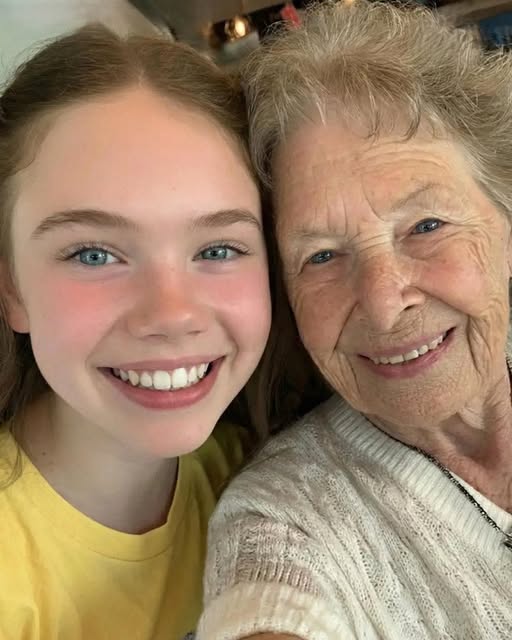
I was thirty-two the day I discovered I wasn’t really an orphan.
By that point, I believed I had already buried three people: my mother, my father, and my grandmother. At least, that’s how I had always understood my life.
The letter arrived three days after her funeral.
Same kitchen table. Same cracked vinyl surface. Same empty chair where her cardigan still hung, one sleeve slipping down like it had lost its will to stay upright. The house smelled faintly of dust and cinnamon, as though trying to remember her on its own.
Out of habit, I put the kettle on and set out two mugs.
I didn’t realize what I was doing until I found myself staring at the second cup.
The envelope had my name on it, written in her handwriting.
I stared at it for a long time.
“Nope,” I muttered. “Absolutely not.”
Then, because that’s what she would have done, I made tea I didn’t want. Kettle on. Two mugs. Even though one of us was no longer here.
When I finally opened the envelope, her handwriting hit me harder than anything said at the funeral.
And suddenly, I was six years old again.
“My girl,” it began.
If you’re reading this, my stubborn heart has finally given out. I’m sorry to leave you alone again.
Again?
I frowned but kept reading.
Before I say the hard thing, I want you to remember this: you were never unwanted. Not for a single second.
The kettle whistled. I poured the hot water, sat down, and continued reading.
I remembered the rainy day when they told me my parents were gone. The way the adults spoke in hushed tones. A social worker telling me there had been a “bad car accident.”
“Instant,” she had said. “They didn’t feel a thing.”
I remember staring at a stain on the carpet instead of her face.
Then my grandmother arrived.
Her house felt like a different world.
Tiny. Warm. A gray bun pulled tightly at the nape of her neck. A brown coat that smelled of fresh air and laundry soap. She knelt down until we were eye to eye.
“Hey, bug,” she said. “You ready to come home with me?”
“Where’s home?” I asked.
“With me,” she said. “That’s all that matters.”
That first night, she made pancakes for dinner.
“Pancakes are for emergencies,” she said, flipping one that came out shaped like a lopsided blob. “And this counts.”
I laughed, even though my throat ached.
That’s how it began.
Life with her was small but full.
She worked mornings at the laundromat, cleaned offices at night, and hemmed jeans at the kitchen table on weekends while I did my homework. Her cardigans grew shiny at the elbows. The soles of her shoes were held together with more duct tape than rubber. At the grocery store, she checked every price tag and sometimes sighed before putting things back.
But my field trips were always paid for.
I had birthday cakes with my name written in frosting. Picture-day money tucked into envelopes. Fresh notebooks and sharpened pencils for every school year.
People at church would smile and say, “You two are like mother and daughter.”
“She’s my girl,” my grandmother would say. “That’s all.”
We had rituals.
Sunday tea with too much sugar. Card games where she conveniently forgot the rules when I started losing. Library trips where she pretended to browse for herself but always ended up beside me in the kids’ section.
At night, she read aloud, even after I could read on my own.
Sometimes, she’d nod off mid-chapter. I’d gently take the book from her hands, mark the page, and tuck a blanket around her shoulders.
“Role reversal,” I’d whisper.
“Don’t get smart,” she’d mumble without opening her eyes.
It wasn’t perfect.
But it was ours.
Then I turned fifteen and decided it wasn’t enough.
Everything changed when the parking lot did.
Suddenly, status was measured in cars. Who drove the newest models. Who climbed out of shiny vehicles. Who still had bus-pass ink smudged on their fingers.
I was firmly in the last group.
“Why don’t you just ask her?” my friend Leah said. “My parents helped me get one.”
“Because my grandma counts every grape she puts in the cart,” I said. “She’s not exactly the car-money type.”
Still, the jealousy ate at me.
One night, I tried anyway.
“Everyone at school drives,” I said.
She sat at the kitchen table, sorting bills into neat piles. Her reading glasses rested halfway down her nose. The chipped mug with the faded flowers sat beside her.
“I think I need a car,” I said.
“The car can wait,” she replied.
“I could get a job,” I argued. “I could help.”
That made her pause.
“You will help,” she said. “Just not that way.”
“How long?” I snapped. “Until I’m the only senior still on the bus?”
“You’re not the only one,” she said calmly. “And the bus is safer than half those idiots behind the wheel.”
“That’s not the point,” I said. “You don’t get it.”
Her mouth tightened. “I know more than you think.”
“If you did, you’d help,” I shot back. “You never spend money on anything. You’re just… cheap.”
The word landed harshly.
“That’s enough for tonight,” she said quietly.
Her face changed in a way that made my stomach drop.
“I see,” she said. “We’ll talk when you’re not using words to hurt.”
I stood so fast my chair scraped.
“Don’t worry,” I said. “I’m not asking you for anything ever again.”
I slammed my door and cried into my pillow, rehearsing apologies by morning.
I never got to say them.
I chickened out. Stayed at a friend’s house. Came home the next day to a house that was too quiet.
No radio. No humming. No sounds from the kitchen.
Her bedroom door was half open.
She was lying on top of the covers, work clothes still on, shoes still tied.
Her hand was cold.
People said “heart attack.” They said “quick.” They said “she didn’t feel a thing.”
I felt everything.
Three days later, the letter arrived.
Back at the kitchen table, hands shaking, I kept reading.
Go to my closet. Top shelf. Behind the blue shoebox.
Behind it was a thick folder with my name on it.
Inside were savings accounts. A college fund. A small life insurance policy.
Numbers that didn’t match the duct tape or watered-down soap.
A sticky note read: For your education. And maybe a small, sensible car if I’m not there to argue with you.
I cried into the paper.
Then came the part that made my skin go cold.
You were six when they told you your parents died in a car crash.
They did not.
I read it twice.
Your parents went to prison.
Fraud. Forgery. Assault.
They chose money over you.
I had a choice, she wrote. I could tell you the truth and let it crush you. Or I could tell you they were gone and that none of it was your fault.
I chose the story that let you sleep.
You were never an orphan.
I lowered the letter and sat there trembling.
Seventeen years later, I stood in a cramped dressing room, staring at my reflection under harsh lights. A cheap costume. Smudged makeup.
On the counter was a small glass award with my name etched into it.
Best Actress – Regional Theatre.
Not huge.
But mine.
I laid the letter beside it.
“Hey, Grandma,” I whispered. “I get it now.”
The no to the car. The patched shoes. The lie.
“I forgive you.”
Somewhere out there, my parents are probably alive.
I’ve never called.
Because the truth is simple now:
She didn’t lie to steal from me.
She lied to protect what mattered.
And somehow, that lie gave me a life they never could.