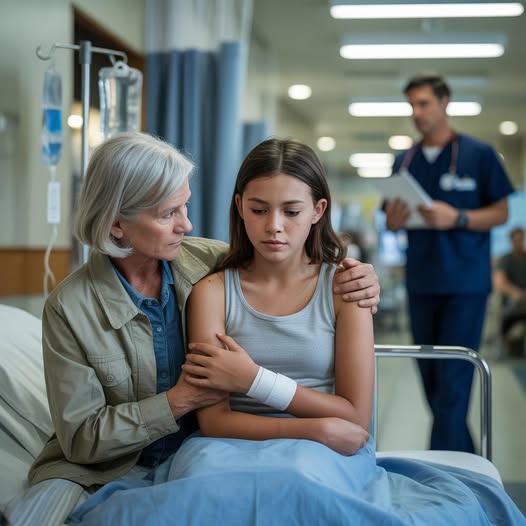
I have been awakened by a ringing phone at three in the morning more times than I can count.
For forty years, a call at that hour meant one thing: someone’s heart had stopped—or was about to—and I had roughly eleven minutes to scrub in before the outcome became irreversible. After years of this, you learn to bypass the moment your mind needs to orient itself. Your eyes open. Your feet are already moving. The thinking happens on the way, not before.
So when my phone buzzed at 3:17 a.m. on a Tuesday and I saw my granddaughter’s name, I was already upright before the second vibration ended.
Brooke is sixteen.
She’s also the reason I had a second phone line that nobody else in her household knew about—a private number I had given her eight months earlier, quietly, after a Sunday visit where I noticed her flinch when her stepfather’s car turned into the driveway. Not dramatically, not in a way anyone casual would find alarming. Just the way someone flinches when they’ve learned certain sounds mean danger.
I noticed. I filed it away. I said nothing that afternoon.
Instead, I gave her a line only she had and told her it didn’t matter what time it was.
She used it that night. I answered on the first ring.
Her voice was low, controlled—the way teenagers sound when they’ve cried enough that the crying is over, and only information remains.
“Grandma, I’m at the hospital. My arm. He broke my arm. But he told the doctor I fell. And Mom—”
Then a pause, heavy with more than just silence.
“Mom stayed by his side.”
I asked one question: “Which hospital?”
“St. Augustine. The ER.”
“I’m leaving now. Don’t tell anyone else until I get there.”
“Okay.”
Her voice sounded like someone who had just been told she could set down a very heavy burden.
I was dressed in four minutes—not rushing, because rushing is for those who haven’t done this before. I was efficient. Keys in the right pocket of the beige leather jacket I keep on the hook by the bedroom door—because I have always believed in knowing exactly where the things you need in an emergency are. I was in the car before 3:22.
Driving through empty Charleston streets toward St. Augustine Medical Center, I thought about the note I’d started on my phone in October and about James Whitaker, who had worked beside me for eleven years before I moved to Roper Hospital. On Tuesday nights, he was the attending orthopedic surgeon at St. Augustine. James is a good doctor. More importantly, he is precise. He doesn’t misfile things. He listens to instincts. I was counting on both.
I parked at 3:39, found a spot on the second level, turned off the engine, and sat for exactly four seconds. Not to collect myself, but because forty years of surgery taught me that four seconds of stillness before entering a room makes the difference between walking in as someone in control and walking in reacting.
I got out of the car. I knew what I was walking into. I knew what I was going to do.
Here’s what I actually knew—and when. Because there’s an easier version of this story, one where the grandmother is blindsided, where the signs were invisible, where no one could have seen what was coming. That version is simpler. But it’s false. I spent forty years in medicine allergic to comfortable fictions.
The truth: I saw Marcus Webb clearly the first time I met him, fourteen months earlier, at a dinner my daughter Diane hosted to introduce him. He arrived twelve minutes late, with a story too detailed to be spontaneous. He pulled out Diane’s chair not as a gesture to her but as a performance for the room. Within twenty minutes, he asked whether I still had hospital privileges, whether I had a financial adviser, and if I had thought about retirement in terms of the house. Every question was framed casually, but I cataloged each one.
Diane looked happy—the type of happiness carefully maintained, almost invisible, but not quite.
I need to be precise about Diane. She’s fifty-one, brilliant in a way that is obvious early, and never asks for applause. She put herself through a master’s program while raising Brooke alone after a divorce that would have crushed most people. She loves fully. That is her finest quality—and greatest vulnerability. Marcus Webb recognized that in thirty seconds. I know because I’ve seen people like him before, in medicine. Partners who attend every appointment, answer every question first, reframe concerns as overreactions. Slowly, control is built in small increments, each defensible alone, but collectively suffocating.
October was when I stopped observing and started documenting.
Brooke appeared at my door on a Sunday without calling—a first. She had biked twelve blocks, wearing long sleeves in sixty-eight-degree weather. As she reached for water, her sleeve slipped back just enough.
I saw the bruise before she adjusted it.
It was a contact bruise. Not from a fall, not a bicycle. The pattern and coloring didn’t match impact against a surface. Forty years of examining bodies taught me the difference between a hand and a hard edge. She claimed she fell off the bike, giving me the street, the crack in the sidewalk, the sequence. She had prepared it carefully—likely practicing stories longer than one day.
I treated the bruise and asked the questions a concerned grandmother would ask. I didn’t mention what I had observed—telling her would have alerted her that I knew, which could have reached Marcus, making her less safe, not more.
After she left, I opened a new note.
October 14. Brooke. Unannounced visit. Bruise, left forearm. Contact pattern inconsistent with reported bicycle fall. Long sleeves in warm weather. Story prepared in advance. Did not confront. Watching.
That was entry number one.
Over the next eight months, I built a record the way I built surgical cases: methodically, without gaps, without interpretation beyond what the evidence supported. I noted Thanksgiving, when Brooke barely spoke at the table—she had always been the loudest in any room. I noted Marcus answering two questions directed at Diane before Diane could finish speaking. I noted December, when Diane said they were simplifying the holidays, which meant Brooke wouldn’t stay at my house for the week between Christmas and New Year’s as she had every year since she was four. I noted January, when Brooke stopped responding to my texts within a day. Her messages changed too—shorter, flatter, neutral in the way someone composes words knowing another will read them first.
In February, I gave her the second phone number.
I chose a Tuesday afternoon when Marcus was traveling, invited Brooke to lunch directly—not through Diane—and she came. She ate two bowls of the chicken soup she’d been asking me to make since she was seven. Toward the end of the meal, I slid a piece of paper across the table with a number on it.
“This is a line only you have,” I said. “No one else knows it exists. You never have to use it. But if you ever need to reach me and can’t use your regular phone, this is how.”
She looked at the paper for a moment, said nothing, folded it carefully, and tucked it in the inside pocket of her jacket—not her bag, not a back pocket, but the pocket that is harder to find. She understood exactly what she was being given—and why.
Entry forty-one had been written five days before that 3:17 a.m. call: Brooke. Sunday visit restricted to two hours. Makeup heavier than usual around left jaw. Mentioned new foundation, different coverage. Possible. Also possible not. Documenting.
James Whitaker saw me before I reached the nurse’s station. He was with a resident, reviewing something on a tablet. When the automatic doors opened, he handed the tablet to the resident without glancing at it and met me halfway across the floor. He looked like a man who had been carrying a burden for hours and just found someone to hand it to.
“Dorothy.”
“James. Tell me where she is, and what you’ve filed.”
He held my gaze for one steady beat. “I haven’t filed anything yet.”
I kept my expression unchanged. “Why not?”
“Because the mother corroborated the stepfather’s story. The girl refused treatment twice while he was present, and I wanted to know if she had family coming before making anything permanent in the record.” He paused. “I had my charge nurse let her use a personal phone about ninety minutes ago.”
“Thank you,” I said.
“She’s in bay four. I moved the parents to the family waiting area forty minutes ago and told them the evaluation was ongoing.”
Then he lowered his voice. “Dorothy, the fracture pattern on that radius doesn’t match a fall down stairs. It’s consistent with forced hyperextension. I’ve seen it before.”
“So have I.”
“The stepfather is in the waiting area. He’s been loud. The mother hasn’t said anything.”
“I know. File the report. Complete and accurate. Everything observed. Include the inconsistency between the stated cause and the fracture pattern. I need it on record before anything else happens tonight.”
He nodded once. “Already drafted. I just wanted to confirm she had someone with her.”
“She does.”
He picked up the chart and went toward his office. I moved toward bay four.
Brooke was on the exam table, back against the wall, right knee drawn to her chest. Her left arm was in a temporary splint. She had made herself as small as possible, only now beginning to uncurl.
When I pulled the curtain aside, she looked up.
The sound she made wasn’t a word. It was like a month’s worth of held breath finally escaping.
I had to keep my face composed. Composure is what she needed from me then—not the other thing, not what I felt, seeing my sixteen-year-old granddaughter in an emergency room at four in the morning.
I pulled a chair close and sat beside her. Not looming. Same height. Same plane.
“I’m here,” I said. “You’re safe. Nobody comes into this room without my permission.”
She nodded. Her eyes were dry. She had passed the point of tears, which told me she had been managing this alone for longer than tonight.
She told me what had happened. I listened the way I listen to patient histories: fully, without steering, without reactions that would make her self-edit. The dinner-table argument. The exact phrase Marcus decided was disrespectful. The hallway. Her mother in the doorway. The drive to the hospital, Marcus calmly explaining what Brooke supposedly did to cause the fall. Her mother in the front seat, not turning once.
When she finished, I asked three questions—specific, clinical. I needed dates. I needed to know if this had happened before in ways that left marks. I needed to know whether anyone at school had noticed anything. Her answers took eleven minutes. I didn’t interrupt.
When she was done, I placed my hand carefully over hers—away from the injured arm—and gave her the truth, which is the only thing I’ve found genuinely useful in a crisis.
“You did everything right tonight. Calling me. Keeping the phone hidden. That was exactly right.”
“What happens now?”
“Now I make some calls. And while I do that, no one gets near you. That is not a hope. It’s a fact.”
I stood and stepped outside the curtain.
I went to work.
The first call was to Renata Vasquez, the hospital’s on-call social worker. I had kept her number for four years because of my work on a hospital abuse-protocol task force. She answered on the second ring at 4:17 a.m.
“Renata, it’s Dorothy Callaway. I’m at St. Augustine with a sixteen-year-old. Suspected injury caused by a stepparent. Fracture inconsistent with the reported mechanism. Mother corroborating his story. The attending has a report drafted. I need you here.”
Two-second pause. “I’m twenty minutes out. I’ll be there.”
The second call I made from the far end of the corridor, near the stairwell, where foot traffic was nearly nonexistent. I stood at the window overlooking the parking structure and dialed Francis Aldridge. She has been my attorney for fifteen years, is sixty-three, and lives twelve minutes away.
She answered on the third ring.
“Dorothy, what time is it?”
“4:20. Francis, I need emergency temporary custody of my granddaughter. Tonight if possible. Tomorrow morning at the latest. I have a medical report being filed as we speak, a social worker on the way, and eight months of documentation on my phone.”
I paused. “I need to know what you need from me to make this happen before Marcus Webb walks out of this hospital a free man and goes back to that house.”
Four seconds of silence—processing, not hesitation. In fifteen years, I’ve never known Francis to hesitate.
“Send me everything on your phone right now. Every note. Every date. Every observation. I’ll review it on the way.”
“On the way?”
“I’m already getting dressed. I’ll be there in thirty-five minutes.”
She arrived in thirty-one.
While waiting, I returned to bay four and quietly asked Brooke if she would be willing to speak with the social worker. I explained what a social worker does, that everything she said would be documented exactly, that she controlled what she shared, and that this wasn’t about causing trouble in the next ten minutes—it was about building a record to protect her going forward.
She listened. Then asked, “Will you be outside the curtain the whole time?”
“Yes.”
“Okay. I’ll talk to her.”
Then I said what I had been calculating since 3:22 a.m.:
“Brooke, your mother is in the waiting area.”
Her expression changed—not to surprise, but to confirmation of what she had feared.
“She didn’t come find me,” Brooke said.
“Not yet,” I replied.
She looked at her immobilized arm, then back at me. Her face had settled into something quieter, older than sixteen.
“Is she okay?”
Even then, her first instinct was concern for someone else.
“I don’t know yet,” I said honestly. “But that is not your job tonight. Tonight your job is to tell the truth to the people who can help you.”
“Yes.”
“Good.”
Renata spent forty minutes with Brooke. I stood outside the curtain the whole time. Francis sat at the end of the hallway, reviewing my notes, occasionally making the small exhalations I’ve learned to interpret over fifteen years: a short exhale meant something useful; silence meant careful reading.
At the twenty-minute mark, she looked up.
“Dorothy. Entry thirty-seven—the one about the makeup around her jaw. The equivocation is useful. ‘Possible. Also possible not.’ A judge will read that as credible. It shows observation without overstatement.”
“That is why I wrote it that way.”
She returned to her reading.
When Renata emerged, she spoke carefully. “Her account is consistent, detailed, and internally coherent. She describes a pattern of escalating incidents over roughly fourteen months, starting with what she calls isolated events and increasing in frequency and severity. Tonight was not the first time, only the first time she sought outside help.”
“How many visible incidents does she recall?”
“Seven that left marks. Possibly more she isn’t ready to name.” Renata paused. “She also described isolation: restricted access to her phone, monitored school activities, visits to extended family systematically reduced. She identifies the onset about two months after the marriage.”
Beside me, Francis set down her phone.
“Presented as credible?” she asked.
“Yes. No rehearsed quality. No major inconsistencies. She self-corrected twice when unsure of dates, which aligns with genuine recollection rather than invention.”
“I’m filing the mandatory report tonight,” Renata said. “Notification goes out within the hour.”
Francis was already picking up her phone.
At 5:44, James called.
“Dorothy, I sent the fracture imaging to Thomas Park at MUSC for a second read—pediatric orthopedics. He consults on injury pattern cases for the county. He confirmed my assessment: forced hyperextension, almost certainly manual. Angle inconsistent with a fall.”
He paused.
“He also noted a healed fracture in the same limb—distal ulna, roughly six to nine months old. It received no medical treatment.”
I stood very still.
“She didn’t tell me about a previous fracture.”
“She may not have known it was one,” James said. “Or she may not have been allowed treatment. I’m adding it to the report.”
I hung up, phone in hand, holding the information about the healed fracture exactly where I intended to feel it properly later—not now.
Then I turned back to Francis.
“Here’s where we are,” she said. “Emergency temporary custody is petitionable based on the mandatory report Renata is filing, the medical documentation James is filing, and your eight months of observational records. The combination makes this possible tonight rather than next week.”
“What else do we need?”
“One more statement: someone outside the family who observed Brooke and can attest to behavioral changes consistent with the documented pattern.”
“The school,” I said. “I have a contact—the principal.”
I called Andrea Simmons at six a.m. She had given me her personal number two years earlier, and she’s the kind of person who answers at six when the caller ID belongs to someone she trusts.
Over twenty-two minutes, Andrea filled gaps in the timeline. In September, Brooke’s guidance counselor spoke with her; Brooke abruptly ended the conversation when she saw Marcus’s car. In November, a creative writing assignment described a girl making herself invisible at home—so realistic the teacher kept a copy. In February, Brooke missed four days of school reported as illness; the dates matched a bruise I had logged in entry twenty-six.
“I need a written statement of staff observations, what was documented, and when,” I said. “Can you have it to my attorney by eight?”
“Seven-thirty,” she said.
Then, softly: “Dorothy, is she okay?”
“She will be,” I said. And for the first time that night, I meant it in the present tense.
Francis received Andrea’s written statement at 7:19. Three pages, timestamped, with detailed dates, staff names, and observations. She read it in four minutes, made two margin notes, and looked up.
“This is enough,” she said.
In fifteen years, I’d heard Francis say those words exactly three times. Every time, she was right.
She called me at 8:14. I answered before the screen fully lit.
“The judge signed. Emergency temporary custody. Ninety days. Effective immediately. You are Brooke’s legal guardian as of 8:09 this morning. Marcus Webb has been formally prohibited from any contact with the minor.”
I set down the coffee I hadn’t meant to drink.
“Francis, thank you.”
“Don’t thank me yet. Ninety days goes fast. We need to build the permanent case in parallel. This buys time. It doesn’t finish the work.”
I quietly pulled back the curtain. Brooke looked at me the way patients look when surgery has gone well—seeing it in my face before I say a word.
I sat down.
“A judge signed an emergency custody order at 8:09 this morning,” I told her. “You’re coming home with me. Marcus cannot contact you. That is not a plan. It is a legal fact.”
She stared for a moment. “Forty-five minutes ago?”
“I didn’t want to tell you until it was done.”
Something moved across her face—several things in quick succession, the way a person processes news they’ve been needing but stopped allowing themselves to hope for.
She pressed her lips together. Her chin did the thing it does when deciding whether to cry—and then deciding not to.
She chose not to.
“Okay,” she said.
Then, after a beat: “Can I have real coffee before we leave? The stuff here tastes like hot cardboard.”
I looked at her for one beat.
“There’s a place two blocks from my house that opens at eight-thirty. You can order anything you want.”
For the first time since I stepped through that curtain at four in the morning, she smiled. Brief, tired, and entirely real.
We left the hospital at 9:02.
Before we went, I found Diane in the corner of the family waiting area by the window. Marcus was gone—departed voluntarily after being informed of the custody order. Diane looked like someone who had been awake a very long time, sitting in a particular kind of silence. Not peaceful. The silence of someone holding a decision she had not yet learned to name.
I sat across from her. She needed to see my face.
I told her what I could: the custody order had been signed, Brooke was coming home with me, and the legal process in motion had not been initiated by us, but by the mandatory reporting system doing exactly what it was designed to do.
When I finished, she said, “I should have called you.”
“You can call me now. That option is still open. How you use it is your decision, not mine.”
She looked down at her hands. “Is she okay?”
“She’s going to be okay. She already ordered coffee.”
Diane made a sound that was neither quite a laugh nor quite a sob—possibly the most honest sound I’d heard from her in fourteen months.
I stood and placed my card on the table in front of her—my personal card, with the same number I had given Brooke eight months earlier.
“When you’re ready to talk,” I said, “not before, but when you are.”
I left her with the card and her thoughts, because I could not carry that understanding for her.
Marcus was formally charged on day nine: two felony counts of serious bodily injury to a minor, one domestic-violence count, one child-endangerment count. The prior healed fracture elevated the case—it established a pattern. One incident can be argued as an accident. Two similar injuries to the same limb, with the same probable mechanism, create a pattern the prosecution relied on.
Diane was not charged. While her hospital corroboration was documented, the evidence also showed she had been subject to coercive control. She had been harmed too. That fact needed to sit in the record.
Brooke chose to testify. She made the decision herself, after sessions with Camille, her trauma psychologist, and a separate conversation with Francis. She did not ask my opinion first—she told me afterward, in the correct order.
“I just kept thinking,” she told me, “if I don’t say it, it’s like it didn’t happen. And it happened.”
“That is exactly right,” I said.
She added, “Francis said my testimony, with the medical evidence, is pretty much airtight.”
“Francis is rarely wrong.”
“She said ‘pretty much,’ not completely.”
“Francis never says completely. That’s how you know she’s good.”
Brooke nearly smiled. “You and Francis are the same person.”
I considered that. “We both keep good notes.”
There are things I would do differently. One I’ve never said aloud: I would have trusted what I felt in October sooner. Not the documentation—I stand by every entry, every timestamp—but the moment before documentation. The moment Brooke adjusted her sleeve at my kitchen table and I knew—not suspected, not wondered, but knew. Forty years of examining bodies teaches you to know before confirmation arrives.
I waited. I documented. I built a case. All of that was correct and necessary. I would do it again.
But I waited longer than needed before giving her the number. I gave it in February. I could have given it in October. Four months I cannot return. She lived them. She carried them with a composure no sixteen-year-old should have been asked to bear.
I did not cause that. Marcus did. But I could have shortened it. That is the truth I carry.
One Tuesday morning in early spring, I sat on the back porch when Brooke came outside with a bowl of cereal and her phone, moving with the easy, unselfconscious manner of someone at home in a place. She ate. She scrolled. After a few minutes, she looked at the garden, which was doing what gardens do in spring: chaotic, insistently alive.
“You need to deadhead those,” she said, pointing at the rosebushes along the fence.
I looked. She was right. “I know.”
“I can do it if you want. Ms. Okafor said I need volunteer hours for my service requirement.”
“Deadheading my roses doesn’t qualify as community service.”
“It’s a service,” she said. “And you’re a community.”
I looked at her. She held the perfectly composed expression she has deployed since age four, aware of the weight of her words and waiting to see if it landed.
“Fine. Log your hours.”
She returned to her cereal. I returned to my coffee. The garden continued its slightly unruly, insistently alive way. A car passed. The morning went on.
Stripped to its simplest truth, beyond reports, legal filings, and medical precision:
She called me at 3:17 a.m. because she had a number that worked, and she believed I would come.
That is everything.
All else—the documentation, the custody order, the charges, the trial, the slow, honest healing—flows from that single fact.
She believed I would come.
The decision that mattered most in my life was not made in an operating room.
It was made on a Sunday in February, when I slid a small piece of paper across a kitchen table and said: this is a line only you have. Use it if you need to.
She needed to.
I came.
That is the whole of it.