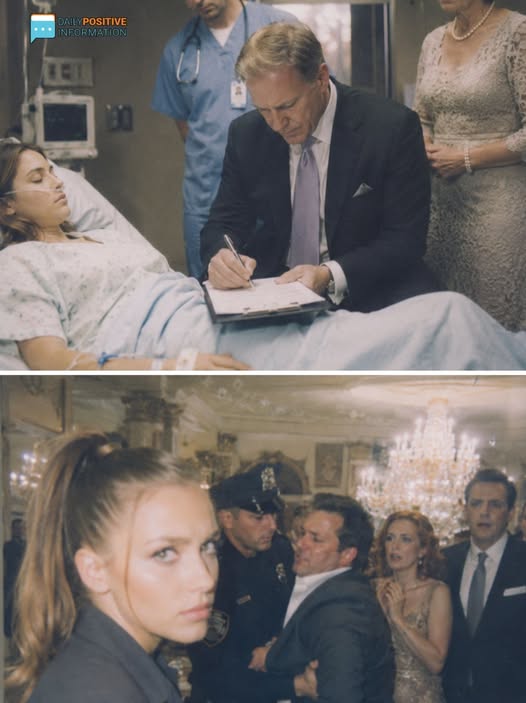
The voicemail from the hospital’s billing office came exactly three weeks after Wendy Thomas finally regained consciousness.
She was sitting carefully on the couch in her friend Deborah’s apartment, every movement measured because even the slightest deep breath sent sharp pain through her ribs. Her phone sat on the coffee table while the automated message echoed through the speaker.
“This is St. Catherine’s Hospital regarding outstanding balances for patient Wendy Thomas. Please contact our billing department at your earliest convenience to discuss payment arrangements for services rendered.”
Wendy slowly lowered the phone into her lap and stared at it in silence.
“Services rendered.” That was certainly one way to describe the emergency surgery that had kept her alive. The same surgery her father had refused to approve. The same surgery he had tried to prevent entirely by signing a Do Not Resuscitate order while she lay unconscious. And the only reason that surgery happened at all was because a nurse named Pat Walsh cared enough to check Wendy’s employee records more carefully than her own father had ever bothered to look at her life.
At twenty-nine years old, Wendy Thomas worked as a registered nurse at St. Catherine’s Hospital outside Philadelphia. For nearly a month, however, she had been lying in one of its ICU rooms as a patient herself, unconscious while her father weighed the cost of saving her life against what he believed she was worth. In his mind, the answer was simple: she wasn’t worth it.
What he never imagined was that she would survive, wake up, discover every decision he had made behind those hospital doors, and methodically unravel the image he had spent decades building for himself.
But none of what happened inside that hospital room can truly be understood without first understanding the twenty-nine years that came before it.
The Childhood Where Love Always Came Attached to a Bill
Wendy was born with a congenital heart defect — a hole in her heart that required open-heart surgery when she was only four years old. The operation lasted eleven exhausting hours and cost more than two hundred thousand dollars even after insurance coverage.
In many families, something like that becomes part of the family history — a terrifying chapter that eventually turns into proof of love, sacrifice, and survival together. But inside the Thomas household, Wendy’s surgery became something entirely different. It became evidence. Proof that she owed a debt for merely existing.
“Do you have any idea how much you cost this family, Wendy?”
She was only eight years old the first time her father said it aloud.
She had asked for a new pair of sneakers because the soles on hers had split open, and rainwater soaked through her socks every time she walked to school. Her father sat at the kitchen table with medical bills spread around him like exhibits in a courtroom.
“Two hundred fourteen thousand dollars,” he said coldly. “That’s what you cost us.”
She never got the sneakers.
More importantly, she learned something far more damaging than going without shoes: she learned that her existence came with a price tag. And from that point forward, she understood that her value would always be measured against whatever she could give back in return.
Her older sister Meredith never had to live with that kind of accounting.
When Meredith turned sixteen, she received a brand-new Volkswagen Jetta with a giant red bow across the hood. Wendy inherited their mother’s aging Toyota Camry with a broken air conditioner and a passenger-side window that no longer sealed properly.
When Meredith decided she wanted a new bedroom design, their parents hired an interior decorator and spent thousands without hesitation. When Wendy begged her father to repair the leak in her ceiling that dripped every time it rained, he shrugged and promised he would “get around to it eventually.”
He never did.
Wendy placed a plastic bucket beneath the leak and emptied it every morning before school. The constant dripping became background noise to her teenage years.
Meredith’s college education was completely paid for — tuition, dorms, spending money, sorority fees, everything. Wendy was handed student loans and a few empty words of encouragement.
“You’re smart enough to figure it out.”
So she did.
She worked before classes, after classes, and long after midnight. Coffee shop shifts before sunrise. Tutoring in the afternoons. Freelance coding projects late at night. Four hours of sleep became normal. She pushed herself through nursing school, graduated summa cum laude with nearly eighty thousand dollars in debt, and looked out at graduation only to realize no one from her family had bothered to come.
The only person who never treated her like a burden was her grandmother, Lillian Price.
Lillian lived alone in a modest brick house on Elm Street in Norristown, Pennsylvania. Two bedrooms. One small bathroom. A porch swing that squeaked softly every time the wind moved it.
Starting in her early twenties, Wendy drove there every Saturday without fail. She brought groceries, checked Lillian’s blood pressure, fixed small things around the house, and spent hours sitting beside her grandmother on that old porch swing.
Lillian never once mentioned money.
Instead she asked questions no one else ever bothered asking.
“Did you eat enough this week?”
“How are you sleeping?”
“Are you taking care of yourself?”
Near the end of her life, when her hands had begun trembling and even speaking exhausted her, Lillian said something Wendy barely understood at the time.
“I made arrangements for you, sweetheart. When the time comes, a man named Kesler will find you.”
Wendy assumed the medication was making her grandmother ramble. She smiled, squeezed her hand, and let the comment drift away.
Lillian passed quietly in her sleep on a Thursday morning in March. Wendy’s father arranged a brief funeral and instructed her not to make a scene.
“Keep the eulogy short,” he told her. “We’re not turning this into a performance.”
The Night Everything Changed
Three months after Lillian’s funeral, Wendy finished a brutal twelve-hour overnight hospital shift and started driving home through light rain just after four in the morning.
At 4:17 a.m., on Route 202, a pickup truck sped through a red light and slammed directly into the driver’s side of her car at nearly fifty miles per hour.
She never remembered the impact itself.
The paramedics later told her she remained conscious for less than two minutes — just long enough to whisper her name before slipping into unconsciousness.
Traumatic brain swelling. Multiple broken ribs. Internal bleeding.
The emergency team at St. Catherine’s rushed her into surgery immediately. But the bleeding continued. A second operation became necessary, along with a specialist whose services would dramatically increase the cost of treatment.
Someone had to authorize it.
Her emergency contact was still listed as Gerald Thomas — her father.
The hospital called him that evening.
According to records, Gerald arrived at the hospital at 10:47 p.m. But instead of going to see his daughter, he walked directly to the billing department.
He asked only one question.
“How much is this going to cost?”
Pat Walsh, the charge nurse working that night and Wendy’s longtime colleague, overheard the conversation that followed between Gerald and Dr. Richard Hail, the surgeon handling Wendy’s case.
The second surgery, Dr. Hail explained, would cost somewhere between one hundred eighty and two hundred forty thousand dollars depending on complications. Insurance would help, but there would still be significant expenses remaining afterward.
Gerald didn’t hesitate.
“She doesn’t have a healthcare proxy,” he said. “I’m her father. I make the decisions.”
Then he spoke the sentence Pat Walsh would never forget.
“Let her go. We’re not paying for this. She’s been a financial drain her entire life.”
At 11:18 p.m., Gerald Thomas signed a Do Not Resuscitate order with a perfectly steady hand.
Then he left.
He never entered Wendy’s room.
Never held her hand.
Never looked through the ICU window at his unconscious daughter.
He simply walked out of the hospital believing she would die before morning.
The Two-Minute Decision That Saved Her Life
Pat Walsh stood frozen at the nurses’ station after Gerald left, gripping the counter hard enough for her knuckles to turn white.
Then she opened Wendy’s employee file.
During hospital onboarding, employees are given the option to file healthcare proxy documents. Most people skip it.
Wendy hadn’t.
Three years earlier she had listed Deborah Owens — her closest friend from nursing school — as her legal healthcare proxy.
Pat found the paperwork in less than two minutes.
She called Deborah immediately.
Deborah answered on the second ring.
Pat explained the accident, the coma, the surgery, and the father who had just attempted to deny treatment to his own daughter.
Deborah responded with only three words.
“I’m coming now.”
She drove ninety minutes through heavy rain to St. Catherine’s Hospital, arriving just before one in the morning with identification and the signed healthcare proxy documents.
She revoked the DNR order immediately and approved the surgery.
Dr. Hail returned to the operating room within the hour.
Meanwhile, Gerald Thomas slept peacefully at home believing the hospital would soon call to report his daughter’s death.
Before her shift ended, Pat filed a formal incident report documenting everything Gerald had said and done — including exact timestamps and his statement about Wendy being “a financial drain.”
Every word became part of the official hospital record.
The Mistake That Destroyed Him
While Wendy remained unconscious, Gerald made another catastrophic mistake.
What he didn’t know was that Lillian Price had quietly transferred ownership of her Elm Street home into Wendy’s name before she died. The paperwork had been handled legally through her attorney, Donald Kesler.
Gerald assumed the house was unclaimed.
Using forged documents with Wendy’s falsified signature, Gerald transferred ownership of the property into his own name and immediately borrowed $280,000 against it through a mortgage loan.
The money vanished into gambling debts no one in the family even knew existed.
He believed no one would ever question the paperwork.
He was wrong.
The Morning Wendy Woke Up
Three weeks later, Wendy opened her eyes beneath the sterile fluorescent glow of a hospital room she recognized far too well.
Her throat burned from the breathing tube. Her ribs screamed with every breath.
The first person she saw was Pat Walsh.
Not her father.
Not her sister.
Pat sat beside her bed, took her hand gently, and simply said:
“You’re safe.”
Her father finally appeared later that afternoon carrying flowers and tears that looked carefully rehearsed.
“Oh sweetheart,” he whispered dramatically. “We were terrified.”
Wendy studied his face the same way she had studied patients and grieving families for years. She recognized genuine fear immediately.
This wasn’t fear of losing someone.
This was fear of being discovered.
Two days later, Pat told her everything.
The DNR.
The billing conversation.
The exact words Gerald used.
The incident report.
Wendy listened silently.
Then she asked one question.
“Is all of it documented?”
“Yes,” Pat answered. “Every single word.”
Wendy picked up her phone and searched for the name her grandmother once mentioned.
Kesler.
The truth unraveled quickly after that.
Donald Kesler informed her that Lillian had left the Elm Street house and eighty-five thousand dollars entirely to Wendy. Gerald had intercepted attempts to contact her and forged legal documents while she lay unconscious in intensive care.
By the time Kesler finished explaining everything, Wendy already knew exactly what she intended to do.
And she wanted it done publicly.
Sunday Morning at First Grace Community Church
Gerald Thomas had spent fifteen years serving as a respected deacon at First Grace Community Church outside Philadelphia.
Every month, during church gatherings, he spoke passionately about faith, sacrifice, and family values. The congregation adored him.
The Sunday Wendy walked into that fellowship hall, Gerald stood proudly at the microphone telling everyone how he had prayed beside his daughter’s hospital bed every night while she fought for her life.
Then he invited Wendy forward.
She accepted the microphone with a calm smile.
And destroyed the lie.
She told the congregation exactly what happened at the hospital.
Exactly what he said.
Exactly what he signed.
She explained that she survived because a friend cared enough to save her life after her own father chose not to.
Then Donald Kesler entered the room carrying the original will and legal documents proving Gerald had forged property transfers while Wendy remained in a coma.
For the first time in her life, Wendy saw genuine panic on her father’s face.
“I’m not here to humiliate you,” she told him calmly. “I’m here because you tried to let me die. And when that failed, you stole from me.”
The room fell completely silent.
When Gerald tried to defend himself, Wendy answered with the sentence that finally shattered him.
“You did what was cheapest, Dad. Not what was right.”
By Monday morning, the mortgage was frozen.
The property transfer was under legal challenge.
Police investigations had begun.
And Gerald Thomas’ carefully built reputation collapsed within twenty-four hours.
What Remained After Everything Fell Apart
Eventually the house was restored to Wendy’s name. Gerald accepted a plea deal involving restitution and probation. Meredith admitted she had known about the forged documents and the DNR but stayed silent out of fear.
Wendy returned to work part-time.
And one quiet October afternoon, she unlocked the front door of her grandmother’s little brick house on Elm Street and stepped inside.
Lavender still lingered faintly in the air from the sachets Lillian kept tucked in drawers.
For the first time in her entire life, Wendy stood somewhere that belonged entirely to her — not because she had earned permission, not because she had sacrificed enough, but simply because someone loved her enough to protect her future.
She finally understood something her grandmother had tried to teach her for years:
Boundaries are not cruelty.
Telling the truth is not revenge.
And survival sometimes means refusing to keep protecting the people who tried to destroy you.
Wendy doesn’t hate her father anymore.
Hatred would mean he still controls part of her.
He doesn’t.
Now he is simply a man forced to live with the consequences of his own choices.
And Wendy?
She still attends church.
Different church. Smaller congregation. Better coffee.
These days she sits in the front row.
Not because she wants attention.
Because she’s finally done hiding.