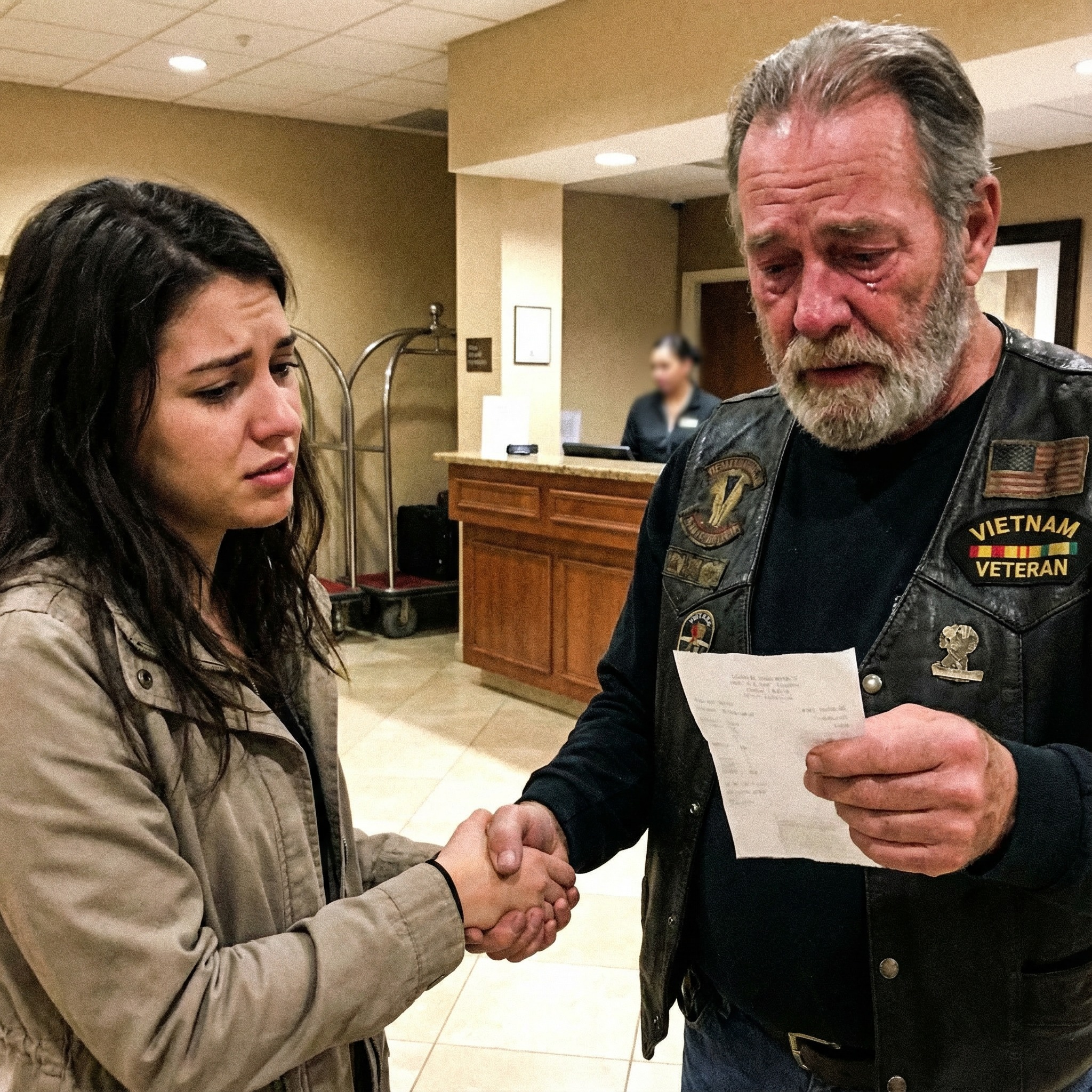
My family left my 74-year-old biker grandfather stranded with a $12,000 resort bill after five days of luxury, assuming that a man who still rides a Harley must be too naïve or clueless to fight back. They believed he’d just accept the debt and thank them for the “honor” of funding their vacation.
When I walked into that resort lobby and saw him—my grandfather, the man who raised me after my parents passed—standing at the counter, holding a crumpled bill in shaking hands, something inside me froze. This was the man who had worked 52 years in a factory, making sure everyone else in the family had food, education, and comfort. This was the man who still polished his ’87 Harley every Sunday morning because it made him feel free. And there he was, looking small and ashamed under the fluorescent lights.
He wore his old leather vest covered in Vietnam patches—the one my cousins always mocked or told him to “leave in the car” because it embarrassed them. He kept muttering the same line, over and over, as if trying to convince himself this was all a misunderstanding.
“They said it was their treat… I didn’t know… I didn’t want to cause trouble…”
The manager pulled me aside and explained the truth. My aunt, uncle, and three cousins had booked the entire vacation under Grandpa’s name: five rooms, every meal, every drink, every spa package, every rental, every excursion, every overpriced souvenir. They’d spent the week posting on social media about “celebrating the world’s best grandpa” and “family first.” Then, they checked out that morning, smiled at the staff, and said, “Mr. Morrison will settle everything when he leaves this afternoon.” And they left.
They left a 74-year-old widower, living on a fixed income, with just $8,000 in savings—the money he’d set aside for his funeral—holding a $12,847 bill.
They knew he couldn’t pay it. They counted on it.
Outside, I called my cousin Ashley. She answered, laughing, as if Grandpa wasn’t inside trying not to cry.
“Ashley,” I said, “why did you leave Grandpa with the bill?”
She giggled. “Oh, relax. He’s retired. He’s had money saved for years. After everything this family has done for him, paying for one vacation shouldn’t kill him.”
“Everything YOU did for him?” I snapped. “He raised half of you. He paid for your tuition. He babysat your kids. He kept you afloat for years.”
“That was forever ago,” she said. “And he wasn’t using that money anyway. He just sits in the garage with that stupid motorcycle. At least we gave him a good week.”
“You left him stranded with a bill he can’t pay.”
“He’ll figure it out. He always does. Anyway, we’re at brunch. Byeee!”
She hung up.
I had to walk away for a moment to keep from exploding. Then I returned to Grandpa, took his hand, and quietly told him, “Don’t worry. I’ve got this.”
What my family didn’t know about me is that I’m a prosecutor specializing in elder abuse. My job is to send people to prison for exactly what they’d just done.
What they also didn’t know is that Grandpa had given me power of attorney three years earlier, and I’d been documenting their financial exploitation for two years—small withdrawals, “loans” they never repaid, forged signatures on credit applications.
They thought they were clever. They weren’t.
I paid the resort bill myself, got Grandpa home, cooked him dinner, and reassured him he was safe. Then I went to work.
First, I gathered all the evidence I had: bank statements showing unauthorized transactions, forged documents, text messages where they bragged about taking advantage of him.
Second, I contacted Adult Protective Services. Within two days, an investigation was underway.
Third, I filed criminal charges: elder financial abuse, identity theft, fraud, and theft by deception. In our state, exploiting someone over 65 is a felony, with each count carrying up to ten years.
Fourth, I froze Grandpa’s credit and secured all his accounts.
Then I sent a group text to everyone involved in that “vacation”:
“Charges have been filed for elder abuse, fraud, and identity theft. Detectives will be contacting you. A civil suit has also been filed for the full resort bill plus damages. You’ll want attorneys.”
My phone exploded.
Aunt Patricia called seventeen times. Uncle Robert alternated between threats and sobbing voicemails. Ashley bombarded me with texts—from denial, to blaming me for “ruining the family,” to begging for mercy.
I didn’t answer any of them.
The investigation uncovered even more theft—mail interception, coerced account access, and withdrawals totaling over $34,000. Two credit cards opened in his name with $12,000 owed.
The case was airtight.
My aunt and uncle pled guilty. Felony convictions. Probation, restitution, community service. Uncle Robert lost his real estate license. Patricia lost her banking job.
Ashley and her siblings tried to fight it. The jury took less than an hour. Ashley got eighteen months in jail. Her brother got two years. Her sister received probation because she cooperated.
We settled the civil suit for $127,000.
But the part that mattered most to Grandpa wasn’t the legal victory.
It was loyalty.
Two weeks after the resort disaster, his motorcycle club—the Desert Riders, a crew of Vietnam vets he’d ridden with for decades—showed up at his house. Not one or two, but forty-seven bikers in full leather.
They raised enough money to cover the resort bill and any legal fees until the settlement came through. “You’re our brother,” their president told him. “Nobody hurts our brother.”
They even attended Ashley’s sentencing. Forty-seven bikers filled the courtroom, silent, arms crossed. Just standing there for him.
The judge gave her the maximum.
During the civil trial, Grandpa broke down on the stand.
“I just wanted them to love me,” he said. “I gave them everything. They left me standing in that lobby like trash. I was ashamed. Not because I owed money. Because I raised people who could do this.”
The jury cried with him.
Afterward, I took him to dinner. He confessed he felt guilty—like he had failed as a father.
“Grandpa,” I told him, “you raised them well. They chose to be selfish. That’s not on you.”
Two years later, Grandpa is thriving. The settlement money sits untouched in an account I manage. His new will leaves everything to veterans’ charities and a local animal shelter. His former abusers get nothing.
He still rides every Sunday, escorted by the Desert Riders—forty-seven bikers making sure he’s never alone again.
Ashley got out of jail last month. She tried to call him. He let it ring.
“I don’t hate her,” he said. “I just don’t have any love left. They used it up.”
Robert tried to sue for defamation. The judge threw it out in minutes.
Patricia showed up on his porch crying for forgiveness. He forgave her—but told her to stay out of his life.
He doesn’t regret pressing charges. Not anymore.
“For 74 years I kept the peace,” he told me. “I let people walk on me. And it ended with me alone in a hotel lobby with a bill I couldn’t pay. Keeping the peace damn near destroyed me. I’m done with that.”
His biker brothers made him an honorary officer with a new patch: “Elder Warrior.”
Every Sunday, I ride behind him. Watching his back. Because real family isn’t the people who share your blood—it’s the people who show up.
My biological family left him with a $12,000 bill.
His biker family raised the money in three days.
Blood means nothing. Loyalty means everything.
And if you try to take advantage of my grandfather again, I’ll end you—legally, professionally, and absolutely.