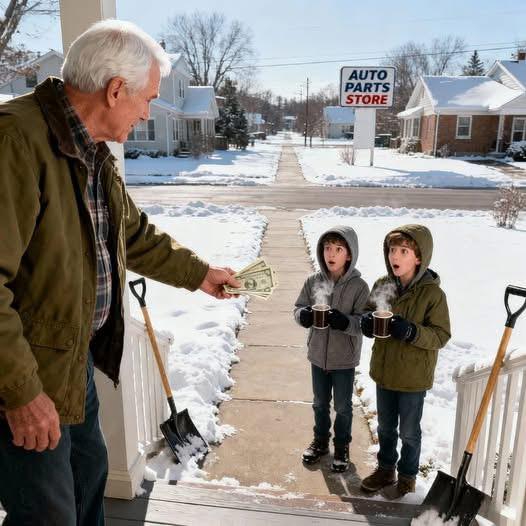
The doorbell rang exactly at seven on a freezing Saturday morning, sharp and insistent, cutting through the silence. At first, I was furious. Saturdays were sacred—especially in winter—the rare chance to sleep in after a long workweek. I remember yanking on a sweatshirt, already rehearsing the irritated words I planned to greet whoever thought that hour was acceptable.
When I opened the door, no one was there.
Just the cold. Bitter, biting cold that rushed in like it had been waiting for permission. Snow blanketed the ground in thick, uneven layers, the kind that squeak under boots and sting your fingers within seconds. At the edge of my driveway stood two boys—maybe thirteen and ten—holding shovels almost as tall as they were. Their cheeks were red, noses running, breaths coming out in fast, visible puffs.
Before I could speak, the older one said, “We can shovel your driveway, sir. Real quick. We don’t need much.”
I looked at the time, looked at them, and sighed. Half-asleep and not in the mood to negotiate, I told them I didn’t need help and that they should go home before freezing solid. They nodded politely, said “Yes, sir,” and trudged down the street, boots crunching in the snow.
I thought that was the end of it.
But an hour later, when I finally sat down with my coffee and looked out the window, my driveway was spotless. Not just cleared—clean. Every inch shoveled, edges sharp, even the walkway done. It was the kind of careful work most adults rush through and still leave half-finished.
The boys were gone.
I felt a twinge of guilt, but life went on. I assumed someone else had paid them, or that it had just been kids doing something nice.
The next morning was even colder—the kind that seeps into your bones. Coffee in hand, I noticed something near the front door: a folded piece of paper tucked between the storm door and the frame, edges damp with frost.
My name was written on it in uneven, shaky handwriting.
Inside was six dollars. Three crumpled bills and a handful of coins.
And a note:
“Sir,
We came up $6 short for the battery.
We are very sorry.
We will pay you back every dollar we owe.
—Marcus and Leo”
I read it three times.
Six dollars.
It wasn’t the amount that struck me—it was the weight of it. The responsibility. The apology. Two kids felt so strongly that they owed a grown man money for work he never asked for that they left what little they had.
I stood there longer than I care to admit, staring at that note as if it had cracked something open inside me.
I grabbed my coat and went back into the cold.
I didn’t know exactly where Marcus and Leo lived, but I had a hunch. In a small town, few places are open early on a Saturday. The auto parts store was my best guess.
The bell jingled as I stepped inside. Fluorescent lights hummed softly. A man behind the counter looked up and smiled, recognizing me.
“You looking for the Johnson boys?” he asked before I could speak.
I was surprised. “You know them?”
“Everybody does. Their mom’s a night nurse at the hospital—one of the hardest-working people I know. Helps anyone who needs it. Those boys? They’re cut from the same cloth.”
I swallowed. “Did they… get what they needed?”
The clerk leaned back, arms crossed. “Barely. They came in shaking from the cold, dumped everything they had on the counter—coins, wrinkled bills, even a couple of laundry tokens. Still came up short.”
My stomach dropped. “So what happened?”
“We covered it,” he said simply. “Couldn’t let them walk out empty-handed.”
I nodded, then asked the question weighing on me: “What did they say?”
The clerk smiled. “The older one—Marcus—looked me dead in the eye and said, ‘Sir, we’ll work it off. We shovel. We rake. We clean. Anything.’ Kid looked like he’d stand in front of a train for his family.”
That was it.
I thanked him, returned to my truck, and sat for a moment before starting the engine. I didn’t trust myself to drive immediately.
Later that afternoon, I found their house. Small, worn, but neat. Snow piled against the fence, toys scattered in the yard. I knocked.
Marcus opened the door, eyes widening. Leo peeked out behind him.
“I—sir—we’re really sorry about the money,” Marcus stammered. “We didn’t mean to—”
I held up the note and smiled. “You don’t owe me anything.”
They froze.
I handed Marcus an envelope. Inside was the six dollars they left… plus a little extra.
“This is for the work you did,” I said. “And for the next battery. Maybe a bit more.”
Marcus tried to hand it back. “We can earn it.”
“You already did,” I replied.
Their mother appeared behind them. Tired eyes, hospital badge still clipped to her jacket. She quickly understood more than I said.
She thanked me quietly. I told her she didn’t need to.
That winter, Marcus and Leo shoveled half the neighborhood—not always for money, sometimes for elderly neighbors, sometimes just because.
And every time I see a clean driveway after a storm, I think of six dollars. Pride. Honesty. Two kids who reminded me that character isn’t something you grow into—it shows itself, sometimes at seven in the morning, in the cold, with a shovel and a handwritten note—and it can change how you see the world.