The phone rang while I was setting the table for dinner.
It was a regular Tuesday in early December, just three days before Christmas. The house smelled of roasted chicken and vanilla candles—the kind I only lit during the holidays. Wrapping paper spilled from a box in the corner, and the kids were bickering in the living room over which present belonged to whom. Everything felt loud, warm, alive.
I answered without looking at the screen.
“Hey.”
“I’m heading out now,” Ethan said. His voice was tired, but calm and familiar, the kind that made everything feel manageable. “I just need to stop at the store real quick. The kids won’t let the gift thing go.”
I smiled, balancing the phone between my shoulder and ear. “They’ll survive if it shows up tomorrow.”
He chuckled softly—a laugh I can still hear in my head. “You say that, but you know how they get. I promised, kind of.”
“Dinner’s ready,” I reminded him. “Hot.”
“I can almost smell it,” he said. “You made that chicken I like, didn’t you?”
“The one you steal extra pieces from.”
There was a pause. Comfortable. Familiar. The kind that comes only after years of shared routines and quiet understanding.
“You sound exhausted,” I said. “Everything okay?”
“I am,” he replied. “Just tired. I’ll be home before they finish arguing.”
A flicker of worry passed through me. “Don’t take too long.”
“I won’t. Tell them I’m on my way.”
“I will.”
“And… thanks for waiting,” he added softly.
“Always.”
“Save me a plate.”
“I will. Hurry home.”
That was the last time I ever heard my husband’s voice.
After we hung up, I tried to keep the evening normal. I told the kids their dad had to run a quick errand. I reheated his dinner, covered it with foil, and set it aside like I had done countless times before.
An hour passed. Then two.
I checked my phone. No messages. I sent a text, trying not to show worry: Are you driving?
Nothing.
I called. It rang until voicemail picked up.
That’s when the unease settled in—heavy, quiet, unmistakable. Ethan never vanished without explanation. Never forgot to text. Never left me wondering.
I tried to convince myself it was nothing. A dead phone. Traffic. A long line. I even laughed when the kids asked if Daddy got lost and sent them off to brush their teeth.
But when the house went quiet, I sat alone at the table, staring at the plate I had set aside.
That’s when I knew.
The police search began that night. By morning, they found Ethan’s car abandoned near a back road, the door open, the windshield cracked. His phone and wallet were inside.
They searched for days—dogs, helicopters, volunteers. Every inch of the forest was combed.
They never found him.
Weeks turned into months. The searches slowed. People spoke more quietly around me, as if he were already gone.
I refused to accept it.
Six years passed. I learned to function with grief folded into every moment. I showed up for the kids, smiled when I had to. Life went on while a part of me stayed frozen in that December evening.
I never packed away Ethan’s things. His jacket hung by the door. His sweater draped over the chair. People said I needed closure.
They didn’t understand. Hope isn’t dramatic. It’s quiet. It’s setting an extra plate. It’s leaving a jacket where it belongs.
Our dog Max became my shadow. We had adopted him shortly before Ethan disappeared. Some nights, he would sit by the door, staring like he was listening for footsteps no one else could hear.
And maybe he was.
Everything changed on a Thursday in March.
I was folding laundry when Max began scratching at the back door. I opened it, and my heart nearly stopped.
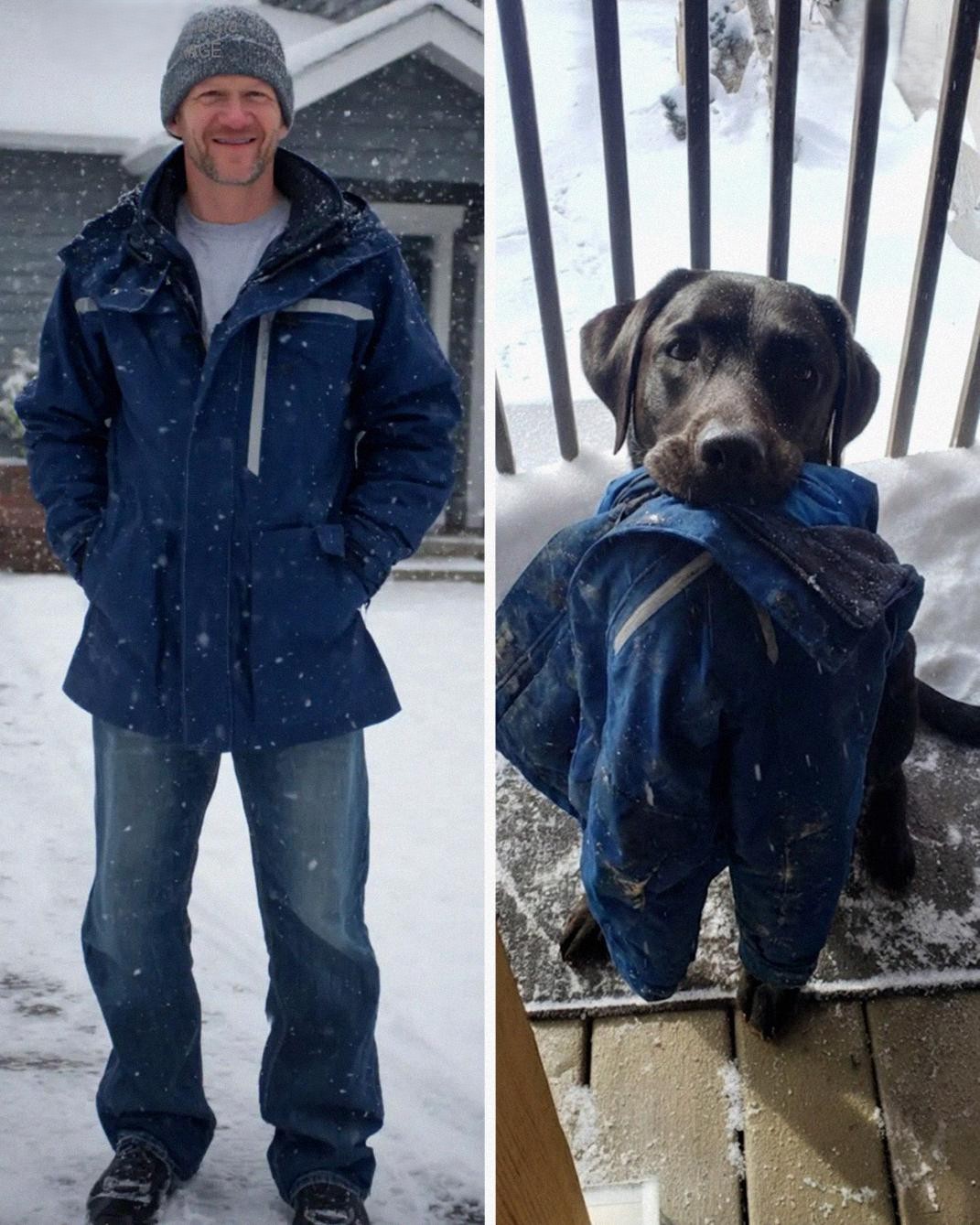
He held something muddy and worn in his mouth—Ethan’s jacket.
My hands shook as I dropped to my knees. “Max… where did you get this?”
Max barked sharply, then ran toward the trees behind the house, glancing back as if to make sure I followed.
I ran after him. Branches scratched my arms, leaves slipped underfoot. My lungs burned as I struggled to keep up. Max led me down a narrow, familiar path.
Then the trees opened.
An old, abandoned structure stood there, half-hidden by brush. Its door hung crooked, windows shattered. Forgotten.
Max dropped the jacket and barked at the doorway.
Inside, signs of life: an old mattress, blankets, empty containers, a makeshift table.
And then I saw him.
Ethan sat against the wall, thinner, hair longer and streaked with gray. His face was older, harder—but unmistakably him.
“Ethan?” I whispered.
He looked up, wary. “I… I don’t think that’s my name.”
My legs gave out.
Max went to him, tail wagging. Ethan reached out, resting his hand on Max’s head, as if remembering something his mind had forgotten.
I called 911 through sobs. “My husband… he’s been missing for six years. I found him.”
At the hospital, doctors explained: a severe head injury, memory loss, years wandering without knowing who he was, surviving on odd jobs and the kindness of strangers.
Recovery was slow. Some days he remembered nothing. Other days, fragments surfaced—a smell, a tune, a feeling.
The kids met him gradually. First as a stranger. Then as someone familiar, trying. They shared stories, photos, laughter.
Sometimes he’d say, “I don’t remember this, but it feels like it belongs to me.”
That was enough.
Max never left his side.
Ethan doesn’t remember our wedding, the birth of our first child, or the fight about kitchen paint.
But he remembers to smile when our daughter tells a joke. He remembers homework. He remembers staying.
Some nights, I still set an extra plate.
Not from grief.
Because now, someone is really coming home to eat it.
Hope isn’t loud. It doesn’t promise perfection.
Sometimes, it just waits—and returns muddy, broken, and alive, led by a dog who never stopped believing.