Three weeks after losing my daughter, life felt like moving underwater—slow, heavy, numb. Grief had torn my world open, and nothing made sense anymore. That morning, the fog outside the kitchen window hung low over the yard, softening edges and muting colors. I sat at the table in my husband’s sweatshirt, clutching a cold mug of coffee, trying to remember what it felt like to exist before tragedy hollowed me out.
My name is Erin. I’m forty. My daughter, Lily, was ten.
She died on a rainy Saturday morning, strapped into her booster seat and smiling at her dad, excited for her art class. Daniel, my husband, had promised her hot chocolate afterward. They never made it. A pickup truck lost control, shot across the divider, and crushed the passenger side of Daniel’s car. Lily died instantly. Daniel survived, with broken ribs and a spirit battered by guilt and loss. By the time he returned home, he moved through the house like a man already serving a sentence.
I left Lily’s room untouched. Her half-finished sunflower sketch lay on her desk. Her lamp glowed faint pink at night. Her bracelet kit waited on her nightstand. Passing her door felt like trespassing in someone else’s life. The silence in the house was oppressive, suffocating, as if it claimed every corner.
The police had collected her belongings from that morning—her backpack, sneakers, purple headband, sketchbook, and her yellow sweater. That sweater was sunshine in fabric. Every time she wore it, she lit up a room. Knowing it was locked away in an evidence file made the loss sting all the more.
That morning, as I sat at the table, unable to touch my coffee, I heard an unusual sound at the back door. Scratching—frantic, insistent. Baxter, our golden retriever mix, had always been Lily’s shadow, following her everywhere, sleeping by her bed, and lying at her feet during homework. But he never scratched like this.
I stood slowly, nerves taut. “Baxter?” I called.
The scratching paused, then a single sharp bark rang out—the alert he reserved for emergencies.
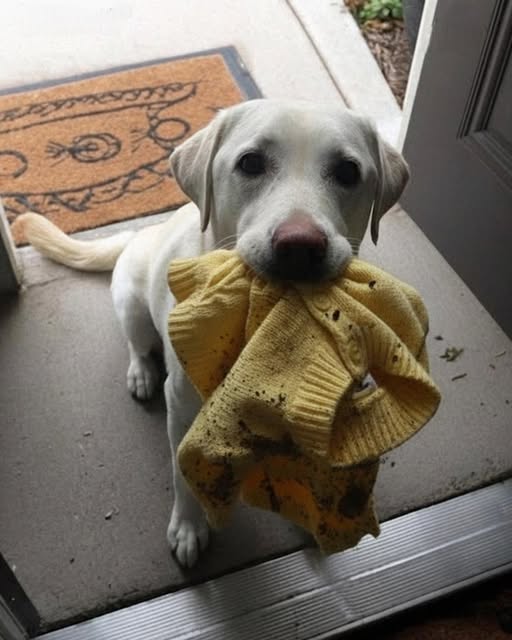
I opened the door. Baxter stood there, chest heaving, eyes locked on mine. In his mouth was something soft, golden, familiar.
A yellow sweater.
My knees nearly buckled. “No… no, that can’t be,” I whispered.
Baxter gently placed it at my feet and bolted toward the back fence. I grabbed the sweater—warm, impossibly intact—and ran after him, slipping on shoes as I went. He squeezed through a gap in the fence, the same one Lily used in summers to play in the empty lot behind our house.
I followed him, clutching the sweater with trembling hands. Baxter led me to an old shed at the lot’s far edge, its door crooked and barely hanging. He stopped, tail still, head lowered, waiting.
Inside, dust hung in the sunlight filtering through the boards. And then I saw it.
In the back corner, tucked behind an overturned pot, was a nest—not of straw, but of clothing. Lily’s clothing. Her purple scarf. An old hoodie. A cardigan she hadn’t worn since second grade. All carefully layered.
Curled in the center was a small calico cat, protecting three newborn kittens.
Baxter laid the sweater beside them. The kittens burrowed into its softness.
And then I understood.
It wasn’t the sweater from the accident—it was Lily’s spare, the second identical one she insisted on having. I had forgotten it. She must have brought it herself.
Lily had been sneaking out to care for this cat, using her clothes to keep the mother and her babies warm. She had built this little sanctuary, hidden from view.
I sank to my knees, covering my mouth as tears streamed. “Oh, sweetheart,” I whispered. “You were taking care of them.”
The mother cat lifted her head and looked at me calmly, as if recognizing my presence. Baxter sat beside me, resting his head against my shoulder.
I gathered the kittens, cradling them carefully. The mother climbed in without hesitation, trusting me as she had trusted Lily.
I carried them home.
I made a bed for them in a laundry basket lined with towels. Baxter lay beside them like a vigilant guardian. When Daniel came downstairs, pale and slow, he stared at the basket, at the kittens, at the sweater folded in my lap.
“What is this?” he whispered, afraid to hope.
“Lily’s secret,” I said softly. “She was helping a mother who needed her. She didn’t get to tell us… but Baxter did.”
A flicker of warmth broke through Daniel’s grief as he knelt beside me, touching a tiny paw. “She always had the biggest heart.”
“We still have a piece of it,” I said.
We kept the mother and her kittens. Baxter watched over them. And each day, caring for them pulled me a little closer to breathing again.
Some losses remain forever. But sometimes, love leaves traces—soft, warm, unexpected—that guide you back to the world. And every time the kittens purr, it feels like a whisper from Lily, reminding me that she’s still here, wherever kindness exists.