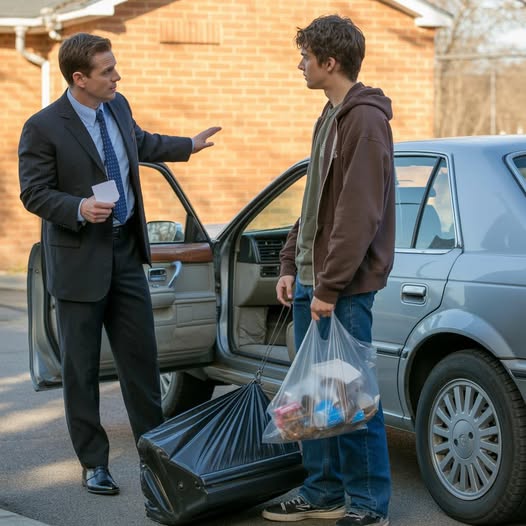
The lawyer found me behind a strip mall restaurant on a Tuesday afternoon, my hands buried in a dumpster, searching for anything edible that hadn’t completely spoiled. I was eighteen, nine days homeless, and hadn’t eaten a proper meal in forty-eight hours. The edges of the world had started to blur, as if I were trapped in a dream I couldn’t wake from.
“Nathan Brooks?”
I spun around, ready to run. Life on the streets had taught me caution—police ordering you to move along, other homeless people guarding what little they had, shop owners viewing you as a problem to be removed.
But this man wasn’t any of those threats. He looked like he had walked straight out of a movie: a crisp suit, confident posture, an expensive watch glinting in the sunlight. His leather briefcase probably cost more than my old car.
“Who’s asking?” I croaked, my voice rough from disuse.
“My name is Richard Hartwell. I’ve been looking for you for three days.” He held up a business card, gold lettering embossed into the thick stock. “I represent the estate of James Brooks. Your grandfather.”
I shook my head, sure hunger had finally cracked my mind. “I don’t have a grandfather. My dad said he died before I was born.”
“Your father lied,” Richard said plainly, no judgment in his tone—like stating the weather. “James Brooks lived until twenty-three days ago. For the last fifteen years, he tried to find you. When he finally did, six months ago, he changed his will. You’re the sole heir—four point seven million dollars in assets, including a house, investment accounts, and a small business.”
I stared at him, hands still caked in trash, stomach empty, life packed into three garbage bags sitting in the trunk of a car that had run out of gas two days prior.
“There is one condition,” Richard added, as if this were an ordinary Tuesday discussion and not a turning point in my entire life.
That was the moment everything shifted. But to understand how I ended up in that parking lot, digging through trash, I need to go back nine days, to the morning my father decided I had outlived my usefulness.
My eighteenth birthday fell on a Tuesday. I didn’t expect a party or gifts—the normal rituals of birthdays had long since lost their meaning after my mother died and my father remarried Patricia. I just wanted to get through the day quietly, go to school, return home, and count down the weeks until graduation when I could finally leave that house forever.
I had a plan. Three years of part-time jobs—grocery stores, lawn mowing, dishwashing at a diner—had allowed me to hide nearly three thousand dollars under my bed, counted nightly like a promise to myself. Enough for a cheap apartment deposit, maybe first month’s rent. Enough to survive until I figured out my next step.
That morning, I came downstairs to find my father sitting at the kitchen table with Patricia and my stepbrother Tyler. Their expressions were impossible to read—some mixture of satisfaction and anticipation, like they’d been waiting for this moment.
“Nathan, sit down,” my father said, not meeting my eyes. He hadn’t really looked at me in years—not since I stopped being the little boy who reminded him of my mother and became a teenager who made his new wife uncomfortable.
I sat, stomach twisting with anxiety.
“You’re eighteen today,” he continued. “Legally an adult. Which means we are no longer legally responsible for you.”
The words hit like stones shattering glass. I already knew what came next.
“It’s time for you to leave.”
Patricia’s thin, satisfied smile followed. “We’ve discussed it extensively. This is the best decision for everyone. You always talk about independence—well, now you can have it.”
“I still have three months until graduation,” I said, voice smaller than I wanted. “I’m still in high school.”
“You can finish from wherever you end up,” my father replied, as if solving a trivial logistics problem. “That’s not our concern anymore.”
I looked at Tyler, practically glowing with satisfaction. This was probably the best birthday present he’d ever received—the removal of the stepbrother he’d never wanted, the boy who’d taken up space that could have been his.
“Where am I supposed to go?” I asked.
“That’s for you to figure out,” my father said, standing up, signaling the conversation was over. “We’ve packed your things. Garbage bags by the front door. Take them and leave.”
“Garbage bags,” I repeated. Somehow, that detail hurt more than the eviction itself.
“We didn’t see the point in wasting good luggage,” Patricia said, her voice carrying that practiced tone of false reasonableness.
I sat there, trying to process what had just happened. Eighteen years of being unwanted, and now it was official. They were throwing me out like trash—down to the garbage bags.
“What about my money?” I asked, thinking of the box under my bed, the three thousand dollars I’d saved over years of part-time jobs. My escape plan, my lifeline.
Patricia’s smile widened, like she’d been expecting the question. “We needed that for Tyler’s college applications. Consider it back rent for all the years we’ve supported you.”
They had taken my money. Three thousand dollars I’d earned, saved, and protected—all gone, to fund the boy who had tormented me for thirteen years.
“That was my money,” I said, voice trembling. “I earned it.”
“You earned it while living under our roof, eating our food, using our electricity,” my father said, cold and final. “We’re being generous by not charging you more.”
I wanted to scream, to throw things, to make them understand the magnitude of their cruelty. But I’d learned long ago that showing emotion in this house only made things worse. Pain was ammunition here.
So I stood. I walked to the front door, picked up the three garbage bags that contained everything I owned in the world.
And I walked out.
“Happy birthday, Nathan!” Tyler called after me, laughing.
The door slammed shut behind me, a finality that echoed through my chest.
I stood on the porch for a long time, holding my life in those garbage bags, trying to figure out what to do next. No money. No family. Nowhere to go. The morning sun painted the suburban streets in soft gold light, while everyone else probably slept, dreaming ordinary dreams of ordinary lives.
I had never felt more alone.
Eventually, I walked to school, the only routine I had left. I hid the garbage bags in my locker, crammed them into a space never meant to hold a person’s entire life. I went to class, took notes, answered questions, acted as if it were just another Tuesday.
After school, I retrieved my bags and went to my car—a fifteen-year-old sedan I had bought myself. It barely ran, engine knocking, transmission grinding, but it was mine. The only thing in the world that truly belonged to me.
I sat in the driver’s seat and cried for the first time in years—great, heaving sobs from somewhere deep inside, a part of me I’d long locked away.
When the tears stopped, I started the car and drove away from everything I’d ever known.
The next nine days were a brutal education in how fast life could fall apart.
I slept in my car, moving each night—Walmart parking lots, highway rest stops, quiet streets where nobody would notice a teenager in a beat-up sedan. I learned not to stay in one place too long. Police knocked on windows at two a.m., neighborhoods called the cops on anyone who looked out of place.
I showered at the school gym before classes, standing under hot water until it went cold, trying to feel human again. I ate what I could find. Weekday lunches were rationed for dinner; weekends I went hungry.
I applied everywhere—fast food, retail, warehouses. But nobody wanted a homeless teen with no permanent address, no reliable phone, no references beyond teachers who didn’t know I lived in a car.
Shelters were full. Social services had months-long waiting lists. I fell through the holes of a system designed to catch people like me.
By day nine, I was desperate. My car had run out of gas two days prior, stranding me in a strip mall parking lot. Walking to school each day left me weak. I hadn’t eaten in forty-eight hours. The world felt too bright, too loud.
And there I was, behind that restaurant, digging through the dumpster for anything—bread a little stale, vegetables rejected for not being pretty enough, anything to keep going for one more day.
That’s when Richard Hartwell found me. That’s when my life changed forever.
Richard ordered food first. Real food, delivered from a real restaurant to the law office conference room where we sat, surrounded by legal documents and photographs I’d never seen before.
“Eat,” he said. “Then we’ll talk.”
I ate like I’d never seen food before, because I almost hadn’t. I ate until my stomach hurt, until the shaking in my hands stopped, until I felt almost human again.
Then Richard told me the truth about the family I’d never known I had.
“Your grandfather, James Brooks, was a successful businessman,” Richard began, sliding a photograph across the table. An older man with kind eyes and a warm smile stood in front of a modest Victorian house. “He built a construction company from nothing, grew it over forty years, sold it for substantial profit when he retired. He was also, according to everyone who knew him, a genuinely good man—kind, generous, devoted to his family.”
“My father never mentioned him,” I said, staring at the photograph of a stranger who somehow had my eyes, my jawline, my hands.
“That’s because your father cut him off twenty years ago, right after your parents married.” Richard pulled out more documents—a timeline of a family falling apart. “James didn’t approve of some of your father’s choices. Specifically, your father had a serious gambling problem in his twenties. James tried to help—paid for treatment, covered debts, offered support. But your father resented the interference. When James finally refused to give him more money, insisting he get help instead, your father cut him out completely. Never spoke to him again. Never let him meet your mother or know you existed.”
I sat with that information, trying to reconcile it with the father I knew—the man who’d married Patricia, the man who’d let his new wife treat me like garbage, the man who’d just thrown me out on my birthday.
“Your grandfather hired a private investigator six months ago,” Richard continued. “He was dying—cancer, same as your mother. He wanted to make amends before the end. He wanted to reconnect with his son. Instead, he found you.”
Richard’s voice softened with something between sympathy and admiration.
“He discovered his grandson had been living in that house for eighteen years, being treated like you didn’t matter. He was devastated. He wanted to come get you immediately, but you were still a minor. Your father had legal custody. Any attempt to intervene could have made things worse, potentially costing you the little stability you had.”
“So he just watched?” I whispered.
“He watched—and he planned,” Richard said. “He changed his will to leave everything to you. He set up protections to ensure your father couldn’t contest it. He did everything he could to make sure that when you turned eighteen, you’d have options, opportunities, a future that didn’t depend on people who didn’t value you.”
Richard slid another document across the table—the will, dense with legal language but unmistakably clear in intent.
“He was going to send you a letter on your eighteenth birthday,” Richard said quietly. “Introducing himself, explaining everything, inviting you to visit. He wanted to build a relationship, give you the family you deserved. But he died two weeks before your birthday. The cancer moved faster than anyone expected.”
I looked at the photograph again—this stranger who’d cared for me sight unseen, who’d planned for my future while I struggled through my present, who’d tried to give me what his own son had denied me.
“You said there was a condition,” I finally managed. “What is it?”
Richard nodded. “James knew inheriting significant money at eighteen could be overwhelming. He also knew you’d need guidance, someone to help you navigate the transition. The condition is this: to receive your full inheritance, you must live for one year in his house under the supervision of a guardian he appointed. During that year, you’ll receive a monthly allowance and access to educational opportunities, but the bulk of the estate remains in trust.”
He ticked off requirements on his fingers. “Graduate high school. Enroll in some form of higher education or vocational training. Complete a financial literacy course. And stay away from your father and his family for the entire year.”
“Stay away from them?” I repeated.
“James was concerned your father might try to manipulate you once he learned about the inheritance,” Richard explained. “He’d seen it before—long-lost relatives suddenly appearing when money was involved. He wanted to give you time to establish yourself, build confidence and independence, and understand your own worth before facing that dynamic.”
Stay away from the people who’d thrown me out like garbage? That was the easiest condition I could imagine.
“Who’s the guardian?” I asked.
“Her name is Eleanor Vance. She was James’s closest friend for thirty years. A retired teacher, now seventy-three. She lives in the house you’ll be inheriting and has agreed to stay for the year to help you settle in.”
“And if I don’t agree?”
“Then the estate goes to charity. Every penny.”
It wasn’t really a choice. I was homeless, broke, desperate. Even if I had reservations about living with a stranger for a year, the alternative was going back to that parking lot, to sleeping in my car, to digging through dumpsters.
“Where do I sign?”
The house was a Victorian mansion on three acres, with a wraparound porch and more rooms than I could count. When we pulled up the long driveway, a small silver-haired woman stepped onto the porch, her bright eyes and warm smile radiating a genuine kindness I’d almost forgotten existed.
“You must be Nathan,” Eleanor said, coming down the steps to meet me. “I’m Eleanor, but you’ll call me Ellie. Your grandfather talked about you constantly for the last six months. I feel like I already know you.”
“He talked about me?” I asked, stunned.
“Every day,” she said, eyes glistening. “He was so proud of you, Nathan. So proud of the young man you were becoming despite everything. Come inside—you need a proper meal, a hot bath, and about twelve hours of sleep. You look like you need all three.”
She was right. I needed all three.
The year that followed was the strangest, most healing, most transformative period of my life. Eleanor—Ellie—wasn’t the clinical guardian I’d imagined. She was warm, present, endlessly kind. She treated me like family from day one, making sure there was always food in the kitchen, clean sheets on my bed, sitting with me in the evenings to talk about everything and nothing.
The first few weeks were disorienting. I didn’t know how to behave in a house where someone actually cared about me. I would flinch when Ellie walked into a room, expecting criticism. I would apologize constantly—for existing, for taking up space, for eating food.
“Nathan,” she said one evening after I’d apologized for the third time for sitting in the living room, “you live here now. This is your home. You don’t need to apologize for being in your own home.”
She told me stories about my grandfather—growing up poor in rural Pennsylvania, building his construction company one house at a time, his marriage to my grandmother Ellen, who’d died fifteen years ago.
“He never got over losing her,” Ellie said. “Just like he never got over losing your father. He spent his last years with two holes in his heart, wondering what he’d done wrong, why the people he loved had left him.”
“My father left him,” I said slowly. “Not the other way around.”
“No, dear,” she confirmed. “Your father cut him off completely. James tried everything—letters, phone calls, even showing up once. Your father called the police and had him removed from the property.”
She squeezed my hand. “Your grandfather spent years wondering if he’d done the right thing, whether he should have just kept giving money, kept the peace at any cost. But he believed enabling destruction wasn’t love. Sometimes the most loving thing you can do is say no.”
I thought about that constantly—about my grandfather drawing a line and losing his son, about my father choosing pride over family, about all the choices that led me to sit in this mansion with a stranger who felt more like family than anyone I’d ever known.
I finished high school with honors that spring. Ellie sat in the front row at graduation, crying happy tears, holding a glittery sign that said, “Congratulations, Nathan.” She threw me a small party afterward—just us and a few friends from school—with a cake and candles I actually got to blow out. It was the first graduation celebration anyone had ever thrown for me.
I enrolled in community college that fall, planning to transfer to a university later. I took the financial literacy course my grandfather had specified, learning about investments, budgeting, and wealth management from an instructor who’d known him personally.
“Your grandfather believed wealth was a tool, not a goal,” the instructor told me. “He said money should be used to build things, help people, create opportunities—that hoarding it is a waste of the gift you’ve been given.”
I took those words to heart.
At the end of the year, Ellie signed the papers certifying I’d met all the conditions.
“You’ve grown so much,” she said, hugging me tight. “Your grandfather would be so proud.”
“Thank you,” I whispered. “For everything. For not giving up on me.”
“Oh, sweetheart,” she said, pulling back with wet eyes. “You’re the one who didn’t give up. You survived everything they threw at you and came out stronger. I just provided a soft place to land.”
The money transferred to my control the next day. Four point seven million dollars—suddenly mine to manage. I remember staring at the numbers on the screen, feeling panic mixed with possibility.
I didn’t go crazy with it. I invested most conservatively, following the principles I’d learned. I kept living in my grandfather’s house, which now felt like home. I continued my education, transferring to the state university to study business.
Eventually, I reached out to my father.
I know that sounds strange after everything, but I needed closure. I needed to understand why he’d made the choices he made, needed to hear him acknowledge what he’d done, needed to see if reconciliation was even possible.
We met at a coffee shop—neutral territory. My father looked older than I remembered, smaller somehow. The man who’d loomed large in my childhood now seemed diminished.
“I heard about the inheritance,” he said, not meeting my eyes. “I suppose you think you won.”
“I don’t think this is about winning or losing,” I said.
“Your grandfather always did enjoy making me look bad,” he muttered, bitterness still lingering even from beyond the grave.
“He wasn’t trying to make you look bad,” I said quietly. “He was trying to help me. By giving something to the grandson you threw out on his eighteenth birthday. The grandson you stole three thousand dollars from. The grandson you treated like he didn’t matter for fourteen years.”
My father finally looked at me. “I did what I thought was best.”
“You did what was easiest,” I replied. “There’s a difference.”
We sat in silence. I realized I wasn’t angry anymore. I’d expected rage, prepared speeches about all the ways he’d failed me. But looking at him now, all I felt was pity—for a man who’d pushed away his father and his son, who’d chosen bitterness over love, and who would probably spend the rest of his life wondering what might have been different.
“I’m not going to give you money,” I said. “I know that’s probably why you agreed to meet.”
He flinched. I’d guessed right.
“But I want you to know I don’t hate you,” I continued. “I’m not going to spend my life angry about what you did. You made your choices, and I’m making mine. My choice is to move forward, to build something good, to be the kind of person my grandfather would have been proud of.”
I stood up, leaving money on the table for the coffee.
“Goodbye, Dad. I hope you find some peace.”
I walked out and never looked back.
That was three years ago. Three years of healing, growing, becoming the person I was always meant to be. I graduated from university last spring, top of my class. Ellie was there, of course, crying before my name was even called.
I took over my grandfather’s construction company after graduation. Learning the business has been humbling—I started by shadowing foremen, understanding the work from the ground up. I’ve made mistakes, but the people who worked for my grandfather have been patient and kind.
“Your grandfather would be proud,” one of the older foremen said recently. “You’ve got his eye for detail and your way with people. This company is in good hands.”
Those words meant more than any amount of money.
Ellie still lives with me. She turned eighty last month, slower now, needing a cane to get around. But her mind is sharp, her wit intact, and her capacity for love still infinite. She’s the grandmother I never had, the family I always needed.
We still sit on the porch every evening, watching fireflies, talking about the day and the future. Sometimes she tells me stories about my grandfather. Sometimes I tell her about the projects we’re building. Sometimes we just sit in comfortable silence.
Last year, I hired a private investigator to find my mother’s family. She had a sister—my aunt Catherine—who’d been searching for eighteen years. She lives in Oregon with her husband and three children. My mother’s eyes, my mother’s laugh, and a photo album full of pictures I’d never seen.
We met last Christmas. She cried when she saw me. “You look just like her,” she said. “Just like Michelle.”
She told me she’d tried to find me after my mother died, but my father had cut off all contact. “She would be so proud of you,” my aunt said, holding my hands, tears streaming down both our faces. “She wanted you to know every day that you were loved and wanted.”
“She told me that,” I said, my voice breaking. “The last thing she said—that I was loved, that I was wanted, that I was exactly who I was supposed to be.”
“That sounds like Michelle,” my aunt smiled.
I spent a week with her family that Christmas, experiencing what a normal holiday was supposed to look like. It was overwhelming, wonderful, and heartbreaking all at once—mourning what I’d missed while celebrating what I’d found.
I’m twenty-one now. I run a construction company, live in a Victorian mansion, and am surrounded by people who love me. The journey from that dumpster to this office wasn’t easy. There were days I doubted everything, nights I woke in cold sweats, certain it had all been a dream.
But those moments passed. They always passed.
I don’t know what the future holds, but I know I have security, opportunity, and something more valuable than either: family. Not the one I was born into, but the one I built—Ellie, who saved me when I didn’t know I needed saving; Aunt Catherine, making up for lost time; friends who know my story and care about me anyway.
And the memory of a grandfather who loved me from a distance and gave me everything when he could finally reach me.
Every night, before sleep, I look at that photograph Richard gave me three years ago and say: “Thank you. Thank you for not giving up. Thank you for believing in me. Thank you for the condition that saved my life.”
My grandfather never got to meet me, but he saved me anyway. Every day, I try to be worthy of that gift. I try to be kind, generous, to see people struggling and help them the way he helped me.
I hired a homeless teenager last month, a kid who reminded me of myself. I set him up with an apartment, gave him a chance to prove himself. I donate to shelters and programs for homeless youth, trying to catch the kids who fall through the cracks the way I almost did.
I try to be the person my grandfather believed I could be.
That’s what family really means, I’ve learned. Not blood. Not obligation. Not the people who are supposed to love you but don’t.
Family is the people who choose you. The people who see you struggling and reach out. The people who believe in you when you’ve stopped believing in yourself.
My grandfather chose me sight unseen, gambled his entire legacy on a grandson he’d never met, and won.
I was homeless at eighteen, digging through dumpsters, wondering if anyone in the world cared whether I existed.
Now I know the answer.
Someone did.
Someone always had.
And that made all the difference.