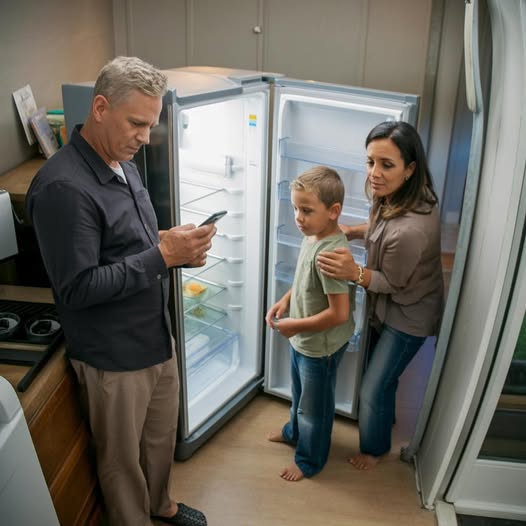
My father didn’t raise his voice. He rarely did. That was what made him terrifying in these moments—his silence was more accusatory than any shout could be. He stepped closer, his boots echoing softly on the linoleum. “Laya,” he said again, this time slower, deliberate, heavy with meaning, “I’ve raised men and women to handle hard truths. I’ve faced what most people can’t even imagine. And I’ve taught them that honesty comes before pride. Tell me—how did it come to this?”
I wanted to shrink into the floor. My chest burned, my ears rang with the memory of Ben’s hopeful little face, the smell of scorched rice still lingering in the kitchen from last night. I wanted to explain, to make it make sense, but the truth was a knot I couldn’t untangle. I had allowed myself to be erased, piece by piece, by the man I’d promised forever.
My husband’s smirk had faded slightly, replaced with a look that suggested mild annoyance that our little domestic drama had become inconvenient. “Dad,” he said, trying for casual, “it’s not what it looks like. Laya knows we agreed…”
But no. There had been no agreement. Nothing that remotely resembled partnership. Just the quiet theft of my own labor, funneled to someone else while my child went hungry.
I inhaled deeply, the cool air of the refrigerator door still brushing my hand. “No,” I said, voice small but steadier than I expected. “I didn’t agree. I don’t agree.”
The words hung in the kitchen like smoke. My father’s eyes softened just slightly, the steel giving way to something warmer—recognition. A subtle nod, as if to say, I see you now.
“You work,” he said, more a statement than a question. “You sacrifice every hour for that money. And it belongs to you. Not anyone else. Not even family.”
Tears burned behind my eyes, but I refused them. I had spent years telling myself that survival was enough, that keeping the peace and avoiding confrontation was love. But it wasn’t love. It was erasure. And now, in the quiet, humming light of my nearly empty refrigerator, I understood that for the first time.
Ben’s voice echoed in my mind: “Maybe they’ll have it next time, Mommy.”
No more.
I turned fully toward my husband. The man I had married—the man who thought generosity meant taking without consent—was suddenly smaller, diminished under the weight of his own assumptions. “This ends now,” I said. “You will never take my paycheck again without my permission. Not a dollar, not a dime. And if Ben is hungry, we fix it together, as a family.”
My father’s hand rested lightly on my shoulder. Not pressing, not directing—just steadying me. The kind of presence that says, I’ve got you, even if you’ve forgotten how to hold yourself.
For the first time in months, I felt air fill my lungs as if it had been withheld. My father’s nod, slow and approving, told me what I had known deep down but feared to admit: I had the strength to reclaim what was mine, to protect my child, and to finally speak the truth aloud.
Ben’s cereal, the frozen peas, the congealed rice—these were not just meals. They were symbols of my surrender, my silence, and my exhaustion. But now, standing in that cold, buzzing kitchen, I felt the first pulse of something new: control, clarity, and the unshakeable knowledge that I would never let anyone—no one—decide the value of my work, or my child’s well-being, ever again.
My father finally spoke, softer this time, almost a whisper meant for me alone: “Good. That’s my daughter.”
And I felt, for the first time in months, a spark of the life I had been too afraid to claim—the life I would now fight for, fiercely, for Ben, for myself, and for the dignity that had been quietly stolen.
The tension in the kitchen didn’t just hang—it pressed, thick and suffocating, like the humid air before a thunderstorm. My husband’s hands trembled slightly as he gestured toward me, as if trying to reclaim some authority that had evaporated the moment my father’s voice cut through the room.
“This is ridiculous,” he spat, but it lacked conviction. His eyes flicked toward Ben, who had been silently watching from behind my leg, clutching his threadbare fox like a talisman. That small, terrified figure made my chest tighten. I realized that every second my husband spent arguing was another second he’d exposed our son to a household where hunger was a constant companion, and my father wasn’t letting that happen anymore.
“Sit down,” my father said, voice low, precise. “Sit. And answer questions without interrupting. We’re documenting this. Your actions are not a matter of opinion. They’re facts.”
I could see the panic finally creeping into my husband’s carefully curated composure. He floundered, trying to justify the theft of my labor, twisting words around “family,” “help,” and “generosity,” but every sentence seemed weaker than the last. My father’s calm authority, honed over decades of policing and commanding respect in moments of real danger, was a wall he could not breach.
I knelt beside Ben, smoothing his hair back gently, whispering, “It’s okay, baby. You’re safe now.” He leaned into me, tiny arms wrapped around my waist, and for the first time that morning, I felt the weight in my chest shift slightly. Protection, not fear, was filling the space.
The call my father made had already set things in motion. Within minutes, a uniformed officer arrived, not with sirens or aggression, but with a quiet efficiency that mirrored my father’s own demeanor. My husband’s face lost all color as the man asked him to step aside for a brief conversation about financial responsibility and child welfare.
I watched him, the man I had once trusted, reduced to stammering and defensive postures while Ben and I sat together, shielded by the presence of my father and the officer. It felt surreal, a scene I had never imagined could unfold in my own home, yet it was also the clearest moment of empowerment I had ever known.
The officer’s questions were straightforward. “Were you aware that the wife’s paycheck was being redirected without her consent?” he asked. “And that the child was left with inadequate food and resources?”
The answers came haltingly, excuses spilling out like water from a cracked jug. But no amount of justification could hide the truth. Not from the officer. Not from my father. And certainly not from me.
When the questioning ended, the officer left, but the shift in the household was permanent. The smirk that had once been my husband’s shield was gone. Ben’s eyes were wide but curious, sensing the newfound boundary that had been drawn. And I, for the first time in years, felt an almost dizzying clarity: this was my home. My paycheck. My son. And no one—no one—would ever take that from us again without consequence.
I turned to my father, voice trembling, not with fear, but with gratitude. “Thank you,” I whispered.
He nodded once, simply, as though to say, I always knew you had the strength. You just needed to see it for yourself.
Ben leaned into me, his small body trembling slightly from the intensity of the morning, and I held him tighter than ever before. I realized that the first step toward rebuilding wasn’t just protecting him—it was reclaiming myself. And this time, there would be no compromise, no quiet surrender, no stolen paychecks to be gaslit away.
The kitchen, once a place of silent despair, now felt like a threshold—a crossing point from a life where my voice had been silenced to one where I would finally speak, act, and insist on the dignity that had been denied for too long.
My father shook his head, exhaling like he was letting out a long-held breath. “Forget cash. Forget cards. We’ll handle it. You focus on feeding him and taking care of yourself. You’ve been running on empty for too long.”
I felt my throat tighten, a mixture of relief and embarrassment. Relief that someone—someone I trusted completely—was finally stepping in, taking the burden off me. Embarrassment that it had taken this moment, this confrontation, for the truth to be visible to the world.
He reached into his coat pocket, pulling out a small notebook and a pen. “Let’s make a list. First, groceries. Second, bank accounts. We’re separating yours from him today. Third, a plan for the coming weeks so you’re never in this position again.”
Ben tugged at my sleeve, looking up at me with those wide, innocent eyes. “Mommy… real food?”
I smiled, though my chest still felt tight. “Yes, baby. Real food. Today, we’re going to fill this kitchen with everything you need.”
My father ruffled Ben’s hair and crouched to his level. “And I’ll help. Don’t you worry about a thing.”
For the first time in months—maybe years—I felt the weight of exhaustion and fear begin to lift. The apartment didn’t feel like a trap anymore. It felt like a place where change could start, where I could reclaim my life and protect my son without compromise.
I went to the cupboard, opening the few cans of beans and pasta I’d hoarded like treasure, and let myself breathe for the first time in a long time. My father’s hand rested on my shoulder, steady, grounding, reminding me that I wasn’t alone anymore.
And as I looked at Ben, clutching his stuffed fox but now smiling faintly at the prospect of an actual meal, I realized that the first step toward freedom wasn’t dramatic courtroom battles or confrontations—it was simply reclaiming control of the small, vital things: his food, our money, our home. From there, we could rebuild everything else.
The refrigerator might have been empty before, but now it was a symbol of possibility. And I, finally, could start to fill it.
I let his words sink in, the weight in my chest easing just slightly. For the first time in months—or maybe years—I realized that the guilt I’d been carrying wasn’t mine to bear. It had been manufactured by someone who wanted me compliant, invisible, and drained.
Inside the bank, the teller raised an eyebrow as I handed over my ID. My father stood silently behind me, a steady presence that made the world feel like it could be navigated without panic. We opened a new account, separate from my husband’s reach. I signed forms, initialed papers, and watched as my wages were redirected to a space that belonged entirely to me. The sense of relief was profound; it felt like drawing the first line in a map back to autonomy.
Back in the car, my father drummed his fingers on the steering wheel. “Next step,” he said, “we make sure Ben’s needs are met weekly. You’re going to set up a budget, and I’ll help you stick to it until you’re confident. You’re not doing this alone.”
I exhaled, feeling something I hadn’t in months—control. Agency. The quiet power that comes from knowing that, no matter what anyone else does, I have the ability to protect myself and my son.
“Can I… do this?” I asked, voice small. “Can I really do it on my own?”
“You can,” he said without hesitation. “You’ve been doing it in secret for years, without support. Now you just have to do it out in the open, with a plan. And you won’t fail.”
For the first time, I believed him.
When we returned home, Ben ran into the kitchen like it was a playground of miracles. I unpacked the groceries with deliberate care, placing each item where it belonged. I could feel the tension in the apartment shift as the cupboards filled. My father quietly supervised, offering small tips on storage and planning, but never overstepping—letting me reclaim authority in my own home.
My husband hovered for a moment, his posture stiff, his mouth opening and closing like a fish out of water. I didn’t look at him. My father’s hand rested lightly on my shoulder, a silent anchor.
That night, as Ben drifted to sleep with a full belly and a storybook in hand, I sat at the kitchen table, counting the bills and organizing the accounts. It was the first act of self-preservation I’d undertaken that felt like victory rather than obligation. For the first time, I understood what freedom looked like: it was measured in quiet steps, in a fridge that wasn’t empty, in the knowledge that your child could eat without fear, and in the certainty that someone had your back when the people who were supposed to love you had failed to do so.
And for the first time in a long time, I let myself feel… safe.
At the bank, a familiar face greeted my father—Maureen, who had apparently worked there since before I was born. She hugged him warmly, then offered me the same genuine kindness.
“This is my daughter, Laya,” my father introduced me. “She needs to open a personal account, not joint, and we need her direct deposit rerouted immediately.”
Maureen’s professional demeanor was reassuring, clearly accustomed to helping women in situations like mine. “Let’s get this sorted for you,” she said.
In her office, I filled out the forms, each signature on the line feeling like a small act of independence. “This account is entirely yours,” she emphasized. “Do not share passwords or add authorized users. Anyone who needs funds can ask directly, and you can choose to transfer if you wish, but this is your control.”
Walking out into the winter sunlight afterward felt different—sharper, clearer, as if someone had finally cleaned the smudged glass I’d been seeing the world through.
That evening, I left a note on the counter: My money feeds my child, not your pride.
I didn’t wait for my husband’s reaction. I prepared a proper dinner with protein and vegetables, gave Ben seconds, and read him two bedtime stories without checking my account balance.
Three months later, I filed for separation. The courthouse was exactly as dreary as I had imagined—fluorescent lights, worn linoleum, and a clerk with years of similar cases behind her.
My father drove Ben and me. I filled out forms reducing years of marriage to boxes and brief statements. The hearing was anticlimactic; the judge quickly reviewed documents and confirmed my husband did not contest custody. The tangled web of finances and manipulation began to unravel legally.
“How do you feel?” my father asked outside.
“Free,” I admitted. “And terrified.”
Six months after the empty fridge incident, a social media post I wrote that sleepless night went viral, recounting my experience with financial abuse. Women shared their own stories, and a media company offered me a job as Director of Community Storytelling, helping women recognize and escape economic abuse.
Two years later, I live in my apartment, chosen myself. Ben, now six, does homework at the table while I watch him grow in stability. My father still visits, ensuring everything is well-stocked. The fridge is never empty again.
My ex-husband sees Ben per court schedule, no more excuses, no more scrambling. I respond to messages from women learning they aren’t failing—they’re being robbed. That is why I do this work, to give someone else the chance to reclaim their life.