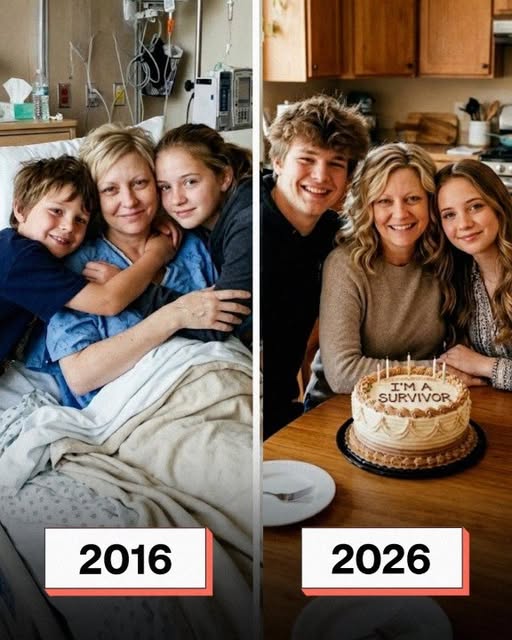
When I was fourteen, my life changed in ways I could never have imagined, and I would carry the weight of that moment for years, like an invisible scar that whispered every time I felt stability slipping through my fingers.
It began on a cold autumn afternoon. My mother had just begun chemotherapy for stage 3 breast cancer—a brutal treatment that sapped her strength but never her spirit. She had faced her diagnosis with quiet dignity, masking her fear behind a brave smile that faltered only in the quiet of the night. I had just started high school, a time when I should have been worried about homework and friendships, not the fragility of my family.
But that day, my father packed his suitcase. Jason, my younger brother, and I watched from the staircase, frozen in disbelief, our hearts pounding against our ribs as though trying to scream out what our mouths could not. We heard the zipper of his bag, the finality of each tug echoing through the small house. Then came the words I would never forget:
“I’m not a nurse. I can’t do this.”
Within an hour, he was gone. No farewell, no promises to return, just an empty space where he once had been, leaving my mother alone to face treatment, pain, and fear. Our father’s departure fractured our home, leaving Jason and me scrambling for answers we didn’t have, grappling with anger, confusion, and a deep sense of abandonment.
The weeks and months that followed were a blur of struggle. We lost our home as the bills piled up. Friends who had promised to help disappeared. My mother, once vibrant and full of life, became gaunt and pale, yet her eyes held a determination that refused to die. We moved into a small, cramped apartment, its walls too thin to block the cries of neighbors, its floors too worn to hide our exhaustion. Every day became a fight for survival, a series of small victories: making dinner, getting to school on time, helping mom through chemo.
I became her shadow, a silent guardian. I learned to administer medications, track her symptoms, and offer comfort when she couldn’t lift her own head. I worked part-time at a local grocery store, stacking shelves and bagging groceries to make ends meet. Sleep became a luxury. Friends faded into the background. High school felt like a distant dream, a place I only visited briefly before returning to the reality that life had handed me far too early.
Watching the nurses who supported her during those grueling days planted a seed in me—a calling I didn’t yet fully understand. Their patience, kindness, and unwavering presence in the face of suffering fascinated me. I wanted to be that person for someone, to stand when others faltered. I wanted to embody the quiet strength that had kept my mother alive.
Years later, after my mother’s health stabilized and we slowly began to rebuild our lives, that seed grew into a purpose. I became a nurse. I devoted myself to those who were scared, isolated, or abandoned, determined to offer the care that some people never received. I vowed to always remain present, to never walk away, no matter how difficult the path became.
A decade after my father walked out of our lives, life brought me to a position I had worked tirelessly to earn: head nurse at a long-term care facility. I loved the work, loved the sense of purpose it gave me, and cherished the quiet gratitude of patients who felt seen and cared for.
One morning, as the sunlight cut through the blinds in neat stripes across the lobby, a new patient arrived following a severe stroke. As I opened the chart to review his history, my heart froze. The name on the file—written in crisp, professional print—belonged to him. My father.
I sat there for a long moment, staring at the page as memories of that autumn afternoon came crashing back: the zipper of his bag, the echo of his words, the hollow feeling of abandonment. I swallowed hard and made my way to his room. He recognized me immediately. His eyes, clouded with pain and regret, searched mine as though pleading for something unspoken. He struggled to speak through the fog of emotion.
“I… I brought this,” he said, fumbling with a familiar silver Rolex—the same watch he had worn the day he left us. I could see the weight of decades pressing down on him, the realization that time had not erased guilt. I returned it to him without a word, keeping my distance, maintaining the professional barrier that was both armor and shield.
Despite the storm of emotions inside me, I performed my duties with precision. I assigned his therapists, monitored his medication, checked vitals, and ensured his comfort. I was his nurse—not his daughter—not yet, and perhaps never beyond the professional. The boundary allowed me to breathe, to process, and to protect the fragile balance of control I had fought so hard to build in my life.
Months passed. He improved slowly and was eventually discharged to live with his sister. Life continued its relentless rhythm, leaving little room for reflection, until a small package arrived at work, addressed to me. Inside lay the watch. Engraved on the back was a simple message:
“For Kelly — the one who stayed.”
I held it in my hands, letting the weight sink in. Not as a token of forgiveness, but as a reminder of resilience—the quiet, steadfast kind that builds character, shapes destiny, and nurtures those who cannot stand alone. I thought of the autumn afternoons I had spent helping my mother, the nights I had spent studying after working long hours, and the countless small moments when I chose presence over despair. This watch became more than metal; it became proof that standing by those you love—even when they abandon you—carries its own reward.
I kept it on my desk, a quiet testament to patience, perseverance, and the courage to remain when life becomes unbearably difficult. It reminds me every day that sometimes karma doesn’t arrive with thunder, doesn’t scream or seek vengeance. Sometimes, it comes softly, in the form of recognition, closure, and the dignity of witnessing a life you preserved despite the odds.
And in that quiet, I understood fully for the first time: the greatest strength is not always loud. The deepest justice is not always immediate. True resilience—the kind that defines a life—is about standing firm, staying present, and being unwavering for those who cannot do it themselves.
Because in the end, that is the legacy of love and courage: to remain, when most walk away, and to let time reveal the quiet triumph of staying.