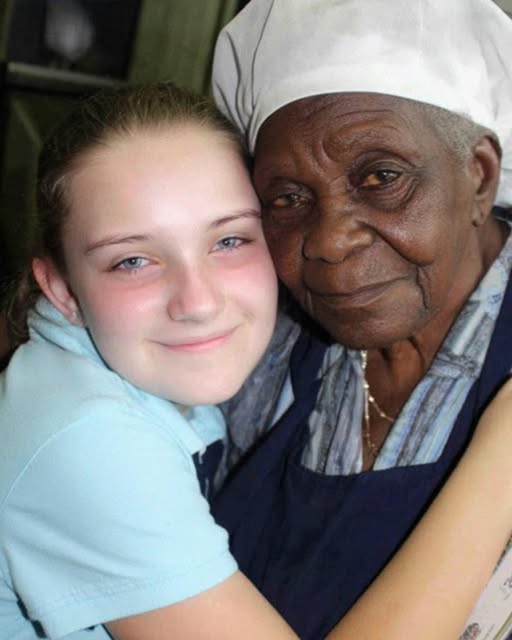
I finished high school just last week, yet I don’t feel like a graduate at all. Everyone keeps asking what comes next, talking about “the future” as if it’s a clear road ahead, but my mind goes blank every time. It feels as though life has paused on a single frozen image while everyone else is waiting for it to move again. Even now, standing inside our quiet home, everything still carries her presence—the scent of freshly baked yeast rolls mixed with sharp cleaning spray and the soft hint of lavender soap she saved for Sundays. Sometimes I swear I hear the familiar creak of her steps in the kitchen, and for a heartbeat, I forget that the quiet isn’t temporary. It’s final.
My grandmother, Lorraine, wasn’t just someone who helped raise me—she was my entire universe. After my parents died in a car accident when I was barely old enough to remember them, she stepped into every role I needed. Mother. Father. Protector. Anchor. She was fifty-two when she took me in, already working full-time as a cook in the local school cafeteria. The house we lived in was older than both of us, drafty and worn, but somehow it always felt warm. To the town, she was “Miss Lorraine,” or more dismissively, just the “Lunch Lady,” a background figure in a hairnet. To me, she was extraordinary—a miracle wrapped in a sunflower-print apron.
Every day, before dawn even thought about breaking, she left for work to cook for hundreds of students. Yet she never once forgot my lunch. Inside every crumpled paper bag was a handwritten note: “You’re my favorite miracle,” or “Eat your fruit or I’ll haunt you.” We didn’t have much money, but she had a gift for turning scarcity into something magical. When the heater broke one winter, she filled the house with candles and called it our “Victorian spa night.” When prom came and I needed a dress, she transformed an eighteen-dollar thrift store find by staying up until midnight sewing rhinestones onto the straps, humming Billie Holiday while she worked. “I don’t need riches,” she used to say, love blazing in her eyes. “I just need you to be okay.”
High school, however, is rarely kind to anyone who stands out. The teasing began my freshman year, quietly at first—whispers in hallways about my grandmother “spitting in the food” if someone crossed her. Soon, the nicknames followed: “Lunch Girl,” “PB&J Princess.” Kids I’d grown up with, who once played in our backyard, mocked her accent and laughed at the way she called everyone “sugar.” I’ll never forget Brittany—sharp, popular, cruel—asking loudly if my grandmother “packed my panties with my lunch.” The hallway exploded with laughter as I stood there, frozen, every laugh carving something out of me.
I tried to protect Lorraine from it all. By then she was seventy, her fingers twisted with arthritis, her back worn down from years on cafeteria floors. I didn’t want to burden her with teenage cruelty. But she knew. She saw the eye-rolls in the lunch line, heard the snickers when she offered extra food to hungry kids. And still, she chose kindness. She memorized names, remembered allergies, slipped fruit to students without lunch money, and loved with a quiet determination no one deserved—but everyone received.
I poured my pain into studying. Scholarships. Books. Late nights at the library, focused only on graduation. Lorraine would smile and say, “You’re going to turn all this into something beautiful one day.”
She never saw how right she was.
It happened during the spring of senior year. She complained about chest tightness, brushing it off as “too many jalapeños” in the cafeteria chili. She refused a doctor, insisting, “Just get me through your graduation.” Then one Thursday morning, the coffee pot was half-full and the kitchen too quiet. I found her on the floor, her glasses beside her hand. A heart attack took her before the sun rose again, and the universe felt suddenly cruel and unfair.
People told me I didn’t have to attend graduation. They said it was too soon. But I looked at the purple honor cords she’d worked extra shifts to afford, the gown she had ironed weeks in advance. I styled my hair the way she liked, wore the dress she picked, and walked into that gym carrying grief like bone and breath.
When my name was called for the valedictorian speech, I abandoned the polished draft I’d written. Standing at the podium, I looked out at the faces—classmates who mocked her, teachers who ignored it, parents who only saw a “Lunch Lady”—and I spoke the truth.
“Most of you knew my grandmother,” I said, and the room shifted, heavy and still. “She fed you thousands of meals. Tonight, I’m feeding you the truth.”
I told them about the woman who remembered birthdays and food allergies. About the woman who smiled at people who never smiled back. “Some of you thought it was funny,” I continued, my voice shaking but steady. “You laughed at her voice. You turned her love into a joke. She heard it all. But she never stopped asking if you were okay. She never stopped choosing love—even when it hurt.”
The silence that followed was overwhelming. I called her my “polar star,” the light that guided me through every dark moment. “She died last week,” I said. “She never got to see me wear this gown. But she gave me everything that made this moment possible. She mattered. And if you remember anything tonight, remember this: don’t laugh at kindness. One day, you’ll realize it was the strongest thing you ever encountered—and you may wish you had said thank you.”
When I stepped away, the applause came slowly, heavy and solemn—less celebration, more confession.
Later, in the hallway, Brittany and the others approached me. Their confidence was gone, replaced with red eyes and quiet voices. “We were horrible,” Brittany whispered. “We thought it was harmless. We’re so sorry.”
They told me about their plan—to build a tree-lined walkway to the cafeteria, a peaceful place they wanted to name “Lorraine’s Way.” Something inside me finally loosened. This wasn’t just guilt. It was change.
“She would’ve fed you anyway,” I told them.
That night, I returned to the empty house. I sat at the kitchen table, staring at her unused coffee mug, the empty hook where her apron once hung. I whispered into the silence, “They’re planting trees for you.” I believe she heard me.
She taught me how to endure. How to forgive. How to love loudly. And maybe—if I try hard enough—I can become someone else’s guiding star, too.