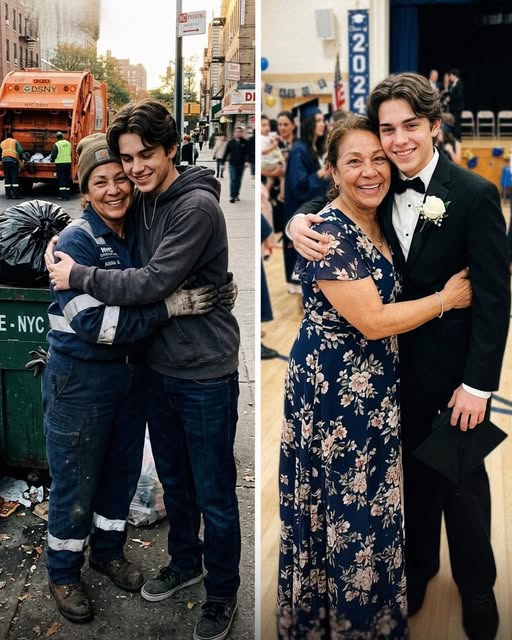
The architecture of a human life is often built upon the foundations of what others discard. My life, for eighteen long years, smelled of diesel exhaust, industrial bleach, and the cloying sweetness of rotting organic matter. These were the aromas of survival, of early mornings and unseen labor. My mother did not plan this life. She was a nursing student with bright ambitions, a loving husband, and a modest apartment that felt like a prelude to a long, joyful story. But stories can be rewritten in an instant, rewritten by tragedy that arrives without warning.
When my father’s construction harness failed, he fell, and with him fell the stability of our world. The accident didn’t just end his life—it dismantled ours. My mother became a widow with no degree, mountains of medical bills, and a young son whose future seemed fragile and uncertain. Society might have seen a résumé full of gaps, incomplete education, and unmet potential, but the city’s sanitation department saw something else: a woman willing to work. She traded her scrubs for a reflective vest, stepping into a world of early mornings, trash-strewn streets, and endless shifts. And I became, forever, “the trash lady’s kid.”
In school, that label became a brand of humiliation. From the first day of kindergarten through my last day of high school, I learned the precise geography of every hallway—not to reach class faster, but to find hidden corners, the quiet shadows behind vending machines where I could eat in relative peace. I became an expert in navigating avoidance: chairs sliding away before I even sat, fake gagging noises following me down the corridor, whispers that cut like paper. And I swallowed it all, quietly, because I carried a secret: I lied to the one person who mattered most. Each afternoon, when my mother returned home with red, swollen hands, she asked me about school. I lied. I said I had friends, that the teachers liked me, that I was happy. She carried the weight of grief, of exhaustion, of double shifts, and I refused to add mine to her burden.
Instead, I poured myself into learning. Education became my escape, a ladder I could build out of the very garbage my mother hauled. We had no tutors, no prep courses, only a library card and a battered laptop she had bought with money from recycled cans. I stayed in the library until the lights went off, studying algebra, geometry, physics. Numbers were fair; they didn’t care about zip codes or parental occupation. They offered a truth no gossip or prejudice could touch.
Everything shifted in the eleventh grade with Mr. Anderson. Frazzled, coffee-stained, and perpetually muttering equations, he was my math teacher. One day, he noticed me hunched over a printout of college-level problems. Instead of passing by, he pulled over a chair, sat down, and spoke to me as an equal. I told him I was poor, that engineering schools were for rich kids. He looked me straight in the eye. “Financial aid exists,” he said. “And smart poor kids exist too.” From then on, he became my mentor, my secret coach, and my ally. He gave me challenging problems, refuge in his classroom at lunch, and, most importantly, he gave me belief that my zip code wasn’t a cage.
By senior year, my GPA was the highest in the class—a source of grudging respect, and new whispers of mockery. I had “good grades because I had no life,” they said. The teachers “pitied me.” Meanwhile, Mr. Anderson and I worked in secret. Application essays that spoke honestly of my life, the 3:30 a.m. alarms, the smell of bleach that never left my mother’s skin, and the relentless guilt of hiding my loneliness so she wouldn’t feel like a failure. Each essay became a story of resilience. I read the final draft to Mr. Anderson; he sat silently for what felt like an eternity before nodding and saying, “Hit send.”
The acceptance email came on a Tuesday morning as I ate cereal in our quiet kitchen. It wasn’t just an acceptance; it was a full-ride scholarship to one of the nation’s top engineering institutes. I laughed until tears rolled down my face, printed the letter, and waited for my mother to finish her shower. When she read it, she collapsed into my arms, sobbing, whispering thanks to my late father that I had made it.
Graduation day blurred into caps, gowns, and a roaring gymnasium. My mother sat at the back, straight-backed in her best clothes, eyes locked on the stage. When I was called as valedictorian, the applause was hesitant, unsure. I stepped to the microphone, staring at the faces that had spent years treating me with disdain.
“My mom has been picking up your trash for years,” I began, voice trembling. Silence fell. “You know me as the ‘trash lady’s kid.’ The gagging, the chairs sliding, the pictures of my mom’s truck you sent to each other. I lied to her every day. I told her I had friends, that I was happy, because I didn’t want her sacrifices to feel wasted. Today, I speak the truth.”
I looked to the back row. My mother’s hands covered her face. I thanked Mr. Anderson, my secret mentor, and then turned my attention to the woman in the reflective vest. “Mom, you thought giving up nursing school was failure. You thought picking up trash diminished you. But every step you took, every shift at 3:30 a.m., every mile in that truck, built this life, this success. That college I’ve been accepted to? Full scholarship, top engineering school.”
The gym erupted. My mother rose, shouting with pride that filled every corner. My classmates’ expressions shifted, some ashamed, some enlightened. I had redefined the meaning of a label meant to shame me. I was no longer “the trash lady’s kid” in humiliation, but a living testament to resilience, sacrifice, and unwavering love. Soon, I would leave for a campus a thousand miles away, but I would carry the scent of that garbage truck—and the lessons of a mother who turned tragedy into triumph—forever in my heart.