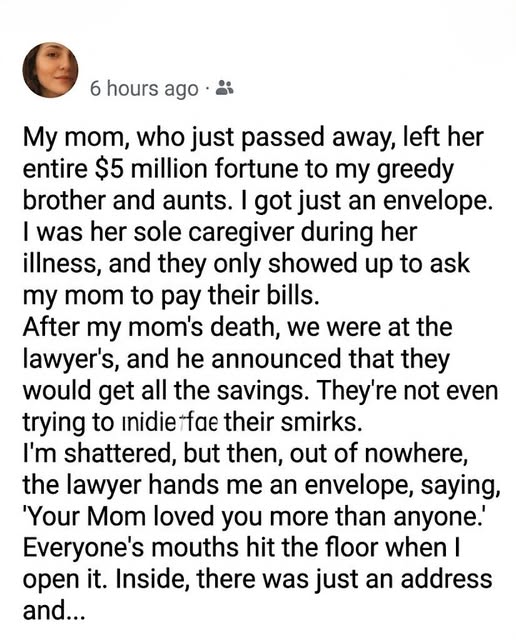
When my mother died, I thought I had already prepared myself for what was coming. I expected the emptiness, the quiet that settles into a house when the person who held it together is gone, and the uncomfortable business of sorting through what she left behind. What I didn’t expect was what happened in the lawyer’s office.
My brother sat across from me, practically vibrating with expectation. He had spent most of his adult life drifting in and out of my mother’s financial support, showing up when he needed help and disappearing when he didn’t. Still, when the will was read, he received everything: millions in liquid assets, property, and the family’s most valuable holdings. My aunts also walked away with generous inheritances—trust funds, jewelry, and assets carefully allocated.
Then came me.
I was the one who had stayed. The one who had moved back in during her illness, managed her medications, sat through hospital visits, and held her hand through the worst nights. When the lawyer reached my name, he didn’t announce a sum. Instead, he placed a single envelope on the table. Inside was an old iron key and a slip of paper with an address written in my mother’s handwriting.
My brother actually laughed. “After everything you did for her,” he said, slipping his check into his pocket, “you were basically the help, Sarah. She left you a mystery and some junk.”
I left the office with a strange mix of shock and humiliation. I could have thrown the key away. I could have dismissed it as meaningless. But sitting in my car, looking at her handwriting, I felt something else—certainty. My mother didn’t do careless things. If she left me a key, there was something it was meant to open.
The address took me out of the city and into the countryside, where paved roads narrowed into gravel and then into a quiet dirt path swallowed by overgrowth. At the end of it stood a small stone cottage, partially hidden by trees and wild lavender. It looked forgotten, but not abandoned—more like something preserved, waiting.
As I stepped onto the porch, it felt solid beneath my feet, as if it had been expecting me. The key turned easily in the lock. Inside, the air was warm with the scent of dried herbs, beeswax, and something painfully familiar—my mother’s perfume. It didn’t feel empty. It felt lived in, carefully maintained.
On a small table in the center of the room was a letter.
“Sarah,” it began, “I gave your brother money because it is the only language he understands. He will always try to fill himself with more of it. But I gave you this place because you understand how to build a life.”
She explained that the cottage wasn’t just property—it was a refuge, part of a larger protected piece of land tied to family history. Then she led me outside, to an old oak tree near the edge of the property. Beneath it, I found a cedar box buried in the soil.
Inside wasn’t wealth in the way my brother understood it. There were family documents, old deeds, a wedding ring passed down through generations, and journals filled with stories I had never been told. There were also legal papers confirming the land’s protected status—it couldn’t be developed or sold freely. Its value wasn’t in what it could generate, but in what it preserved.
Back in the city, my brother’s “victory” began to unravel. Within months, his inheritance turned into pressure he wasn’t prepared for—taxes, legal disputes, failed investments, and relationships that quickly became transactional. He called me once, exhausted and angry.
“I don’t get it,” he said. “You’re out there in that old place and I’m drowning in this.”
“I’m not drowning,” I told him. “I’m living.”
And I was.
I stayed in the cottage. I repaired what time had worn down, tended the lavender, and learned the rhythms of a place that asked nothing from me except attention. While my brother was surrounded by people who wanted pieces of his money, I was surrounded by something quieter and more lasting: peace.
In the end, I understood what my mother had done. She hadn’t simply divided her estate—she had divided her understanding of us. She gave my brother what he had always chased, and she gave me what I had always built.
And in that quiet cottage, I finally realized the truth she had been trying to leave behind all along: real inheritance isn’t measured in money, but in the kind of life you’re able to keep living when everything else is gone.