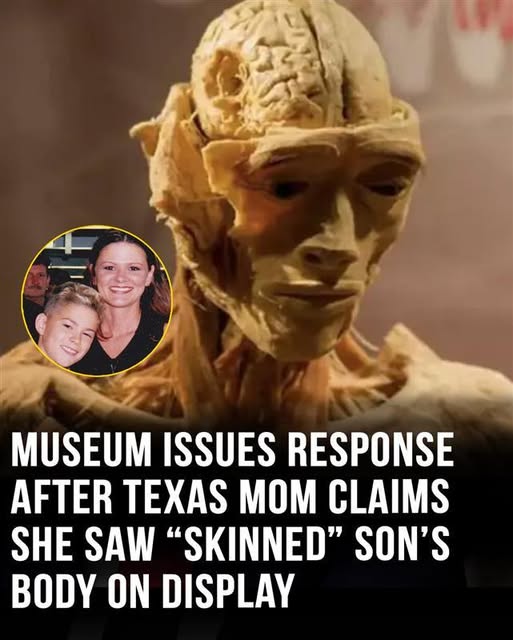
A museum in Las Vegas has strongly rejected renewed accusations from a mother in Texas who claims that one of its plastinated human exhibits is actually the preserved body of her late son. The disturbing allegation has resurfaced online years after it was first made, reopening a painful and unresolved story involving grief, doubt, and lingering questions.
At the heart of the controversy is Kim Erick, who has spent more than ten years questioning the official account of her son’s death. Her son, Chris Todd Erick, died in 2012 at just 23 years old. Although authorities ruled his death a suicide, his mother has never accepted that conclusion. Over time, her doubts deepened into a belief that something far more troubling occurred after his death.
Those suspicions intensified when Erick visited the Real Bodies exhibition in Las Vegas. The exhibit displays plastinated human cadavers to demonstrate anatomy, muscles, and organs and has traveled internationally, attracting millions of visitors. One particular display drew Erick’s attention: a skinned human figure seated in a thoughtful pose, commonly referred to as “The Thinker.”
Erick has said that the moment she saw the figure, she was convinced it was her son. She claims that specific physical traits—such as body proportions, posture, and facial structure—closely resembled Chris in ways she found impossible to ignore. What began as an emotional shock gradually became a firm belief. She came to suspect that her son’s body had been placed into the plastination process without her permission.
The museum has firmly denied these claims. Representatives state that all bodies used in the exhibit are legally acquired, thoroughly documented, and sourced through ethical and lawful channels. They maintain that none of the cadavers originate from the United States and that proper consent was obtained from donors or their families under the laws of the countries involved.
Despite these statements, Erick remains unconvinced. She argues that there are inconsistencies in the official explanation of her son’s death that were never fully addressed. She points to unanswered questions regarding timelines, documentation, and the handling of her son’s remains. From her perspective, the museum’s denials fail to address broader concerns about how human bodies can move between borders, institutions, and private collections with limited transparency.
Over the years, Erick has filed complaints, spoken publicly, and shared her story online, where it has resurfaced and gone viral multiple times. Each resurgence sparks renewed debate, skepticism, and public attention. Some people believe her claims stem from unresolved grief intensified by the shock of encountering such a graphic exhibit. Others argue that her concerns raise valid questions about oversight and accountability within the global body exhibition industry.
The museum has emphasized that plastination is a highly regulated process that requires extensive documentation at every stage. Officials explain that bodies are tracked from donation through preparation and display, making accidental or intentional misidentification extremely unlikely. They also note that the exhibit has been reviewed and shown in multiple jurisdictions without legal challenges related to body sourcing.
Still, Erick’s story continues to resonate because it touches on a deeply unsettling fear: that human remains can be commodified, stripped of identity, and displayed without dignity or consent. Even visitors who trust the museum’s explanations often find it disturbing that a grieving mother believes she recognized her child in such a setting.
Psychologists explain that grief, especially when combined with unresolved doubt, can lead individuals to fixate on alternative explanations. When a loss feels sudden, unclear, or mishandled by authorities, the mind seeks meaning and accountability. In Erick’s case, encountering a human body devoid of skin and identity may have transformed years of quiet suspicion into a single, haunting certainty.
Online reactions to the revived claim are sharply divided. Some accuse Erick of spreading misinformation and unfairly attacking a legitimate scientific exhibit. Others express sympathy, arguing that even if her belief is mistaken, her pain reflects deeper failures in how institutions communicate with grieving families.
The museum has stated that it understands the emotional weight of such allegations but warns that repeating unfounded claims can harm staff, educators, and public trust in science. It reiterates that there is no evidence supporting Erick’s belief and that her son’s remains were never part of the exhibit.
For Erick, however, proof goes beyond documents and records. She has repeatedly said that a mother recognizes her child’s body, even years later. That emotional certainty—rather than forensic evidence—is what prevents her from letting go. To her, the exhibit is not educational but a painful reminder of a death she believes was mishandled from the beginning.
The case underscores the tension between institutional authority and personal experience. Museums rely on legal documentation, expert verification, and compliance. Families rely on memory, intuition, and trust. When these perspectives clash, resolution is often impossible.
As the story once again circulates online, the museum continues to stand by its position, while Erick continues her search for answers she believes were denied to her more than a decade ago. Whether her claim is rooted in grief, misunderstanding, or something more complex, it has become an inseparable part of her son’s story—and a reminder of how deeply issues of memory, loss, and human remains intersect in ways that facts alone cannot always settle.