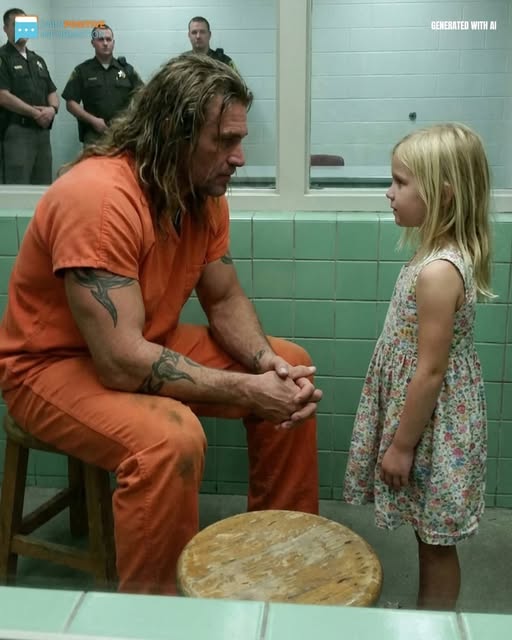
The clock on the wall at the Huntsville Unit read 6:00 a.m., and Daniel Foster had long since stopped counting the days.
For five years, he had marked each one—five years inside concrete walls, five years of sleepless nights staring at the ceiling, five years of insisting on his innocence to a system that never truly listened. The Texas heat pressed heavily against the cell windows, as if trying to suffocate him from the outside, much like the justice system had done from within. Today, the counting would finally end.
In twelve hours, Daniel Foster was scheduled to be executed by lethal injection for a crime he did not commit.
He sat on the edge of his bunk, dressed in the orange jumpsuit that had come to define him, and forced himself to think of his daughter. Emily would be eight now. The last time he held her, she was only three. The last time he saw her in person was during the trial, sitting beside her grandmother—too young to understand why her father sat among strangers who wanted him gone.
At sunrise, the guards approached his cell. Their footsteps echoed down the corridor, silencing the other inmates. Everyone understood what it meant. This was not new.
Daniel stood up calmly. He had given up resisting a long time ago.
“Do you need anything?” one of the guards asked. It was Torres, a younger man who couldn’t quite hide his discomfort.
Daniel paused. Weeks earlier, he had been given the form for his final meal, but he never filled it out. Eating felt meaningless now.
“I want to see my daughter,” he said quietly, his voice rough. “Just once. Before it’s over. Let me see Emily.”
Torres hesitated, clearly affected, then looked at the older guard beside him—Watkins, a man who had witnessed enough executions to become emotionally distant.
“That’s not usually allowed, Foster,” Watkins said, though his tone wasn’t harsh.
“I understand,” Daniel replied. “But I’m asking anyway.”
The request moved slowly through the system, like a fragile hope no one expected to survive. Eventually, it reached Warden Robert Mitchell—a sixty-year-old man whose years at Huntsville had left deep lines on his face.
Mitchell had overseen 147 executions. He had learned how to detach himself, to treat each one as procedure rather than tragedy. But Daniel Foster’s case had always unsettled him.
The evidence had seemed undeniable—fingerprints, blood, a witness placing Foster at the scene. The prosecution had built a flawless case.
And yet, in all their conversations through reinforced glass, Daniel’s eyes never matched those of a guilty man. They held something else—something steady, something that felt like truth ignored.
Mitchell looked down at the execution order on his desk. He thought of his own daughter, now grown and distant, living far away and unwilling to stay in touch. He imagined what it would feel like to face death with only one wish: to see your child one last time.
Slowly, he reached for the phone.
“Bring the child,” he said.
Three hours later, a white state vehicle pulled into the Huntsville Unit parking lot. A social worker stepped out, holding the hand of a small girl. She was eight years old, with blonde hair glowing under the Texas sun and pale blue eyes that had already learned how to be careful.
Emily Foster had spent the past six months in a state-run children’s home. Before that, she had moved between foster families, each trying—and failing—to provide what a traumatized child truly needed. Two years ago, her uncle Michael, her father’s younger brother, had briefly appeared at the social services office, inquiring about guardianship—but lost interest when he realized there was no inheritance to gain.
Emily spoke very little now. Psychologists had labeled it as selective mutism—a coping mechanism in which her mind deemed silence safer than speech. But she drew. Constantly.
She filled page after page with houses, flowers, and dark, abstract shapes the counselors couldn’t interpret, scribbling notes and frowning at the meanings they couldn’t understand.
Her social worker, a kind woman named Rachel who had been working with Emily for four months, wasn’t sure what to expect from this visit. Emily had shown no reaction when told she would see her father—no joy, no fear, only the quiet acceptance of a child who had learned that life rarely asked for her input.
Together, they walked through the prison corridor, Rachel’s hand warm around Emily’s small fingers. Inmates fell silent as they passed—a response Rachel had seen before. A child in a place meant for men convicted of terrible crimes seemed to awaken some dormant conscience, even in the hardest souls.
The visitation room was small and beige, with reinforced windows and a table bolted to the floor. Daniel sat there, shackled at wrists and ankles, wearing the faded orange of death row. He looked smaller than Rachel had expected—worn down by five years of waiting, his hair graying at the temples, his face etched with exhaustion born of endless insomnia.
When he saw Emily, something shifted in his expression that made Rachel’s chest tighten.
“My baby girl…” he whispered, his voice cracking like splintering wood. Tears ran freely, unnoticed.
Emily didn’t flee. She didn’t cry. She walked slowly forward, approaching him as though visiting a memorial, and wrapped her small arms around his neck as far as the restraints would allow.
They held each other.
Rachel stepped back toward the window, giving them privacy. Guards watched through the glass, ready to intervene, but nothing was wrong. A man on death row was quietly weeping into his daughter’s hair, and a child who hadn’t spoken in months was allowing herself to connect without fear.
For a full minute, silence reigned.
Then Emily leaned close to her father’s ear, whispering words only he could hear. Rachel could not make out a thing, nor could any of the guards, but Daniel’s body stiffened. His face drained of color, pale as though someone had opened a valve.
He pulled back, holding her at arm’s length, shackled hands making the gesture awkward, heart-breaking.
“Are you sure?” he asked, each word breaking. “Emily, are you absolutely sure?”
She nodded firmly.
Something unrecognizable—a sound between laughter and sobbing—escaped Daniel. It was the noise of a man whose final thread of hope had been stretched taut, suddenly snapped to life.
He sprang to his feet so abruptly that his chair crashed to the concrete floor. Guards tensed, moving instinctively.
“I’m innocent!” Daniel cried, tears streaming. “I can prove it! I can prove it now!”
The guards advanced, trained and ready, but Daniel did not resist. He was sobbing—desperate, different from the resigned hopelessness they had come to expect from inmates on death row.
“Get the warden!” Torres shouted. “Now! Warden Mitchell!”
Rachel scooped Emily up, the child stiff with shock. Her eyes stayed on her father as he was led away, no longer blank—alive, for the first time in months.
Warden Mitchell watched the scene from the security monitor in his office, Emily’s solemn, certain face frozen on the screen. He sat in silence, fingers steepled before his mouth—a habit he had developed when faced with difficult choices.
Then he reached for the phone and dialed the Texas Attorney General’s office.
“This is Warden Robert Mitchell at the Huntsville Unit,” he said, his voice steady but weighted. “I need to request a 72-hour stay of execution for Daniel Foster.”
A sharp, frustrated voice responded.
“On what grounds? The appeals are exhausted, Warden. We’re forty-eight minutes from final protocols.”
Mitchell closed his eyes.
“New evidence,” he said quietly. “A witness. A child. And I believe we may have convicted the wrong man.”
Two hundred miles away, in a quiet Dallas suburb, where oak trees draped branches over the streets and houses hid like secrets, retired defense attorney Margaret Hayes, sixty-eight, almost choked on her morning coffee.
Margaret Hayes was on her back patio, scrolling through her phone and sipping from a mug that read “World’s Okayest Lawyer”—a gift from one of her grandchildren—when an alert flashed across the screen: EXECUTION HALTED IN FOSTER CASE. NEW EVIDENCE SUGGESTS POSSIBLE INNOCENCE.
After forty-two years of practicing law, Margaret had seen countless cases, won more than she could count, and lost enough to keep some sleepless nights. But one case had haunted her relentlessly—the first one she handled straight out of law school. She had believed in her client’s innocence, and yet her inexperience, her missteps, and her failure to see the full picture had contributed to a wrongful conviction.
She had promised herself that if ever given a second chance, she would approach it differently.
Seeing Daniel Foster’s face on the news—recognizable from the decades-old case she had touched through his uncle Michael—tightened something in her gut. She set down the mug and grabbed her laptop.
Within an hour, she had trial transcripts open, news articles archived, and the prosecutor’s summaries reviewed. Judge Alan Brooks had presided over the case. Conviction based on forensic evidence: fingerprints, blood, eyewitness statements. The scene: a house on Elderberry Lane in suburban Dallas, where Laura Foster, Daniel’s wife, had been found with blunt force trauma. Daniel’s fingerprints and blood were all over the evidence. It had seemed airtight.
But Margaret was skilled at spotting the loose threads that could unravel “airtight” cases. It took her three hours of cross-referencing to notice the first one: Judge Brooks had presided over her uncle Michael’s shoplifting case twenty-eight years ago. Brooks and Michael Foster had personal business ties—a buried real estate investment that had failed in 2006, made through shell companies and spouses’ names.
Margaret dug further. Laura Foster had been a paralegal, diligent and meticulous. In the weeks before her death, she had apparently been investigating financial records—research any competent paralegal could perform thoroughly.
Had she discovered something incriminating?
Margaret called a friend at the Texas Bar Association to get more information about Judge Brooks. Complaints over the years, subtle accusations of bias, hints of impropriety—never enough for formal action, but enough to set her instincts ablaze.
Decisively, she picked up the phone and called the Huntsville Unit.
“This is Margaret Hayes,” she said. “I’m a retired attorney. I need to file an emergency motion in the Daniel Foster case. I have evidence of a serious miscarriage of justice.”
Meanwhile, at the state children’s home where Emily Foster lived, her therapist, Dr. Patricia Nguyen, was reviewing the artwork Emily had produced over the past six months. Seventeen sessions, sixty-three drawings, not a single word spoken. Yet the images told a story her clinical notes could not.
Most drawings depicted a house. Inside, a figure lay on the floor, colored in red or dark purple. A taller figure often stood over them, wearing what looked like a blue shirt. A small figure—Emily—peeked from corners or doorways.
With news of the halted execution, Dr. Nguyen reexamined the drawings. The man in the blue shirt—Michael Foster. Daniel had been reported in a dark hoodie and t-shirt, yet every photo she could find of Michael showed him in a blue shirt.
Dr. Nguyen contacted Margaret.
“I have a child patient whose drawings may be relevant to the Daniel Foster case. With guardianship consent, they should be reviewed.”
“Who has guardianship?” Margaret asked, already suspecting the answer.
“Michael Foster,” Dr. Nguyen confirmed.
Silence.
“Do not send them through official channels yet,” Margaret instructed. “Send them digitally, with timestamp and authentication. We need to keep this tight until we know what we’re dealing with.”
With less than thirty hours left on the paused execution clock, Margaret’s phone rang. The voice on the line was urgent, haunted by years of silence.
“My name is Ethan Reyes,” the man said. “I was the Foster family’s landscaper. I saw what happened that night, and I need to tell someone before Daniel dies for something his brother did.”
Ethan was twenty-three when the attack occurred. He had been trimming hedges in the backyard when he heard shouting. Brave, reckless, and naive, he had gone inside.
He found Michael Foster over Laura Foster with a lamp base raised. Laura lay bleeding, one arm raised to shield herself. In the hallway, seven-year-old Emily watched, frozen in terror.
“Stop!” Ethan shouted. Michael hesitated—the only reason Laura survived.
Michael had already planned backup. He had contacted Judge Brooks, leveraging personal ties. Brooks instructed him with chilling precision: make sure Daniel arrived and evidence was staged.
Daniel, trusting his brother, arrived home to a scene orchestrated to implicate him. Ethan, however, had removed Laura, driven her to a hospital three towns over under a false name, and fled, terrified. He kept records, receipts, a diary, and recordings of what had happened.
“I went back three days later,” Ethan told Margaret. “I left a recorder running in my truck while parked outside Michael’s house. I needed to know exactly what happened.”
“That’s insane,” Margaret said. “And probably inadmissible. But it’s also incredibly brave.”
“Listen first,” Ethan urged. “Then you decide if it’s admissible.”