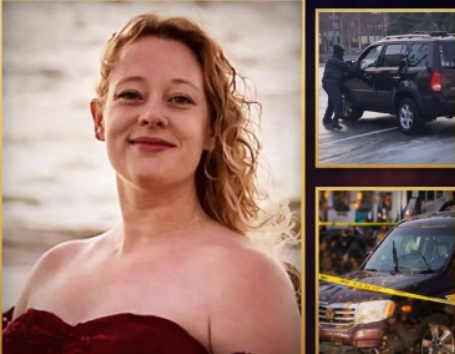
A mother’s life ended in a sudden, terrifying burst of gunfire on what should have been an ordinary, quiet street in Minneapolis. A federal “targeted operation,” intended to enforce the law, turned fatal in a matter of seconds. Neighbors who had stepped outside for the crisp winter air watched in horror as a burgundy SUV, its windshield shattered and riddled with bullet holes, careened into a nearby pole. The official line from authorities was swift and precise: self-defense. Yet the witnesses on the ground, those who saw the terror and desperation in Renee Nicole Good’s final moments, called it something else entirely—murder, an overreach, a tragedy that could have been prevented. Reports circulated that a nearby doctor was even stopped from giving CPR as federal agents secured the scene, a stark image that only deepened the community’s outrage. Friends, neighbors, and passersby were left in stunned silence, struggling to reconcile what they had seen with what officials insisted had happened.
In the days following the shooting, the name behind the headlines began to take shape: 37-year-old Renee Nicole Good. She was a poet, a guitarist, a member of the LGBTQ+ community, a wife, a mother, and a woman whose life had only recently found roots in Minneapolis. Her home was just blocks from the intersection where she was killed, a place she had begun to weave into the fabric of the neighborhood. Online, Renee presented herself as a gentle, creative soul, a woman who used words to connect, inspire, and bring joy—not someone poised to confront armed federal officers in a deadly standoff. Her poetry had earned recognition at the university level, her music brought happiness to friends and family, and her everyday gestures—sharing cookies, offering a smile, lending an ear—spoke of someone who gave more than she ever took.
Her mother, Donna Ganger, struggled to make sense of the violence that had stolen her daughter. “It was so stupid,” she said, voice trembling with grief and disbelief. Donna insisted that Renee was terrified in those final moments, not threatening anyone, her actions driven by fear and instinct, not aggression. The family’s grief was compounded by the knowledge that Renee’s six-year-old son would now grow up without either parent, his father having died years earlier. Neighbors recalled the warmth of both mother and child, the small acts of love and care that had defined Renee’s presence in the neighborhood. As flowers, candles, and handwritten signs began to pile up near the light pole where her SUV had crashed, the grief of the community hardened into anger, a mix of sorrow and indignation that refused to dissipate.
This anger quickly raised larger questions, far beyond one life lost. How do ICE operations, with heavily armed agents, fit into the everyday streets of a city like Minneapolis? What authority allows federal officers to act with such lethal force in residential neighborhoods? Who is protected when officers claim self-defense while a terrified woman lies dead on the pavement? The incident reignited long-standing debates about the presence of federal law enforcement in local communities and the consequences of aggressive tactics that risk civilian lives. Each candle lit, each sign propped against the light pole, became a symbol of these questions, a public assertion that the life of Renee Nicole Good cannot be dismissed as collateral damage in the machinery of law enforcement.
As the city grapples with the aftermath, the tragedy of Renee’s death serves as both a personal and collective reckoning. For her family, it is an irreplaceable loss. For the neighbors who witnessed the event, it is a trauma that cannot be unseen. And for the wider community, it is a stark reminder of the tension between federal authority and local humanity, between procedure and compassion, and between narratives written in official statements and the truths lived in real life. Renee Nicole Good’s life—her poetry, her music, her love, her care—was abruptly ended, but the questions her death raises, and the outrage it inspires, continue to echo across Minneapolis and beyond, demanding accountability, transparency, and the recognition that every life lost carries profound weight.