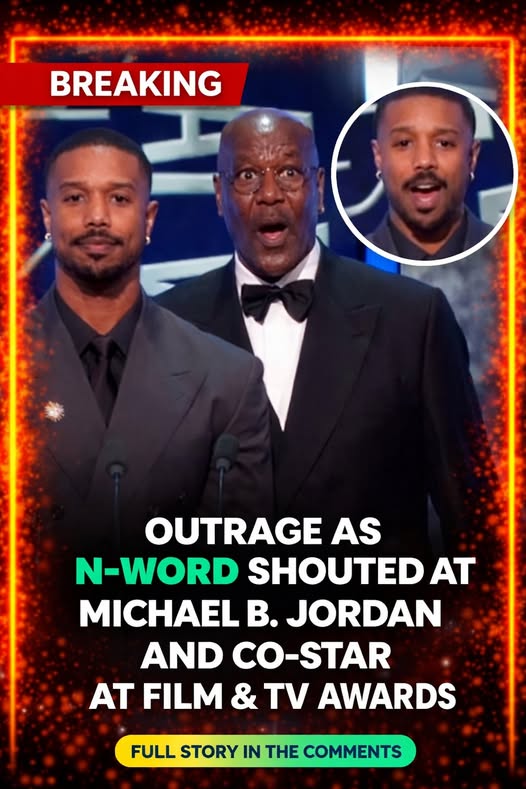
The room froze. Michael B. Jordan stood under the bright stage lights, the cameras rolling, the eyes of the world focused on him, when a single, explosive sound shattered the polished calm of the BAFTA ceremony. A racial slur—harsh, raw, and impossible to ignore—sliced through the silence. It was not supposed to happen, not in a room designed for celebration and recognition, not in a hall where decades of actors, directors, and creators had come to honor their peers. And yet, there it was: the word that had the power to wound, to provoke, to haunt.
The voice came from an unexpected source: John Davidson, a well-known activist and a celebrated campaigner for Tourette syndrome awareness. The outburst was involuntary, a tangle of nerves and muscle control, but in that moment it felt like every person present had been thrown into a whirlwind of shock, confusion, and anger. Cameras panned, whispers rose, and the audience sat stunned, trying to reconcile the elegance of the event with the sudden eruption of raw, uncomfortable truth. Michael B. Jordan froze mid-presentation; Delroy Lindo’s smile faltered as they struggled to maintain the ceremony’s rhythm amid the chaotic intrusion.
What unfolded at London’s Royal Festival Hall was more than a disruption—it was a collision of two brutal realities. On one side, the immediate, visceral pain of hearing a racial slur in a prestigious, public setting; on the other, the devastating, often misunderstood truth of Tourette syndrome: for some individuals, the worst words imaginable can escape involuntarily, beyond their control, beyond their intent. The slur, uttered by Davidson, was not a choice, yet the impact on the audience, on viewers around the globe, was undeniable. Within seconds, the moment rippled through social media, news outlets, and public discourse, becoming a flashpoint for outrage, debate, and confusion.
Alan Cumming, one of the event hosts, paused the ceremony to address the audience directly, explaining carefully and compassionately that the slur had originated from involuntary tics linked to Tourette syndrome, not from malice. The BBC followed with an official statement and apology, emphasizing that Davidson’s words were unintentional and beyond his control. But even with explanation and context, outrage surged online. Many found the distinction impossible to accept, unable or unwilling to reconcile the deeply hurtful nature of the word with the reality of a neurological disorder. Threads erupted, opinions clashed, and the debate grew almost as fast as the viral video clips circulated.
At the heart of the controversy sits a profoundly difficult question: how do we acknowledge and condemn language that is inherently harmful, while simultaneously recognizing and protecting individuals whose condition forces them, without choice, to vocalize those same words? The situation challenges society to balance empathy with accountability, to understand the difference between intent and impact, and to confront the discomfort of learning that the world is not always easily categorized into right and wrong. It is a rare, unsettling moment that forces a collective pause: how do we hold space for both those who suffer from involuntary conditions and those who are harmed by the words they produce?
Beyond the immediate chaos, the incident sparked wider conversations about awareness, representation, and the nuances of disability. Experts in neurology and psychology began weighing in, explaining the mechanisms behind coprolalia—a condition in which individuals involuntarily utter socially taboo or offensive words. Activists stressed the importance of education and understanding, noting that sensationalizing these moments without context risks deepening stigma. Meanwhile, social media debates underscored the persistent tensions in society’s relationship with language, intent, and harm, highlighting how moments of involuntary action are often interpreted as deliberate misdeeds in the court of public opinion.
In the end, the BAFTA incident became more than a viral news story. It was a reflection of how society grapples with complexity: the simultaneous presence of harm and innocence, offense and disability, shock and education. For Michael B. Jordan, Delroy Lindo, and the audience that evening, it was a lesson in navigating an uncomfortable truth with grace. For the wider public, it became a prompt to reconsider assumptions about responsibility, compassion, and the limits of human control. And for John Davidson, it was a moment that reminded everyone that living with Tourette syndrome can be unpredictable, public, and misunderstood—but also profoundly human, deserving of patience, understanding, and dignity.