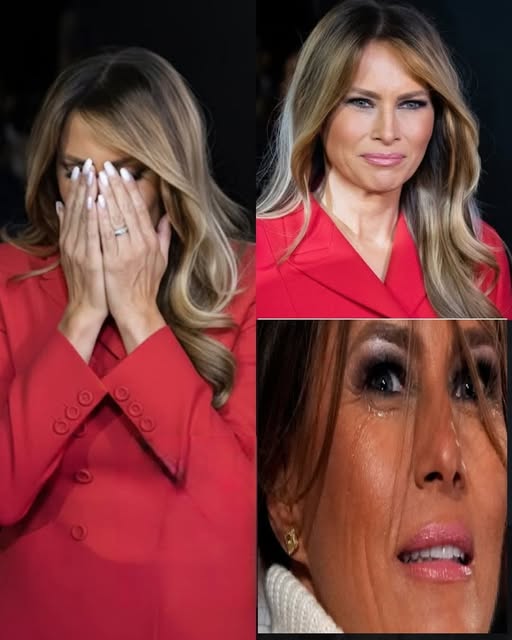
The assassination of Charlie Kirk shook the entire country, but what affected people the most was not just the magnitude of the tragedy—it was the deeply human response that followed. Inside Utah Valley University, where the unthinkable happened before thousands of people, the initial horror was impossible to ignore. Over 3,000 people witnessed a moment that would forever divide their lives into “before” and “after.” A public space became the scene of loss, and for many, the reality of what happened only truly hit later—when the noise faded and the weight of the event settled in.
In the days that followed, statements came from public figures, commentators, and officials. Many spoke in familiar terms—about politics, influence, ideology, and legacy. But it was Melania Trump’s message that stood out. Her words did not follow the usual tone of public reactions. She did not focus on debates or divisions. She did not try to frame the moment through policy.
She spoke about loss.
Her tribute was quiet, measured, and deeply personal. It did not attempt to define Kirk solely as a public figure, even though that is how many people knew him. Instead, she shifted the focus to his private life—his family. She portrayed him not as a political figure, but as a man: a husband, a father, someone whose absence would not be measured in headlines, but in silence.
She spoke of children who would now grow up searching for their father in fragments—through family stories, photographs held tightly, memories repeated to keep him alive. She described a home that would never sound the same again, where ordinary moments—footsteps in the hallway or a voice calling from another room—were gone, replaced by a heaviness that could not easily be filled.
It was precisely this image that stayed with people.
Not the public figure on stage, but the private life interrupted. The routines that disappear overnight. The laughter replaced by a quiet that lingers.
Melania did not dramatize this. She did not need to. The simplicity of her words made them all the more powerful.
She described a man who came home after long days—not perfect, but present. A father who stopped to listen, a husband who understood the importance of family. A person who lived beyond the headlines.
In doing so, she changed the way people saw him.
For many, Charlie Kirk had been a public voice, a figure with strong opinions. But her message brought him into a more human space—inside a family, in a fragile and irreplaceable reality.
And that shifted the conversation.
Because when you see someone this way, it becomes harder to reduce them to a symbol.
Her tribute did not ignore his public impact, but it refused to make that the only story. She reminded people that behind every public figure exists a private life that continues, regardless of the world’s attention.
She spoke about the cost of violence not as a statistic or a talking point, but as a wound that spreads—affecting lives in ways that cannot be fully measured.
A family changed forever.
Children growing up with unanswered questions.
A home where absence is felt in every corner.
What made her message so powerful was not just what she said, but what she didn’t say. There was no division, no attempt to deepen existing rifts. Instead, she made a simple yet strong appeal:
Pay attention to each other.
See the humanity that exists before labels, disagreements, or the distance that public life creates. Her words suggested that moments like this are not just tragedies to mourn, but lessons to understand.
That the cost of not seeing each other clearly can be greater than expected.
It was a shift from reaction to reflection.
And it made people pause.
In a world where events are processed quickly and replaced by the next headline, her message lingered. Not through noise, but through truth that is hard to ignore.
The idea that every life, no matter how public, is built on private moments.
That absence is not abstract.
It is real, immediate, and deeply personal.
As the country continues to process what happened, the memories of that day remain vivid for those who were there. But alongside them now are her words.
Not as a conclusion, but as a lens through which to understand loss.
Because what she offered was not just a tribute.
It was a reminder.
That behind every headline is a human story.
That behind every name is a network of relationships that do not end when the news cycle moves on.
And that sometimes, the most powerful response is not the loudest one—but the one that brings everything back to what truly matters.
In the end, her message did not try to answer every question or resolve every tension. It did something more grounded and profound.
It asked people to look at each other differently.
To understand what can be lost.
And to realize that the time to do so is not after tragedy strikes—but before.