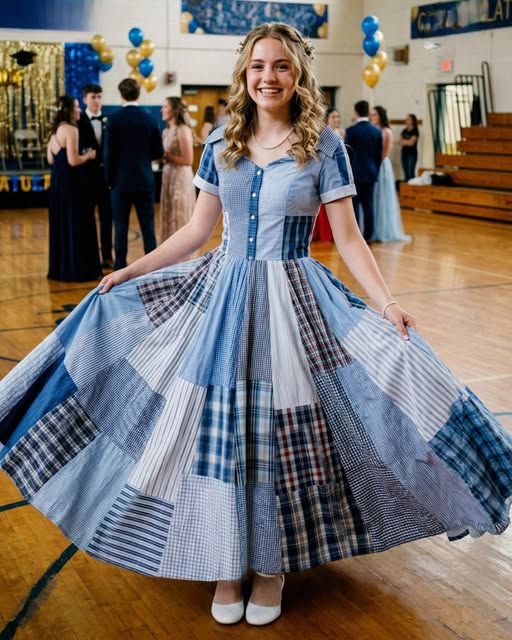
It was always just the two of us. My father, Johnny, was a man of simple needs and a remarkably big heart. My mother died giving birth to me, leaving him to figure out everything alone—braiding hair, packing lunches, and telling bedtime stories he learned through trial and error. He worked as the school janitor, which made me an easy target. I grew up hearing whispers like, “That’s the janitor’s daughter,” and worse. I never cried where anyone could see, but Dad always noticed. He’d just remind me that people who make themselves feel big by making others feel small usually don’t have much worth carrying inside them.
When he was diagnosed with cancer during my junior year, his only goal became seeing me go to prom. “I just want to see you walk out that door like you own the world, princess,” he’d say, even on days when he had to steady himself on his mop handle. He didn’t make it. He passed away a few months before prom, leaving me with a box of worn work shirts and a silence I didn’t know how to hold.
Prom season came anyway, full of expensive dresses, rented cars, and conversations I no longer felt part of. Until I opened that box. Blue shirts, gray ones, even the faded green one he wore the day he taught me to ride a bike—all of them carried pieces of my life with him. With the help of my aunt Hilda, I decided to turn them into something I could carry forward. We carefully deconstructed his clothes and stitched them into a dress. It wasn’t just fabric—it was memory, routine, comfort, and love, all sewn together.
The night of prom, I tried to stand tall. But the moment I walked into the venue, I felt the shift. Whispering started almost immediately. “Is that made from janitor uniforms?” someone laughed. Another voice followed, sharper: “Couldn’t afford a real dress?” The laughter spread quickly, and suddenly I was surrounded by it. I tried to explain, tried to say it was for my father, but no one wanted to listen. I ended up near the edge of the room, blinking back tears I refused to let fall, feeling like that same little girl again—the one who was made to feel small because of what her father did for a living.
Then the music stopped.
Our principal, Mr. Bradley, stepped forward with a microphone. The room went quiet, uneasy. He looked directly at me before he spoke. Then he told them about Johnny—not as the janitor they assumed they knew, but as the man who stayed after hours fixing broken lockers so students wouldn’t lose their things, who repaired backpacks for kids who couldn’t afford new ones, who quietly washed and mended uniforms so no student had to feel embarrassed in front of their peers.
“This dress isn’t made from rags,” he said firmly. “It is made from the shirts of a man who spent years taking care of this school in ways most of you never noticed.”
Then he asked a simple question: “If Johnny ever helped you, fixed something for you, or did something kind for you without being asked—please stand.”
At first, only one student rose. Then another. Then a teacher. Then more. Until half the room was standing in silence, realizing something they had never thought about before: how many small moments of kindness they had taken for granted. The laughter was gone, replaced by a heavy, humbled stillness and then applause—slow at first, then growing.
The people who had mocked me couldn’t meet my eyes anymore. And for the first time all night, I wasn’t shrinking. I was standing in the center of something bigger than humiliation.
I had come to prom trying to honor my father. But in the end, I understood something even deeper: he hadn’t just raised me. He had quietly made himself unforgettable to everyone around him. And standing there in his work stitched into my dress, I realized I wasn’t the janitor’s daughter.
I was his legacy.