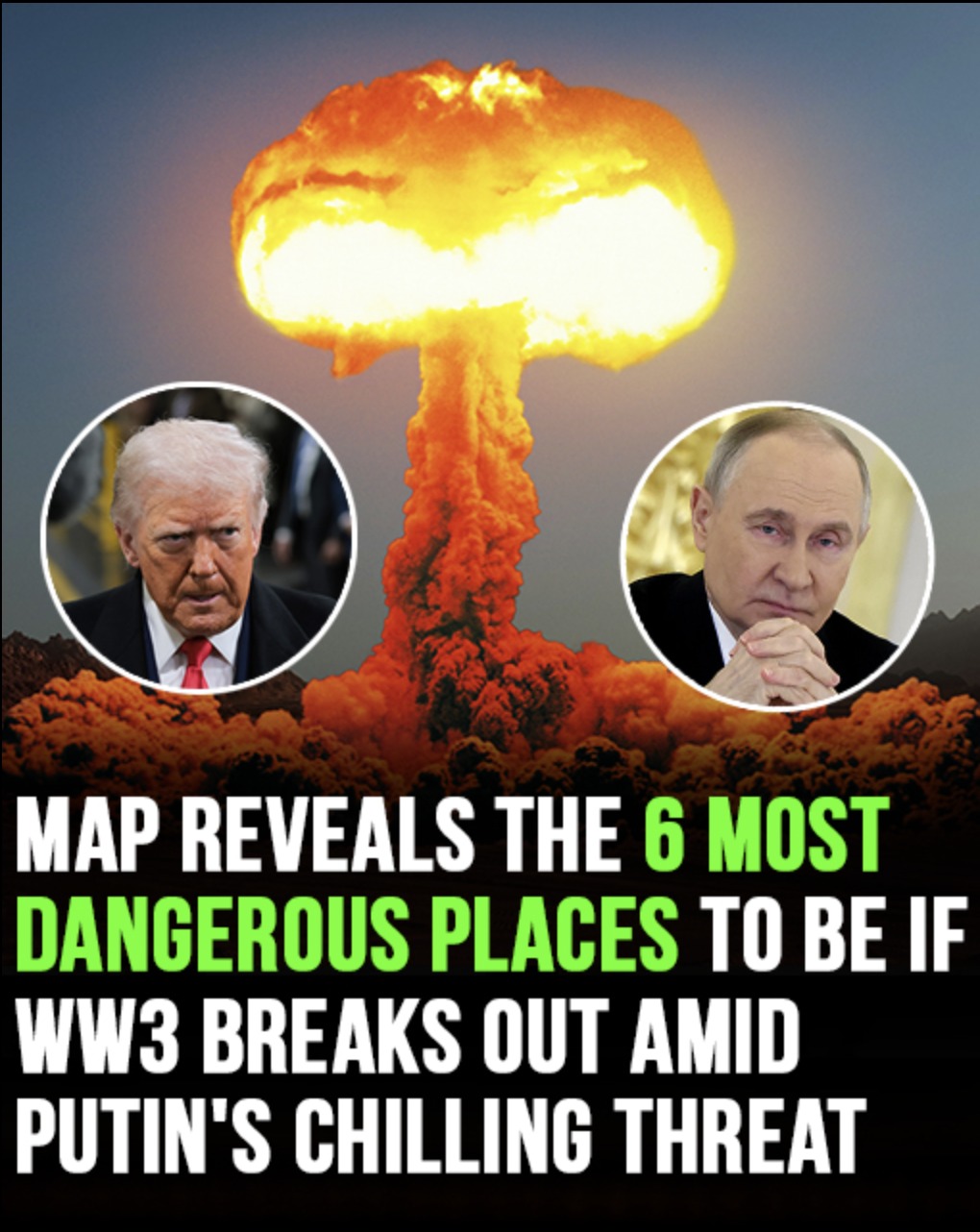
Anyone who understands modern warfare clearly knows that a third world war would benefit no one. There would be no winners, no rebuilding phase to restore balance, and no far-off battlefield to spare civilians. In a world equipped with nuclear weapons, hypersonic missiles, cyber warfare, and autonomous systems, a global conflict wouldn’t be measured in territory gained but in cities erased and lives forever altered.
The threat today isn’t one single crisis, but the accumulation of many. Regional conflicts overlap, alliances harden, rhetoric escalates, and trust crumbles. Every new flashpoint increases the risk of miscalculation. History teaches us one thing: world wars don’t start because everyone wants them. They begin when one decision, made under pressure or ego, sets off consequences that can’t be undone.
If World War III were to break out, no place on Earth would be truly safe. Modern warfare knows no borders, and nuclear fallout doesn’t respect neutrality. However, certain regions would face far greater danger due to military concentration, strategic importance, or long-standing geopolitical tensions. Based on the current global landscape, these are among the most dangerous places to be if a global conflict were to occur.
The United States would almost certainly be at the epicenter of any world war. As the world’s most powerful military force and a key NATO member, the U.S. would be both a primary actor and a primary target. The country hosts hundreds of military bases, nuclear command centers, and strategic infrastructure sites that would be prime targets in a large-scale conflict. Major metropolitan areas, especially those tied to defense, technology, or governance, would face elevated risks.
Concerns are amplified by the unpredictable nature of leadership and political polarization. Under Donald Trump, U.S. foreign policy was often seen as aggressive and transactional, heightening fears of rapid escalation during crises. While leadership may change, the U.S.’s global role ensures it cannot remain insulated from a world war.
The Middle East remains one of the most volatile regions, with Iran at the center of many of those tensions. Ongoing disputes over nuclear development, past U.S. military interventions, proxy conflicts, and internal instability place Iran in frequent confrontation with both regional and global powers. Any major escalation involving Iran would likely draw in allies and adversaries quickly, turning a regional conflict into a global one.
Tied to this instability is Israel, which faces constant threats due to its geopolitical position. The long-running conflict with Palestine, hostility from neighboring states, and prior missile exchanges with Iran keep Israel in a state of near-constant military readiness. While Israel alone might not trigger a world war, any significant escalation involving it would almost certainly involve the United States and other global powers, widening the conflict dramatically.
Eastern Europe has reemerged as a high-risk zone following Russia’s invasion of Ukraine. Russia is already in active warfare, reshaping global alliances and reviving Cold War-style tensions. Russian leadership, including Vladimir Putin, has repeatedly referenced readiness for confrontation with NATO and has openly discussed nuclear deterrence.
A direct confrontation between Russia and NATO would be one of the most dangerous scenarios imaginable. Russia’s vast nuclear arsenal and strategic doctrine mean that escalation could happen swiftly, leaving little room for de-escalation once hostilities begin.
In East Asia, Taiwan stands as one of the most precarious flashpoints. The Chinese government has repeatedly declared reunification with Taiwan is inevitable, and military pressure continues to increase. Xi Jinping has made it clear that force remains an option.
In the event of a broader global conflict, many analysts believe China could use the distraction as cover to move militarily against Taiwan. The consequences would be immediate and global. Taiwan plays a critical role in semiconductor manufacturing, global trade routes, and regional security. Any conflict there would send shockwaves through global markets, supply chains, and military alliances.
Another unpredictable and dangerous player is North Korea. While more isolated than other powers, North Korea remains heavily militarized and highly volatile. Its ongoing missile tests, nuclear developments, and growing ties with Russia make it a wildcard in any global conflict. If drawn into a world war—directly or indirectly—North Korea would be extremely dangerous, both to its population and its neighbors.
What makes World War III particularly terrifying is that it would not resemble previous global wars. There would be no clear frontlines, no gradual mobilization, and no safe distance from the violence. Cyberattacks could cripple infrastructure before a single missile is launched. Communication systems could fail. Civilian populations would be exposed immediately.
The notion of “safe zones” becomes almost meaningless in such a scenario. Neutrality offers no protection from fallout, economic collapse, or global supply disruptions. Even countries far from major military targets would feel the effects—through food shortages, financial instability, and environmental damage.
The world has seen fragments of this path before. Every generation believes it is wiser than the last, but the same patterns repeat: rising nationalism, erosion of diplomacy, and the belief that force can solve what dialogue cannot. The difference now is scale. The tools available today make past wars seem restrained by comparison.
The hope, of course, is that leaders understand what’s at stake. That restraint prevails over pride. That diplomacy outpaces destruction. But hope alone does not prevent war. Awareness, accountability, and global pressure are the true preventatives.
World War III would not be a distant event seen on screens. It would be immediate, personal, and irreversible. The regions most entangled in military power and geopolitical rivalry would face the greatest danger, but the consequences would touch every corner of the globe.
The uncomfortable truth is that avoiding such a future requires more than fear. It requires leaders who are willing to step back from the edge—and a global public that refuses to normalize the march toward catastrophe.