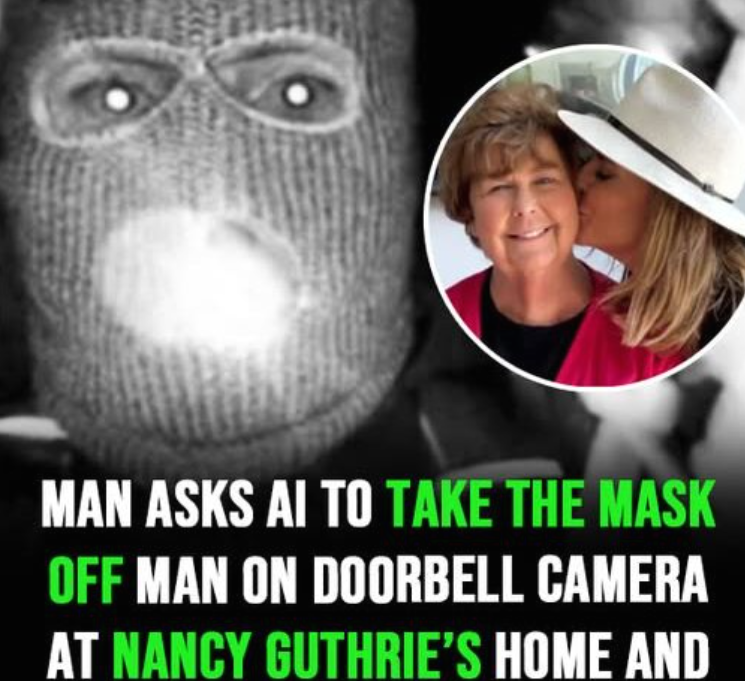
The search for Nancy Guthrie, mother of Today co-anchor Savannah Guthrie, has now entered its second week, and concern continues to mount among family, friends, viewers, and the broader public. What began as a deeply distressing personal crisis has evolved into a matter of national attention, as investigators work tirelessly to gather clues, canvass neighborhoods, and review every available piece of evidence. Public interest has intensified, particularly after surveillance footage from a doorbell camera, which captured a masked figure outside Nancy’s residence in Tucson, Arizona, was released to the public. The footage has fueled both speculation and fear, highlighting the uncertainty surrounding the case and leaving the Guthrie family in a prolonged state of emotional strain.
Authorities have confirmed that the footage is actively being analyzed as part of the ongoing investigation. Despite the public release, the identity of the masked individual remains unknown, and law enforcement has not publicly named any suspects. Investigators have emphasized the importance of verified information over conjecture, warning that online theories, while widespread, carry no weight in the official pursuit of justice. They have urged anyone with credible details to come forward, reinforcing that the investigation remains active and that every lead must be carefully corroborated before action can be taken.
Amid this uncertainty, a controversial and widely discussed development has emerged from outside official channels. A YouTuber operating under the name Professor Nez published a video claiming to use artificial intelligence to digitally “remove” the mask from the individual captured in the doorbell footage. The video rapidly circulated online, drawing both fascination and criticism, as viewers debated the accuracy and ethical implications of using AI in an ongoing criminal investigation. The clip demonstrates how modern technology allows private individuals to attempt digital reconstructions of partial or obscured images, blurring the line between investigative curiosity and potential misinformation.
In the video, Nez explained that he employed generative AI software to produce what he described as a possible visualization of the masked figure’s face. The resulting image, he claimed, resembled a man identified as Dominic Aaron Lee Evans, whom he described as a longtime friend and former bandmate of Tomasso Cioni, the husband of Annie Guthrie and Nancy’s son-in-law. “What you see on the screen right here is AI putting a mask on Dominic Aaron Lee Evans,” Nez stated during the video, asserting that the facial reconstruction bore similarities to the masked individual captured on camera.
Nez highlighted several features, including eyebrow shape, eye spacing, and facial hair, claiming that the likeness was “eerily similar.” “That is very eerily similar… if you look at the facial hair on the chin there, you look at the eyes and the eyebrows, that is eerie,” he said, suggesting that the AI-generated image provided a plausible approximation of the individual behind the mask. According to Nez, the process relied on Grok AI software, which he described as “really, really accurate as far as what the individual may look like,” emphasizing the power and precision of modern AI in generating visual content from incomplete information.
Despite the video’s popularity, it is critical to note that law enforcement agencies have neither verified nor endorsed the AI-generated reconstruction. Authorities have not identified any suspects in connection to Nancy Guthrie’s disappearance and have made clear that the masked figure remains officially unknown. Experts in AI and digital forensics caution against treating such images as definitive evidence, noting that generative AI systems operate through pattern recognition and probability rather than actual verification. When working from low-resolution or partially obscured footage, AI reconstructions can produce images that look convincing while remaining speculative and potentially misleading.
The distinction between digital reconstruction and forensic identification is crucial. While AI tools can approximate likely appearances, they are not equivalent to methods used by trained investigators, such as biometric analysis, fingerprinting, or DNA confirmation. Relying on AI-generated imagery in a criminal investigation can result in false leads, reputational damage, and interference with official procedures. Law enforcement has repeatedly stressed that investigative rigor requires corroboration across multiple forms of evidence, including witness testimony, physical traces, and controlled analysis, none of which can be replaced by speculative AI outputs.
Public reaction to the YouTube video has been sharply divided. Some viewers expressed amazement at the side-by-side comparison, describing it as “uncanny” and compelling. Others warned that spreading AI-generated identifications without official verification could unfairly implicate private individuals and contribute to misinformation. The case has sparked broader debate about the role of generative AI in public investigations, highlighting both its technological capabilities and the ethical responsibilities that come with its use. As AI becomes more accessible, private citizens are increasingly experimenting with image enhancement and identity speculation, raising questions about the impact on ongoing legal proceedings and public perception.
Law enforcement continues to urge the public to prioritize verified information over digital reconstructions or speculative claims. Unlike the AI-generated image circulating online, official identifications are derived from stringent forensic analysis and corroborated evidence, ensuring that investigative standards are met while protecting the rights of victims and potential suspects. Investigators have reiterated that the search remains ongoing, and aside from the original doorbell footage, no additional identifying materials have been released publicly. Police continue to follow leads and request that anyone with concrete information contact authorities directly.
For Nancy Guthrie’s family, the continued uncertainty has been emotionally exhausting. Friends, viewers, and community members have rallied in support, sharing messages of hope and solidarity. Savannah Guthrie, though maintaining a private stance, has benefited from widespread public empathy and encouragement on social media platforms. The involvement of AI in the public narrative has added a new layer of stress, as well as scrutiny, emphasizing the growing tension between technological possibility and responsible application in sensitive matters.