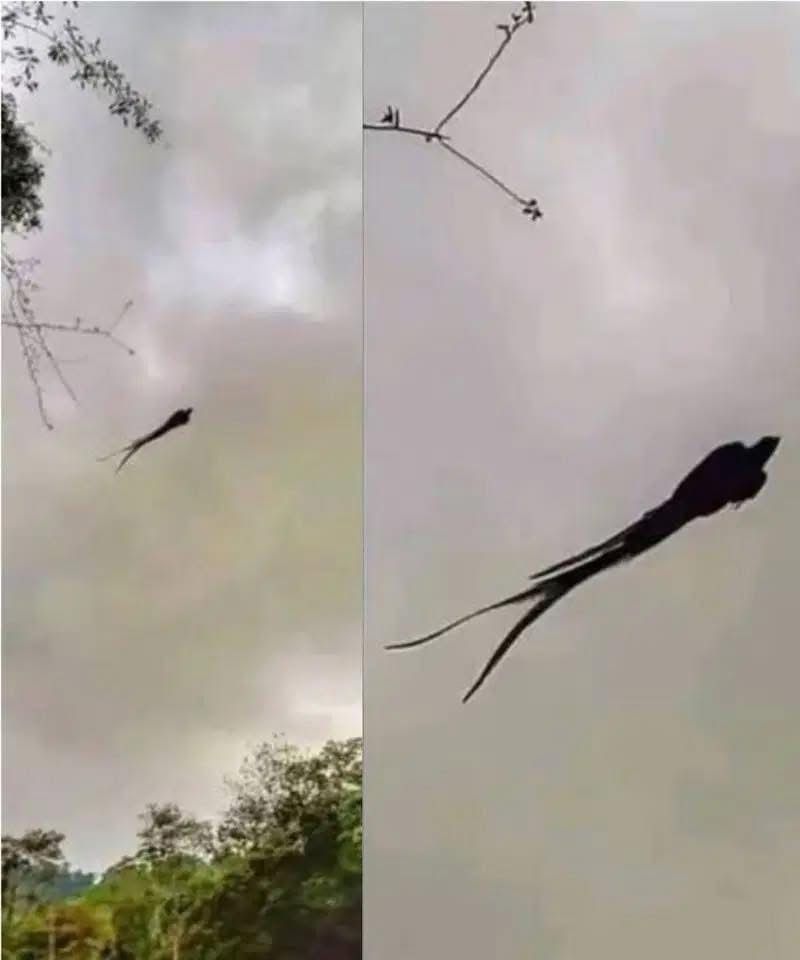
Hidden within the misty cloud forests of Southern Mexico and Central America, a luminous presence moves silently among the treetops—a creature that carries the echoes of ancient civilizations and the urgent hopes of modern conservation. This is the Resplendent Quetzal, a bird whose beauty feels almost unreal, as though it were shaped more by myth than by nature itself. For thousands of years, the quetzal has existed as a sacred link between the earthly and the divine, standing at the threshold where human history and the spiritual world meet. Encountering a quetzal in its natural habitat is not simply an act of birdwatching; it is an encounter with living history, a symbol of Mesoamerican identity that continues to inspire awe through its radiant colors and effortless grace.
The quetzal’s legacy is deeply embedded in the myths and beliefs of ancient Mesoamerican cultures. Among the Maya and the Aztecs, it was regarded not merely as an animal, but as a sacred emissary of the gods. Its name comes from the Nahuatl word quetzalli, meaning “precious” or “upright,” a reference to the male’s extraordinary tail feathers. The bird was sacred to Quetzalcóatl, the Plumed Serpent deity who embodied the unity of sky and earth. The quetzal’s shimmering green plumage symbolized renewal, fertility, and the life-giving forces of rain and sunlight. Killing a quetzal was strictly forbidden and punishable by death. Instead, the Maya practiced a ritual of reverence: they would briefly capture the bird, gently remove a few of its long tail feathers for ceremonial regalia, and then release it unharmed. This tradition reflected a worldview rooted in respect for nature—one in which sacred beauty could be borrowed, but never owned or destroyed.
In appearance, the Resplendent Quetzal seems almost impossibly refined. The male’s vivid red chest contrasts strikingly with his luminous green upper feathers, which do not derive their brilliance from pigment but from microscopic structures that refract light. As a result, the bird’s color shifts fluidly from emerald to turquoise and even gold depending on the light. Most remarkable are the elongated twin tail streamers, which can grow up to three feet long during the breeding season. When the quetzal launches itself from a high branch and glides through the fog, these flowing feathers trail behind like ribbons, creating the illusion of a serpent moving through the air. This breathtaking sight likely gave rise to legends of winged gods. The female, by contrast, wears more subdued tones of gray and green, allowing her to blend into the moss-covered trees as she guards the nest—an elegance rooted in survival rather than display.
In contemporary culture, the quetzal has taken on new symbolic associations. Some observers have likened its drifting silhouette to the Dementors of the Harry Potter universe—not because of darkness, but due to its silent, floating motion through the forest air. Yet unlike fictional creatures, the quetzal’s existence is precarious. It is highly specialized, dependent on the fragile cloud forest ecosystem where mountain air and tropical moisture create a permanent veil of mist. These forests provide the quetzal with wild avocados, its primary food source, and decaying trees needed for nesting. As deforestation advances due to logging and agricultural expansion, this delicate habitat continues to shrink, forcing the quetzal into increasingly isolated refuges.
One of the most powerful elements of the quetzal’s identity is its association with freedom. For centuries, it has been revered as a symbol of liberty, rooted in the belief that the bird cannot survive in captivity. Historically, captured quetzals often refused food, dying rather than living confined—a behavior that cemented its reputation as a creature that chooses death over imprisonment. Though modern conservation facilities have occasionally managed to sustain them under controlled conditions, the idea of the quetzal’s refusal to live in a cage has endured as a potent metaphor. Throughout Latin America, it represents resistance, dignity, and the unbreakable desire for freedom. This symbolism is enshrined in Guatemala’s national identity, where the quetzal appears on the flag and lends its name to the national currency, serving as a constant reminder that freedom is priceless.
Today, the quetzal’s survival has become a central focus for conservationists. Protecting this species requires more than preserving isolated forest patches. Because quetzals migrate across different elevations throughout the year in search of fruit, conservation efforts must establish continuous biological corridors that allow safe movement across the landscape. These initiatives safeguard not only the quetzal but entire ecosystems—orchids clinging to ancient trees, insects pollinating rare plants, and large mammals navigating the forest floor. In this way, saving the quetzal also means preserving an irreplaceable archive of biodiversity and cultural heritage.
Ultimately, the Resplendent Quetzal invites humanity to pause and reflect. It urges us to see the natural world not merely as scenery, but as a living repository of history, spirituality, and meaning. Whether admired by a Mayan priest centuries ago or photographed by a modern traveler today, the quetzal commands reverence. It reminds us that wonder still exists within the mist, and that some forms of beauty must remain untouched to retain their power. In an age defined by environmental uncertainty, the quetzal stands as a luminous guardian of the skies—an emerald symbol urging us to protect freedom, honor the sacred, and preserve the fragile wonders that continue to inspire the human soul.