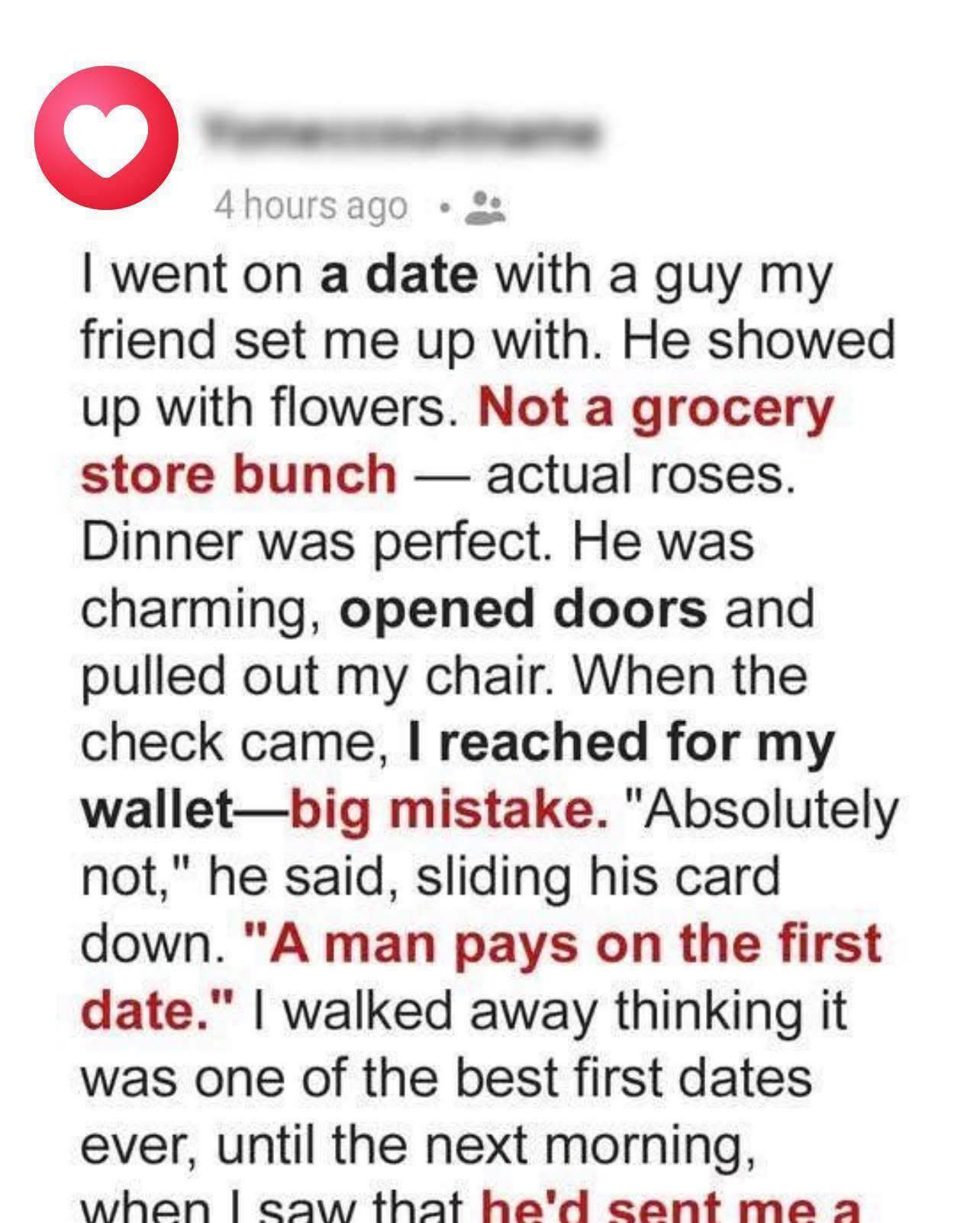
He itemized my body like a business expense. The “Date Night Invoice” should’ve been a joke—but it wasn’t. Every line was a price on my time, my touch, my existence. Each detail felt like a cold calculation, a devaluation of everything I am. It wasn’t just about money—it was about reducing me to a set of measurable actions, like a transaction between two parties who had nothing to offer beyond what was “owed.” It was as though the time we spent together, the connection we shared, had no inherent worth. It had to be quantified, turned into a list of prices, as if love, affection, and intimacy could somehow be reduced to an itemized list of goods and services. The price tags weren’t just on physical things; they were on my very essence, my energy, the way I give of myself to someone else.
I thought I was overreacting. I thought I was just being dramatic, emotional—perhaps I had misread the situation. After all, who would really treat a relationship like a ledger? But then, in the quiet aftermath, the whispers started. “Me too,” they said. It wasn’t just a passing moment; it was a quiet truth that had been simmering beneath the surface for too long. Suddenly, I realized this wasn’t about one man’s misguided behavior—it was about a much larger issue, something that ran deeper than I had ever anticipated. It was about the quiet, creeping belief that affection is a commodity, that love and connection are just another exchange in a world that thrives on transactions. It wasn’t just about him—it was about the wider culture that normalizes this kind of emotional calculus. It was about how many of us—especially women—have been conditioned to measure our worth against the demands and expectations of others, to constantly prove our value in ways that make us feel small, less than, disposable.
I didn’t pay his invoice; I paid attention. And what I saw was chilling. That spreadsheet wasn’t just a joke, it was a reflection of something much darker. It exposed the way romance and affection had been stripped of their depth and reduced to mere transactions. The romance of our evening, the tenderness of our connection, was wiped away in an instant, replaced by something colder—an unspoken, but deeply ingrained, belief that affection is an investment. It’s an asset that must always yield returns, a currency with a defined exchange rate. And once I saw it, I couldn’t unsee it. It wasn’t just him. I began to notice it in every relationship I had ever been in, every conversation I had overheard, every unspoken rule that governed how we interact with one another. It was in the texts, the tone of voice, the subtle ways people put a price on their time and effort. I saw it in the way past lovers had treated me, in the way some friends had treated me—like I owed them something simply because I existed. And the more I thought about it, the more I realized how this dynamic is so deeply ingrained in our culture. It wasn’t just in romantic relationships; it was in friendships, in workplaces, in every corner of society where women are expected to give more, do more, and ask for less. Where we are taught to believe that our worth is always negotiable, always up for debate.
And then came Chris’s counter-invoice. It was like a flare shot into the dark. It illuminated the truth that so many of us had quietly absorbed, like some form of emotional osmosis. His invoice wasn’t just a response to Eric’s; it was a declaration. It was a stand, a refusal to accept the narrative that we, as women, are commodities to be priced and evaluated. Chris’s invoice didn’t just call out one man’s behavior—it called out an entire system of thinking, a pattern of behavior that has been ingrained in us for generations. It was an invitation to examine how we, as a society, have allowed men to feel entitled to our time, our affection, and our emotional labor. The way we have been conditioned to accommodate, to please, to serve without asking for anything in return. And that moment—the moment I saw Chris’s response, the way it reframed everything—was the moment everything shifted. It became clear to me: I was not the problem. I was not the one overreacting. This wasn’t about one man’s mistake, but about a larger, deeply embedded expectation that many of us had unknowingly accepted.
His response turned private discomfort into shared vocabulary. It gave voice to the unspoken, turning the invisible into something we could finally see. And that shared vocabulary became a boundary. A boundary that had been long overdue, but one that we are now learning to set for ourselves, for each other. We don’t have to accept being treated like we are worth less, like we owe something just by being present. I owe Eric nothing, but I owe myself something far more important: the promise that I will never again allow anyone—man or woman—to define my worth based on their sense of entitlement. I won’t allow myself to be reduced to a ledger item, a line on a spreadsheet, or a price on a menu. I won’t spend another moment negotiating my value against someone else’s perception of what I should be, how I should act, or what I should give.
Let them keep their ledgers, their spreadsheets, their invoices. Let them count, tally, and quantify everything in their lives. I’m done being part of anyone’s accounts receivable. I will no longer audition for a spot in anyone’s calculation of what I owe them or what they owe me. My worth is not something that can be itemized or reduced to a transaction. It is inherent, unquantifiable, and immeasurable. It exists beyond the confines of any invoice, any ledger, any expectation. I am not for sale. My love, my energy, my time, my touch—they are not commodities. And I will never again allow anyone to treat them as such.