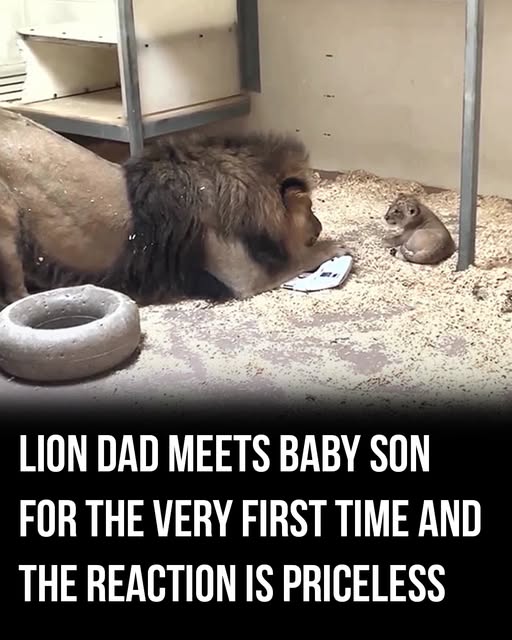
Parental devotion is often discussed as a uniquely human trait, yet the natural world offers striking examples of familial bonds that challenge how we perceive animal emotion and awareness. While we readily accept that primates such as chimpanzees and gorillas experience complex feelings—grief, joy, attachment—we tend to cast large predators in a far narrower role. The African lion, long crowned the “King of the Jungle,” is typically imagined as a symbol of raw power and relentless aggression, not tenderness or care. A remarkable moment at the Denver Zoo, however, has disrupted that stereotype, offering a rare and intimate glimpse into the gentle, paternal side of a lion and capturing global attention in the process.
At the center of this story are Tobias, a powerful adult male lion, and his newborn son, Tatu. Born on July 25, 2019, Tatu quickly became a symbol of optimism for a species facing an uncertain future. With his oversized paws, downy fur, and curious, alert expression, he instantly won over zoo staff and visitors alike. Yet his significance extended far beyond his charm. Tatu was the third cub born to his mother, Neliah, whose attentive and protective motherhood had already set a strong foundation. Still, it was the long-anticipated introduction between cub and father that would become the defining moment of his early life—and a viral sensation seen by millions.
The importance of this meeting becomes clearer when viewed against the grim reality of lion conservation. According to conservation experts and research conducted by the Denver Zoo, wild lion populations have plummeted dramatically, with nearly half disappearing over the past twenty-five years. Habitat destruction, illegal poaching, and the steady decline of natural prey have pushed the species into a precarious position. In this context, Tatu’s birth represented more than a joyful event—it was a meaningful step forward for the Lion Species Survival Plan (SSP), an initiative overseen by the Association of Zoos and Aquariums (AZA). The program functions as a genetic safeguard, ensuring that lions in accredited zoos maintain healthy, diverse bloodlines capable of supporting long-term survival.
For Tobias, the moment carried personal significance as well. Despite his maturity and dominance, he had never sired a cub before Tatu. This made his genetic contribution especially valuable, but it also introduced uncertainty. In the wild, interactions between dominant males and young cubs can be unpredictable and, at times, deadly. Although lions are uniquely social among big cats, living in structured prides, male responses to cubs range widely—from tolerance to fatal aggression. Acknowledging this risk, zoo specialists approached the introduction with extreme care, designing conditions that minimized stress and allowed natural behavior to unfold safely.
What followed was a powerful demonstration of animal sensitivity and restraint. In the now widely shared footage, the contrast between father and son is striking. Tobias is massive, his mane framing a body built for dominance. Tatu, by comparison, is barely twelve pounds—awkward, energetic, and unaware of his father’s imposing stature. As Tobias approaches, there is no sign of hostility. Instead, he lowers himself, moving slowly, gently sniffing the cub with deliberate calm. The expected ferocity never appears.
Tatu’s response is equally compelling. Rather than retreating, he greets his father with fearless curiosity—pawing at Tobias’s face, tumbling forward in playful defiance. Tobias answers with remarkable patience, responding with soft nudges and quiet vigilance. In that exchange, there is an unmistakable recognition—an unspoken acknowledgment of kinship that goes beyond instinct alone.
This moment challenges long-standing assumptions about lion behavior. It reveals that their social lives are shaped not only by dominance and survival but also by bonds, recognition, and connection. The interaction between Tobias and Tatu reframes the lion not just as a hunter or ruler, but as a father capable of gentleness and restraint. For the Denver Zoo’s staff, the encounter affirmed years of careful conservation work. Tobias had proven himself not only genetically valuable, but socially balanced—an essential element of a healthy pride.
Beyond the enclosure, the impact of Tatu’s story has been profound. Its viral reach transformed a private conservation success into a public call for awareness. By witnessing a vulnerable cub and a protective father, audiences around the world found themselves emotionally invested. Abstract statistics about population decline became personal, relatable, and urgent. The footage bridged the emotional distance between everyday viewers and an endangered species struggling to survive.
As Tatu grows, eventually stepping into adulthood, that first meeting remains a defining chapter in his life story. It stands as evidence of the progress modern zoological practices have made—where emotional welfare and social stability are valued alongside physical health. The Denver Zoo’s ability to facilitate such a peaceful introduction reflects a deep understanding of lion psychology and a strong commitment to species preservation.
Ultimately, Tobias and Tatu’s story is one of hope. In a time when wildlife faces mounting threats, it reminds us that moments of connection still exist—moments powerful enough to inspire empathy, responsibility, and action. That image of a mighty lion lowering himself to greet his cub is more than a touching scene; it is a symbol of endurance, care, and continuity. It proves that even in the heart of the wild, love is not a weakness—it is a force as essential as strength itself.