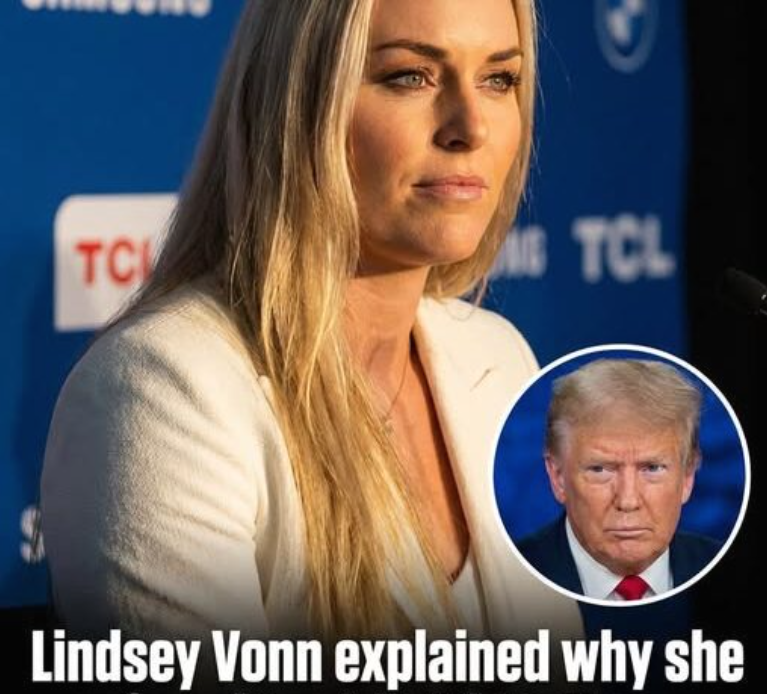
The intersection of elite athletics and national politics has long been a complicated and sometimes fraught arena, and few athletes have navigated this landscape with as much scrutiny and precision as Lindsey Vonn. As the 2026 Winter Olympics in Cortina d’Ampezzo come to a close, the 41-year-old alpine skiing legend finds herself at the center of a narrative that transcends the physical challenges of the slopes. While her pursuit of a historic medal ended with a dramatic and painful physical setback, it is her measured, deliberate stance regarding the political traditions of the American presidency that has captured international attention. Vonn’s recent responses to questions about a potential White House invitation under the administration of Donald Trump exemplify a careful diplomacy, demonstrating how an athlete can use her platform thoughtfully and with nuance, far beyond the finish line of a ski course.
The athletic dimension of this chapter is both inspiring and tragic. Entering the 2026 Winter Games, Vonn was not merely competing; she was testing the limits of human endurance, aiming to become the oldest athlete in history to win an Olympic medal in alpine skiing. Her journey to Italy was emblematic of a career defined by resilience and determination. Only days before the Games, she had suffered a fully ruptured ACL during a World Cup event, an injury that would have sidelined most athletes permanently. Yet Vonn arrived in Cortina ready to compete, defying expectations and proving that her dedication to the sport went far beyond the normal limits of physical tolerance. Her commitment underscored the hallmark of the Vonn legacy: an unwavering resolve to compete, no matter the personal cost.
During the women’s downhill final, Vonn’s Olympic campaign reached a sudden and brutal conclusion. In a high-speed sequence that stunned the audience, her ski pole clipped a timing gate mid-jump, causing a violent crash. Initial fears linked the accident to her previously ruptured ACL, but medical reports clarified that the crash was an unpredictable incident, unrelated to the prior injury. The impact resulted in a complex tibia fracture in her left leg, requiring immediate and extensive surgical intervention in Italy. As she prepares to return to the United States for ongoing treatment, the image of Vonn—a champion brought down by an unforeseen accident—has reignited discussions not only about her future in skiing but also about the symbolic role she plays as a representative of Team USA on the global stage.
In parallel with her physical challenges, the question of the traditional White House visit for Olympic medalists has taken on a more complex significance. This longstanding practice, once a largely apolitical celebration of national achievement, has become increasingly politicized. Vonn, known for her thoughtful public persona, was recently asked whether she would attend such an event under President Trump. Her 2025 response was measured, acknowledging the customary invitation while carefully maintaining her personal boundaries. She noted that all Team USA athletes typically receive an invitation, regardless of medal placement, but she refrained from a direct commitment. “I’m not going to answer that question,” she said lightly, adding with a hint of humor, “I want to keep my passport.” This subtle comment reflected both her refusal to be drawn into political controversy and her awareness of the broader implications of public statements in today’s media landscape.
The shift in tone from her explicit stance ahead of the 2018 Winter Olympics to the nuanced approach in 2026 reveals a strategic evolution. In 2018, Vonn had been more direct, stating outright that she would not attend a White House visit under Donald Trump’s administration. At that time, her reasoning was rooted in a desire to represent the collective interests of the American people rather than any individual political figure. Today, however, her response illustrates a more sophisticated approach, balancing personal principles with public diplomacy. By delivering her stance through humor and subtlety, she demonstrates a heightened awareness of the scrutiny athletes face in the digital era, where every word can be amplified and politicized.
Vonn’s “passport” quip, though playful, underscores the careful navigation required of athletes in contemporary public life. It suggests a recognition of the potential consequences of speaking too plainly, highlighting how statements can affect not only public perception but also international mobility, sponsorship deals, and professional relationships. Her careful choice of words mirrors the precision required on the slopes, where every fraction of a second and every turn can determine outcomes. By sidestepping a direct political answer, Vonn protected herself from unnecessary controversy while still signaling that her principles remain intact.
Her teammates and the wider athletic community have observed her handling of this delicate issue with admiration. For generations, a White House visit has represented the pinnacle of recognition for Olympic achievement, yet in recent years, it has become a source of moral and political tension for athletes. Vonn’s approach demonstrates that it is possible to honor one’s country and one’s achievements without necessarily endorsing or aligning with a particular political administration. Her emphasis on loyalty to the American flag and the ideals it symbolizes underscores a broader commitment to representing her nation responsibly, rather than a single political figure.
The road to physical recovery will undoubtedly be challenging for Vonn, marked by surgeries, rehabilitation, and months of meticulous conditioning. Yet even as she faces this arduous path, her intellectual and public presence remains unwavering. Her skill in handling politically sensitive questions highlights an often-overlooked dimension of elite athletes: media literacy and public diplomacy. Vonn has shown that in 2026, a champion’s legacy is defined not solely by medals but also by the integrity, composure, and strategic thought displayed under intense public scrutiny.
In the final analysis, Lindsey Vonn’s careful response to the potential Trump White House invitation exemplifies her broader approach to life and sport: a blend of high-speed precision, tactical intelligence, and thoughtful restraint. Whether recovering from a tibia fracture or navigating politically charged questions, she refuses to be reduced to a single narrative. As the 2026 Winter Olympics fade into history, Vonn’s measured public conduct may emerge as one of her most powerful statements. Her journey back to the United States for continued treatment will be followed not only by fans of her alpine skiing prowess but also by those who admire her ability to maintain grace, assert her values subtly, and speak with authority without creating unnecessary conflict. The passport remains firmly in her hand, symbolizing both autonomy and deliberate choice, while her path forward, though physically demanding, continues to reflect the agency and resilience that have defined her career.