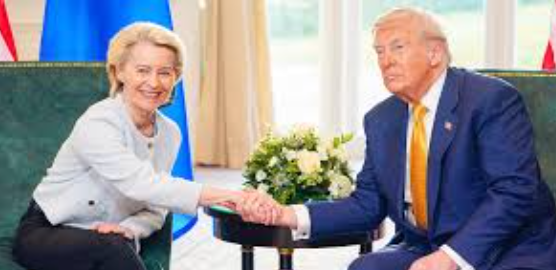
The room changed in an instant, as if the air itself had shifted. One moment, the discussion was cautiously measured, with Donald Trump and Ursula von der Leyen exchanging tentative glances and measured statements, each hedging their bets and signaling restraint. By the next, the two leaders emerged together, papers in hand, the unmistakable aura of finality surrounding them. Only minutes before, Trump had remarked that the odds of a deal were “50-50,” a statement meant to temper expectations and maintain negotiation leverage. Yet, in the blink of an eye, Washington and Brussels were confronted with a deal that defied those cautious predictions, sending ripples of shock through the corridors of power. Moscow, in particular, seemed momentarily unmoored, forced to reevaluate its assumptions about the European energy trajectory and the strategic calculations of its long-standing trading partners. The headlines alone—“15% Auto Tariff Imposed” and “Hundreds of Billions in U.S. Energy Sales Secured”—captured the raw immediacy of what had transpired, but they only hinted at the seismic structural shift that was now quietly underway. Liberals, pundits, and political analysts alike found themselves grinding their teeth, an involuntary acknowledgment that Trump had not only participated in the negotiations but had emerged with nearly everything he had set out to achieve, leaving Washington insiders scrambling to parse the broader implications.
What came out of those negotiations was far more than a ceremonial handshake or a routine statement of mutual intent. It was, in effect, a fundamental realignment of the Western economic order, a recalibration of trade, energy, and industrial policy that will reverberate for years to come. At its core, the agreement delivered a flat 15% tariff on European automobiles, a policy that had been a long-standing point of contention and negotiation. Beyond the tariff, the deal opened vast new markets for U.S. agriculture, giving American farmers a rare advantage in European distribution networks. Perhaps most consequentially, Europe committed to purchasing up to $750 billion in U.S. energy, from liquefied natural gas to renewable technology, and pledged an additional $600 billion in broader European investment in American infrastructure and industries. For a continent long dependent on Russian energy imports, a dependency described by former EU Ambassador Gordon Sondland as being “hooked on cheap Russian gas,” the implications could hardly be clearer: Europe was pivoting its energy lifeline decisively toward the United States, signaling a geopolitical and economic shift that Moscow could not ignore. Pipelines, contracts, and decades of energy strategy suddenly felt precarious, as the West began to chart a course that emphasized American partnership over Russian supply chains.
The political reverberations were equally profound, cutting across ideological and party lines in ways that were both subtle and overt. Critics on CNN framed the deal as a stern warning to emerging global competitors such as China: the message was unmistakable, if unspoken—negotiate on American terms, or risk a trade war that could reshape markets and supply chains. On MSNBC, commentators openly expressed regret that Brussels had not engaged in more protracted negotiation, that it had not “played cat and mouse” for longer, a tacit concession that the pace and terms of the deal had been largely dictated by Trump’s team. Behind the public posturing and carefully scripted commentary, however, a more fundamental reality prevailed: something essential had shifted. The United States had not merely avoided a potential clash with its European partners; it had leveraged the negotiation to gain tangible economic advantages, market access, and a rare form of bipartisan acknowledgment. This time, even critics had to admit that Trump’s strategic instincts had delivered results, and that the leverage now lay unmistakably with Washington.
Moreover, the deal’s implications extended far beyond energy and automotive markets. European investment into the United States was structured not as piecemeal contributions but as a coordinated infusion of capital into sectors critical to America’s long-term industrial competitiveness: technology, defense, green energy, and high-speed infrastructure. For U.S. policymakers and business leaders, this represented a once-in-a-generation opportunity to reshape the domestic economy while simultaneously strengthening transatlantic relations. Meanwhile, the European side recognized that acquiescing to American terms—though politically sensitive—was preferable to leaving trade imbalances and energy dependencies unaddressed, particularly at a moment when geopolitical tensions were escalating across multiple theaters. The pact sent a clear, deliberate signal to Moscow, Beijing, and other strategic observers: the United States and Europe, despite occasional friction, were now capable of executing coordinated economic strategy when interests aligned.
For ordinary citizens, analysts, and foreign observers, the deal crystallized a rare convergence of strategic foresight and political theater. Trump, often criticized for impulsiveness, had used a combination of timing, leverage, and relentless pressure to secure terms that fundamentally shifted both economic and geopolitical power dynamics. Brussels, despite its initial hesitance and internal political debates, ultimately consented to a framework that ensures European markets are more integrated with U.S. supply and investment flows than ever before. And Moscow, left momentarily off balance, now faces the challenge of recalibrating its own energy diplomacy and economic outreach under the shadow of this new Atlantic accord. The resulting landscape is a stark reminder that in modern geopolitics, the speed of a deal, the perception of leverage, and the optics of agreement can sometimes outweigh months or years of traditional diplomacy.
In the end, what appeared as a single, high-profile trade announcement—one that stunned media outlets and political pundits alike—was really the opening chapter of a longer story about power, leverage, and strategic alignment in a rapidly shifting world. The United States had not simply negotiated a deal; it had reshaped expectations, clarified intentions, and demonstrated that, in 2026, the ability to act decisively and seize the narrative could yield results that resonate across markets, continents, and political ideologies. The deal would be dissected, debated, and scrutinized for months, yet one fact was clear from the outset: for all its drama and media spectacle, Trump had secured a moment of unmistakable leverage, and the world was left recalibrating its assumptions about American strategy, European priorities, and the future of global trade.