The Seattle Seahawks left Super Bowl Sunday with a commanding 29–13 victory over the New England Patriots at Levi’s Stadium. Yet while the scoreboard settled the battle on the field, a far more chaotic and amplified clash unfolded beyond it.
This year’s Super Bowl halftime was no longer just an intermission for music. It became a cultural fork in the road—two competing productions running side by side, each fighting for attention, influence, and digital dominance.
On the NFL’s official platform, international superstar Bad Bunny headlined the league’s sanctioned halftime performance. At the same time, Turning Point USA aired its own livestreamed counterprogramming, dubbed the “All-American Halftime Show.” The alternative was positioned as a response to what organizers claimed was a mainstream entertainment industry increasingly disconnected from their audience.
What emerged were not simply two performances, but two contrasting visions of America playing out simultaneously.
The alternative show, funded by conservative donors and aggressively promoted online before kickoff, featured artists tailored to fans of country and rock music. Brantley Gilbert, Lee Brice, and Gabby Barrett made up a lineup familiar to their base but largely absent from recent NFL halftime spectacles.
Promoted as proudly patriotic and tradition-focused, the broadcast framed itself as a rejection of what its organizers described as politicized pop culture. It promised straightforward performances, classic visuals, and artists aligned with the values of its target audience.
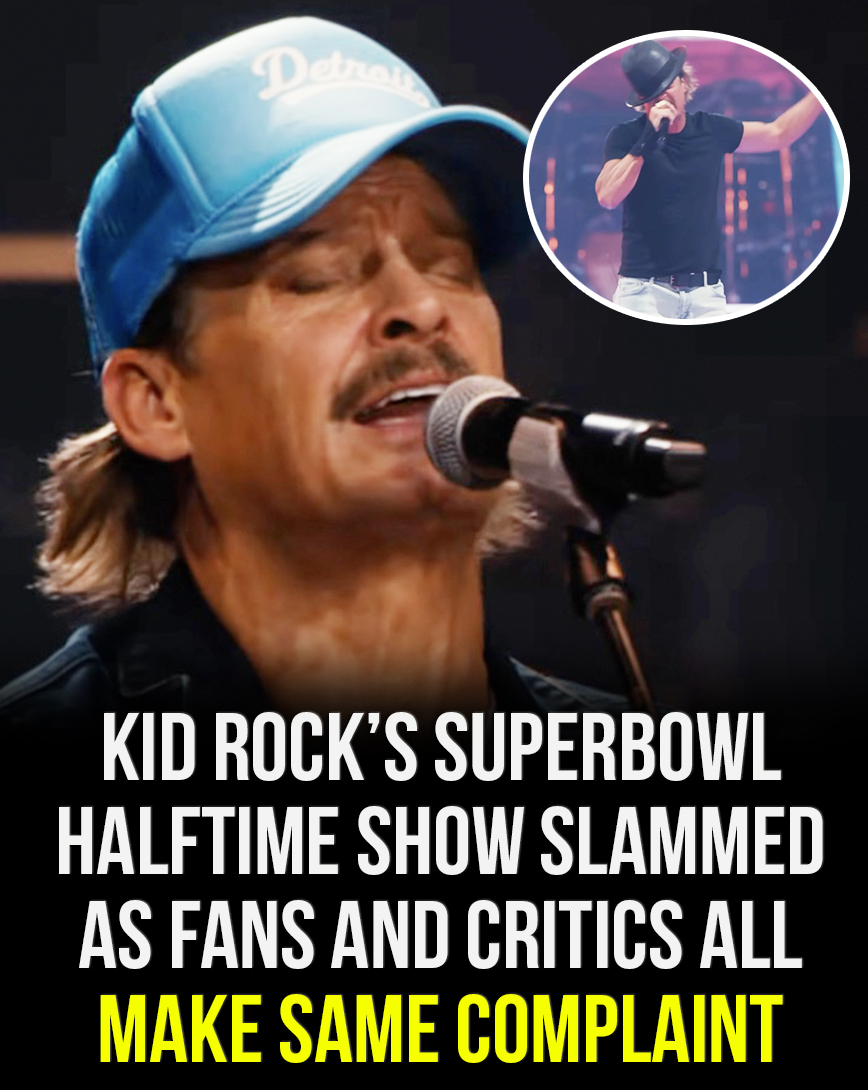
The livestream concluded with Kid Rock—a decision that instantly sparked debate. Now 55, the musician continues to polarize public opinion, hailed by supporters as a defiant outsider and dismissed by critics as a figure whose notoriety has long eclipsed his cultural relevance.
Almost immediately, online reaction flooded in.
Across social media, viewers questioned whether Kid Rock’s vocals were live. Claims of lip-syncing spread quickly, fueled by clips suggesting his voice continued even when his microphone dropped. Others noted moments where his mouth movements appeared out of sync with the audio.
Some defended the performance, suggesting livestream lag or technical issues. Others were less forgiving, labeling the segment artificial, heavily edited, or outright fake.
The brevity of the performance also drew ridicule. Many joked that it ended abruptly, lasting barely over a minute before cutting away. Critics described the staging as clumsy, the energy inconsistent, and the execution lacking the polish expected from a closing act.
What was intended as a high point of the broadcast quickly became its most derided moment.
As backlash intensified, past controversies resurfaced.
Lyrics from Kid Rock’s 2001 track “Cool, Daddy Cool” began circulating again, reigniting criticism over references to underage girls. Detractors argued the renewed attention underscored long-standing concerns, making his role as the show’s centerpiece even more troubling.
Simultaneously, footage from a 2001 Saturday Night Live appearance resurfaced, in which Kid Rock made remarks about Mary-Kate and Ashley Olsen while they were still minors. Though condemned at the time, the comments sparked fresh outrage more than twenty years later.
For critics of the All-American Halftime Show, these resurfaced moments reinforced claims that the event wasn’t merely an alternative, but a deliberate embrace of figures and attitudes they see as outdated or inappropriate.
Neither Turning Point USA nor Kid Rock issued immediate responses as criticism and clips continued circulating online.
Still, the reaction was sharply divided.
Supporters argued the backlash was politically driven rather than rooted in the performance itself. Many celebrated the inclusion of “Bawitdaba,” calling it a nostalgic anthem that delivered exactly what its audience expected.
Others praised the alternative show as a whole, saying it successfully catered to viewers who feel excluded by mainstream entertainment. They applauded its country-and-rock focus, lack of overt social messaging, and its decision to create an alternative rather than protest the NFL’s official production.
Early reports indicated the livestream reached nearly five million concurrent viewers—an impressive figure for an independently produced broadcast. While viewership dipped slightly during Kid Rock’s segment, it rebounded afterward. The archived stream later surpassed 18 million total views on YouTube.
Those numbers quickly became part of the debate, with supporters pointing to them as proof of demand and critics questioning how much attention was driven by controversy instead of genuine interest.
Meanwhile, Bad Bunny’s official halftime show followed the NFL’s established blueprint: massive production, choreographed spectacle, global appeal, and a celebration of Latin pop culture. As expected, it also faced criticism from viewers who felt disconnected from the music.
Together, the reactions to both performances revealed more than simple disagreements over taste.
They highlighted a growing divide in how Americans experience shared cultural events.
Once a near-universal touchstone, the Super Bowl halftime show now exists in fragments. This year, audiences didn’t just argue about quality—they watched entirely different productions, on different platforms, shaped by entirely different narratives.
Entertainment has increasingly split along ideological lines, and Super Bowl Sunday offered a clear snapshot of that shift.
For some viewers, Bad Bunny symbolized the present and future of American culture—global, multilingual, and forward-looking. For others, the All-American Halftime Show represented pushback against that evolution, an effort to preserve a cultural identity they feel is fading.
Neither group watched quietly. Both reacted instantly, loudly, and with certainty that their version of halftime was the one that truly mattered.
Long after the Seahawks’ win fades into statistics, the dual halftime shows will remain as a marker of a moment when entertainment stopped pretending to be neutral.
This year, halftime didn’t just fill time—it revealed sides, and millions of viewers chose exactly which one they wanted to see.