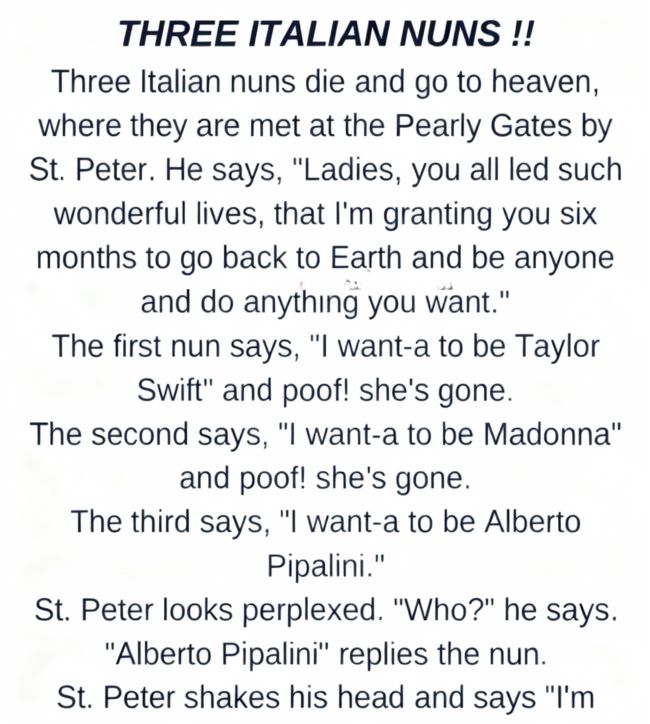
At the Pearly Gates, an ethereal tableau of swirling white clouds and pure light so vibrant it seemed to hum, three Italian nuns stood together, their disciplined lives complete. Sister Maria, Sister Angelina, and Sister Chiara were before St. Peter, their simple habits in stark contrast to the celestial brilliance around them. St. Peter, robust and smiling, welcomed them with a warmth that felt like an embrace. He consulted a list that shimmered with divine light, checking their names against a record of humility, compassion, and tireless service.
“Sisters,” St. Peter announced, his voice carrying the weight of eons, “you have fulfilled your vows with distinction. Your lives have been a testament to sacrifice and devotion. As your reward, Heaven offers you a rare reprieve. You may return to Earth for six months, not in your accustomed roles, but for pure, uninhibited fun. You may be anyone you wish, doing anything you choose.”
The nuns exchanged looks of astonishment. A lifetime defined by rigid adherence to the Divine Office, quiet routines, and constant discipline had suddenly been replaced by the prospect of absolute freedom. Their eyes, accustomed to the solemn quiet of the convent chapel, now sparkled with the gleam of children promised a fantastical adventure.
Sister Maria, the most reserved of the three, was the first to step forward. A thrill of almost-forbidden excitement coursed through her. She imagined the dazzling spectacle of the modern world, the electrifying power of commanding attention. “I would-a like to be Taylor Swift,” she declared, her voice full of newfound aspiration. She envisioned standing beneath stadium lights, microphone in hand, singing songs that moved millions and made complex emotions feel understood. She dreamed of glitter, energy, and the kind of connection that transcended language. With a soft poof, and the faint echo of synthesized pop music, Sister Maria vanished, presumably already rehearsing choreography.
Next, Sister Angelina, the most creative and intellectually daring of the group, stepped forward with confidence. She had always pushed the boundaries, from garden designs to ambitious charity drives. “I want-a to be Madonna,” she declared firmly. She dreamed of a life of artistic reinvention, fearless confrontation of cultural norms, and the kind of groundbreaking creativity that shapes generations. She yearned for the platform to be controversial, celebrated, and utterly in control of her own narrative. With another swift poof, accompanied by the flicker of avant-garde visual artistry, Sister Angelina disappeared, off to craft her new persona.
St. Peter smiled, nodding approvingly at the magnitude of their dreams. He had seen many souls choose fame and influence. Then he turned his gaze to Sister Chiara. She stood quietly, hands folded as they had been in prayer for decades, her peaceful, deep-set smile suggesting she was contemplating something far beyond spotlights or platinum records.
“And you, Sister Chiara?” St. Peter asked gently. “You’ve seen your sisters choose the brightest stars of Earth. What extraordinary life calls to you?”
“I want-a to be Alberto Pipalini,” Sister Chiara said softly, the name carrying a quiet, almost unassuming resonance.
St. Peter blinked, momentarily thrown off his celestial game. He flipped through the heavenly records, checked the divine databases for artists, leaders, or global influencers, and scratched his beard in confusion.
“I’m sorry, Sister,” he said, perplexed. “I truly don’t recognize that name. Is he a celebrated singer? An acclaimed artist? A major world leader?”
Sister Chiara’s smile widened, turning into a look of profound, secret satisfaction. She calmly reached into her habit’s pocket—a mysterious relic she had somehow managed to carry past the gates—and pulled out a small, dog-eared newspaper clipping. She carefully unfolded the paper and pointed to a humble headline printed in bold, unassuming type.
The headline read: ‘Local Man Alberto Pipalini Named Happiest Person Alive.’
The accompanying article detailed how Alberto Pipalini, known not for any grand public achievement, global fame, or massive fortune, was celebrated in his small Italian town for the quiet, enduring success of his simple life. He ran a small, generations-old family bakery. He was known for laughing often, for having an unwavering capacity for gratitude, and for helping his neighbors without seeking recognition. Most importantly, he never, ever took life—or himself—too seriously. His fun lay in contentment.
St. Peter looked from the clipping to Sister Chiara’s peaceful face, then burst into laughter. It was a deep, joyful sound that echoed through the Pearly Gates, momentarily silencing the angels’ chorus.
“Sister Chiara,” St. Peter said, wiping a tear of mirth from his eye, “you know, after everything I’ve seen here—all the ambition, the power, the striving for earthly glory—that might just be the wisest choice any soul has ever made.”
With a final, loving wave of his hand, poof—Sister Chiara vanished, destined not for the dazzling stage or the controversial art scene, but for the profound, unheralded joy of a simple, fully lived life.
As the gates closed, settling back into their magnificent, quiet rotation, St. Peter paused to add a note to the glowing ledger of Heaven’s collected wisdom. He wrote: True happiness isn’t always about being famous or powerful—it’s about choosing joy, gratitude, and balance, and finding contentment exactly where you are.
And somewhere on Earth, three former Italian nuns were beginning their grand, six-month reprieve, each discovering that while fun may indeed come in the form of a superstar, enduring joy and profound contentment are the real, quiet miracles.