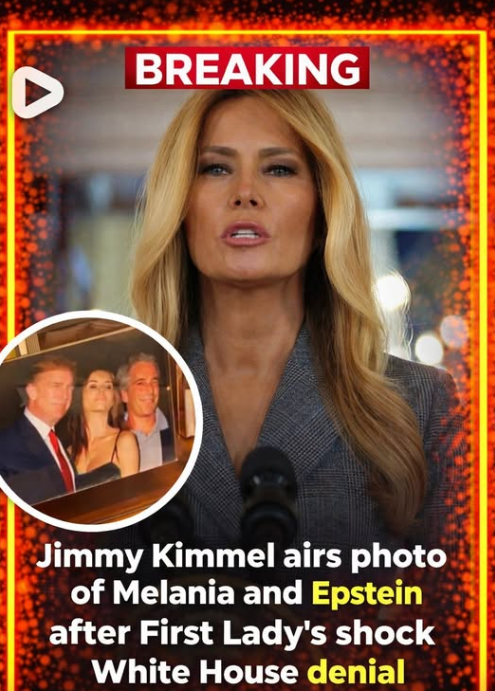
The political landscape was thrown into renewed controversy this week after First Lady Melania Trump issued a rare and forceful public statement addressing long-standing speculation about her past social associations. In her remarks, she drew a firm boundary between herself and the late financier Jeffrey Epstein, insisting there was no friendship, no victimization, and no involvement in his private travel or properties. She emphasized that her name does not appear in any verified legal records or flight documentation, characterizing any perceived connection as nothing more than incidental overlap within elite social circles in New York and Palm Beach.
She further argued that much of the narrative surrounding her has been distorted over time by politically motivated claims and misleading online content, including what she described as manipulated imagery and unfounded assumptions. According to her statement, these repeated allegations have created a false impression of association where none meaningfully existed, and she signaled her intention to continue challenging such claims through legal and public channels. For a moment, her response appeared to reassert control over the narrative, presenting a clear attempt to separate her public identity from longstanding controversy. However, that effort was quickly overshadowed by commentary aired on Jimmy Kimmel Live, where the issue was reframed in a far more provocative context.
During the broadcast, host Jimmy Kimmel referenced a widely circulated photograph showing Melania and Donald Trump alongside Jeffrey Epstein. The image, which has appeared in various public discussions over the years, was used in the segment to question the characterization of their connection as merely casual or incidental. By highlighting the photo to a national audience, the show reignited debate about the nature and depth of the relationships within that social circle, suggesting a more complicated history than the official narrative acknowledges.
The segment escalated further when Kimmel referred to reported remarks attributed to Donald Trump indicating he was unaware of his wife’s statement prior to its release. This alleged disconnect was presented as evidence of misalignment within the couple’s public messaging, fueling speculation about coordination and internal communication at a sensitive political moment. The implication drawn by commentators was not only about messaging strategy, but also about the broader cohesion of a public-facing political partnership under scrutiny.
As the discussion spread across media platforms, reactions were sharply divided. Supporters of Melania Trump framed her statement as a necessary correction to years of persistent rumor and online misrepresentation, while critics argued that visual evidence and historical associations continue to invite legitimate questions in the court of public opinion. The resurfacing of the photograph intensified this divide, reinforcing how enduring and influential imagery can be in shaping political narratives regardless of official denials.
In the end, the episode illustrates how modern political discourse is increasingly shaped not only by statements and legal distinctions, but also by media framing, archival visuals, and real-time commentary. Even carefully constructed public denials can be quickly challenged once reintroduced into the fast-moving ecosystem of television satire and social media amplification, where perception often carries as much weight as documentation.