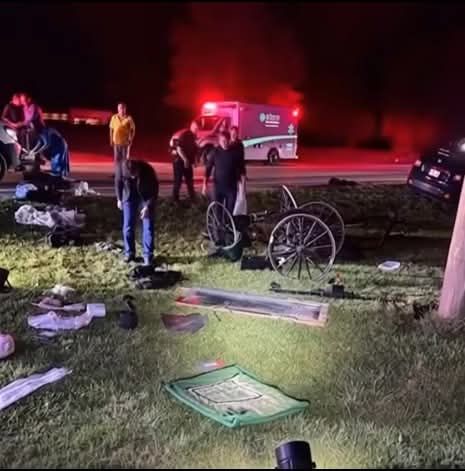
Screams tore through the dark Indiana countryside, slicing the quiet night air with a terror that seemed impossibly loud against the stillness of farmland and fields. In seconds, a serene Amish buggy ride transformed into a nightmare: splintered wood, flashing lights, and the anguished cries of injured children scattered across the cold, unforgiving pavement. A Jeep, sleek and metallic, had appeared in a rural no-man’s-land, a symbol of the modern world colliding violently with a community that moves at a rhythm measured in horse hooves, not horsepower. The scene was chaos incarnate: the smell of burnt rubber, the faint scent of hay and leather from the buggy, and the acrid tang of fear lingering in the air like smoke.
On a stretch of State Road 218 outside Berne, the collision had turned the ordinary into the extraordinary in a heartbeat. A way of life, defined by simplicity and silence, had collided headlong with the relentless pace of the modern world. The horse-drawn buggy, carrying nine Amish occupants, was struck from behind late at night, its delicate wooden frame no match for the metal and momentum of the Jeep. The carriage splintered on impact, throwing passengers—men, women, and children—into the asphalt, their bodies tumbling like ragdolls caught in a violent storm. Seven were injured, most of them children whose laughter from earlier moments now echoed faintly in memory as cries of pain. The quiet ride home had vanished, replaced by the wailing of sirens, the pounding of helicopter rotors overhead, and floodlights cutting harsh lines through the darkness, illuminating the twisted remains of what had been a peaceful journey.
Investigators worked with methodical care, their flashlights skimming over splintered wood and rubber fragments as they tried to reconstruct the unthinkable. Blood tests for the Jeep driver were underway, and the questions hung heavier than the wreckage itself. How could a fragile wooden buggy, so emblematic of a simple and deliberate way of life, endure roads designed for steel, speed, and reckless haste? How could a single miscalculation or a moment of inattention convert a routine ride into trauma?
For the Amish community, this was more than a traffic accident. It was a stark reminder of the daily gamble inherent in every journey outside their quiet lanes, every curve and hill under cover of darkness. Each trip now carries the shadow of a violent collision that could strike without warning. The incident has left a scar not only on the bodies of those injured but also on the collective memory of a people whose lives are measured in seasons, candles, and horse hooves—intersecting, painfully, with a world that moves too fast and often does not see them in time.
Neighbors and witnesses spoke quietly among themselves, recounting the moments leading up to the crash: the sound of hooves fading behind them, a sudden flash of headlights, a deafening impact that left the night ringing with cries of terror. Emergency responders worked tirelessly to stabilize the injured, their movements urgent yet careful, understanding the fragility of young bodies battered by steel and gravity. In the hours that followed, the rural landscape—normally serene, blanketed in moonlight and crickets—felt smaller, more dangerous, as if the night itself had conspired to remind the world of its unpredictability.
In Berne, in homes where children now sat wide-eyed and parents whispered prayers, the collision has rewritten the simple rules of daily life. Every road, every curve, every night journey now carries the memory of a single moment when time slowed, then accelerated violently, leaving innocence and tranquility shattered in its wake. For the Amish, it is a moment they will carry with them forever: the day the modern world came too fast and nearly tore their way of life apart.