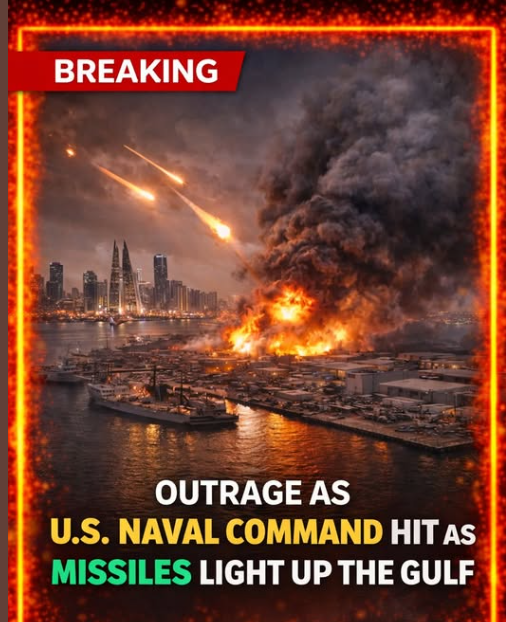
Smoke rose before anyone fully understood what had just been unleashed. The air was thick with a mixture of acrid haze and disbelief. Sirens wailed, explosions echoed across the horizon, and a stunned silence fell over officials scrambling to comprehend the unfolding chaos. In an instant, the Gulf—a region long marked by shadow conflicts, proxy wars, and careful diplomacy—found itself at the epicenter of a terrifying new chapter. A U.S. naval hub, previously thought to be a controlled environment of deterrence and strategic planning, suddenly became a flashpoint. The shockwaves traveled fast, reaching financial markets, foreign embassies, and millions of civilians whose lives now hung, suddenly, on the uncertainties of the moment.
Iran’s reported strike near Naval Support Activity Bahrain, home to thousands of U.S. military personnel, shattered the fragile illusion that tensions could remain contained, behind the veil of deniable operations. What had for years been a theater dominated by proxies, shadow operations, and covert maneuvers now appears to be escalating into a direct confrontation between states. The strike—claimed by Tehran as a “precision response” following the alleged U.S.–Israeli operation dubbed “Epic Fury”—signaled a dangerous shift: a willingness to target high-profile, overt installations, no longer hidden behind layers of plausible deniability. Analysts immediately began weighing the risks of retaliation, miscalculation, and escalation, aware that the region’s delicate balance had been disrupted in a single, explosive moment.
The consequences rippled far beyond Manama. Air raid sirens blared, residents scrambled for shelter, and emergency directives transformed everyday routines into exercises of survival. For ordinary citizens, the political calculations mattered far less than the tangible fear: fear of the next strike, the next missile, the next night spent uncertain whether what had erupted was an isolated exchange or the ominous opening of something far larger and more dangerous. Global markets reacted instantly—oil prices surged, futures wavered, and distant economies felt the tremor of explosions thousands of miles away. Headlines flashed images of smoke rising from the naval base, and the abstract theories of geopolitics became painfully real, as people grappled with the sudden knowledge that conflicts can jump from maps and briefings into streets, schools, and workplaces overnight.
Military strategists and diplomats moved into crisis mode, aware that every decision—every missile intercept, every statement, every calculation of force—carried the weight of potential escalation. International observers warned that what had begun as a tactical retaliation risked spiraling into a strategic confrontation with consequences that would extend far beyond the Gulf. Social media amplified the anxiety, showing footage of shaking buildings, masked soldiers, and civilians huddled in doorways, transforming distant military maneuvers into immediate, visceral experience for millions.
For the people living through it, there was no easy narrative to cling to. Political motives were abstract; survival was concrete. Each moment carried a question: Would this remain a contained exchange, or was it the prelude to an unpredictable escalation? In the Gulf, as elsewhere, the tenuous line between war and peace had been redrawn in smoke, sirens, and explosions, leaving a region—and the world—on edge, watching, waiting, and hoping that a misstep would not trigger something far worse.