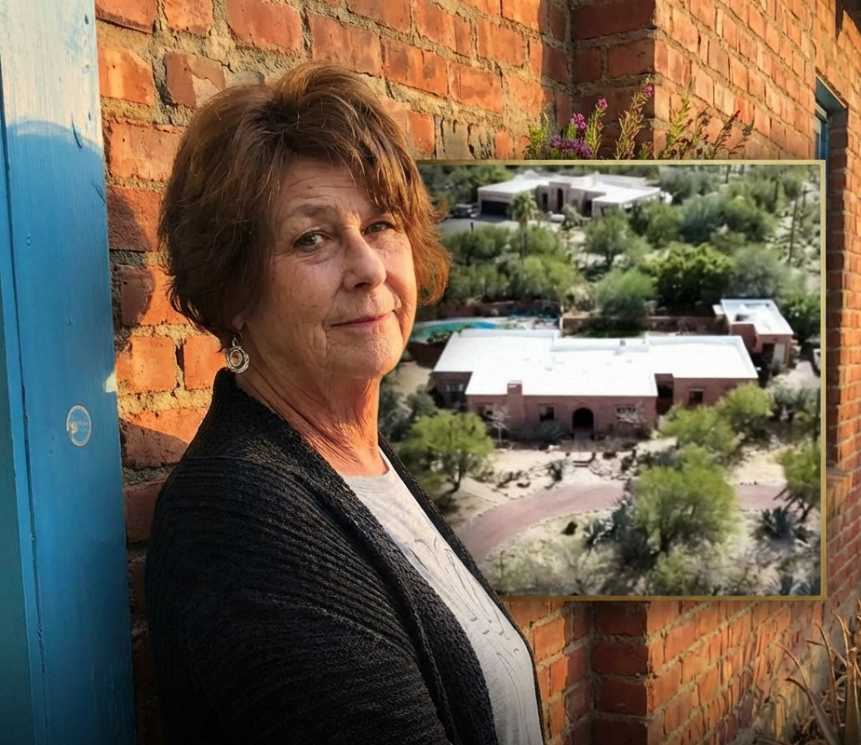
The search for 84-year-old Nancy Guthrie has escalated into a tense, high-stakes forensic investigation, as the Pima County Sheriff’s Department shifts its focus from a routine missing-person search to what is now a potentially violent criminal abduction. What initially seemed like an ordinary disappearance in a quiet Tucson neighborhood has, in just over a week, transformed into a case marked by urgency, fear, and a mounting stack of grim evidence. Authorities describe this moment as “critical”, a window where each passing hour could mean the difference between life and death, and the evidence being uncovered paints an increasingly chilling portrait of the events that unfolded on the night of January 31, 2026.
Nancy, a lifelong pillar of her community, known for her punctuality, warmth, and steadfast routines, was last seen that Saturday evening after a family gathering. She was dropped off at her home around 9:30 PM, and for those who watched her walk to her front door, it seemed like the ordinary conclusion to a pleasant evening. But the next morning, when her familiar seat at her local church remained empty, alarm bells rang immediately. Deputies who arrived at her residence were confronted with a scene that defied any explanation of a simple wandering: Nancy’s vehicle was parked exactly where she left it, her purse, cell phone, and—most alarmingly—her daily medications remained untouched inside.
A Frightening Forensic Turning Point
The trajectory of the investigation shifted dramatically when authorities turned their attention from the inside of the home to its exterior threshold. A significant quantity of blood discovered on the front porch was subjected to DNA analysis and confirmed to be Nancy Guthrie’s. Coupled with evidence of disturbed entry points and signs of struggle, the case immediately escalated into a full-scale criminal investigation.
Experts describe the porch evidence as indicative of a blitz-style encounter—an abrupt, predatory confrontation that likely occurred before Nancy could even lock her doors or call for help. For medical professionals, the fact that her essential medications were left behind is especially harrowing, as it makes it physiologically impossible for Nancy, with her limited mobility, to have traveled any significant distance without assistance.
Federal Involvement and the Digital Hunt
Given the complexity of the situation and its national profile, federal agencies, including the FBI’s Evidence Response Team, have been called in to assist. Investigators are conducting a comprehensive digital canvass, mapping Nancy’s last known movements and the surrounding environment. This painstaking effort involves extracting data from neighborhood Ring cameras, smart traffic sensors, cellular tower pings, and even local social media activity. Every camera angle, every timestamp, and every digital footprint is being scrutinized for anomalies.
Specialized units are also looking for behavioral clues: was Nancy targeted deliberately, or was this a crime of opportunity? Was the forced entry executed by someone familiar with the layout of the house, or was it a hurried, chaotic act? Each detail could shift the entire understanding of how this seemingly serene neighborhood became the stage for a terrifying incident.
The Agony of Uncertainty
For Savannah Guthrie, the Today show co-anchor and Nancy’s daughter, the transformation of the case from a missing-person alert to a criminal investigation has been agonizing. She has used her platform not to sensationalize, but to issue disciplined pleas for public vigilance, reminding the community to remain alert and provide actionable information. Despite the discovery of blood at the scene, authorities continue to operate under the “presumption of life”, noting that many victims have been recovered against the odds, even in cases with evidence of violent struggle.
Public response in Tucson has been unprecedented. Volunteers have canvassed neighborhoods, scoured trails, and shared digital leads with authorities. But law enforcement warns of the dangers of digital vigilantism: speculative theories and online accusations can endanger innocent individuals and overwhelm critical tip lines. Citizens are urged to focus on verifiable evidence, such as dashcam footage or security recordings, rather than conjecture.
A Community on Edge
The disappearance has altered the very fabric of the neighborhood. Streets once considered safe are now patrolled with vigilance, and a pervasive tension lingers as residents ask themselves: how could a grandmother vanish from her own doorstep? Local authorities have increased patrols not only to search for clues, but also to reassure the shaken community. Discussions about senior safety, home security, and the vulnerabilities of aging populations have intensified, highlighting a broader social concern sparked by this single case.
The Race Against Time
As forensic teams painstakingly analyze porch evidence and federal investigators trace Nancy’s digital footprint, the “safest place she knew”—her home—has become the epicenter of a nationwide mystery. Every hour that passes without a sighting intensifies the pressure on authorities to convert these clues into actionable leads. The blood on the porch and evidence of forced entry serve as grim reminders that this investigation is now both a hunt for a perpetrator and a search for a survivor.
The house stands silent, frozen in time, as investigators piece together the events of a dark Arizona night. Every detail, no matter how minute, could hold the key to Nancy Guthrie’s return. And for Savannah, the nation, and her community, the hope that she might yet be found remains fragile—but unbroken.