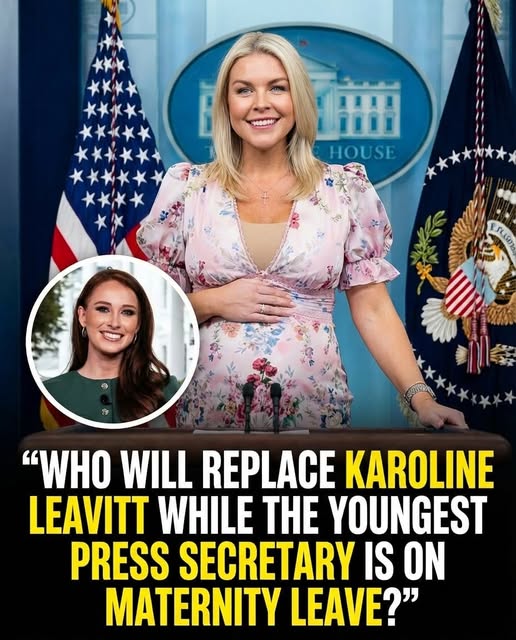
Washington holds its collective breath. As Karoline Leavitt prepares to step away for maternity leave, the question of who will take the helm of the briefing room triggers a quiet, intense undercurrent behind the scenes. Allies and rivals alike are being weighed, measured, and observed through a lens sharpened by election-year stakes. Every gesture, every informal conversation, every whispered evaluation becomes part of an unspoken calculus. One name rises to the top, others orbit, and the eventual decision is more than personnel—it signals who will shape the message, control the optics, and maintain—or challenge—the established hierarchy.
Inside the West Wing, the process is less about celebrity or visibility and more about mastery of influence, the invisible threads of communication, and the ability to hold a room without overstepping it. Anna Kelly, Leavitt’s trusted Principal Deputy Press Secretary, is widely regarded as the most natural heir. She is steeped in Republican messaging, intimately familiar with the rhythms of the briefing room, and trusted by senior aides to maintain both consistency and credibility. Her experience allows her to anticipate every question, to navigate both media scrutiny and internal politics with the subtlety of someone who has spent years reading unspoken signals and crafting careful responses. Around her, aides like Taylor Rogers and Liz Huston work tirelessly, orchestrating every detail from press packages to strategic talking points, ensuring that the machinery of messaging continues to run smoothly regardless of who stands behind the lectern. Their efforts are often invisible to the outside world, but they are the pulse that keeps the system alive.
Beyond this inner circle, the mere mention of other names—Kush Desai, Katie Pavlich, and Tricia McLaughlin—reveals the deeper currents at play. Each candidate embodies a different potential path for continuity or change, signaling the unending tension between stability and reinvention. Their presence in the conversation underscores the subtle tug-of-war between keeping the established message intact and recalibrating for the unpredictable pressures of media, voters, and political adversaries. The scrutiny is relentless, yet it is carefully moderated. This is not a coup, nor a dramatic power grab—it is a temporary vacuum, a pause in the daily rhythm that allows ambition, loyalty, and strategy to intersect, even if only for a moment.
Meanwhile, Leavitt’s impending absence itself highlights a fundamental truth about modern political life: leadership is often negotiated between personal milestones and professional demands. The arrival of a child does not pause the scrutiny of aides, the chatter in the press corps, or the relentless expectations of an election-year administration. For those remaining in the briefing room, it is both a challenge and an opportunity—to prove competence, maintain cohesion, and, if necessary, assert authority in a space where mistakes are magnified and triumphs celebrated only briefly. Every decision made in those hallways, every word whispered or emphasized, ripples outward, shaping the narrative for weeks to come.
In the final analysis, the choice of who steps into the briefing room is as symbolic as it is functional. It signals trust and continuity, communicates political stability, and sets the tone for the administration’s messaging during a period when public attention is merciless. Anna Kelly may be the natural heir, but the broader story—the interplay of ambition, loyalty, preparation, and perception—is what truly defines this moment. It is a reminder that power in Washington is rarely singular; it is the product of networks, strategy, and timing, all converging quietly behind the podium as the cameras wait and the nation watches.
Ultimately, Leavitt’s return, carrying both a newborn and the full weight of her position, will once again crystallize the balance between personal life and public duty. But until that moment, the inner machinery of the briefing room spins quietly, measuring, weighing, preparing, and reminding everyone that in politics, as in life, leadership is rarely about permanence—it is about resilience, readiness, and the delicate art of stepping forward when the moment demands it.