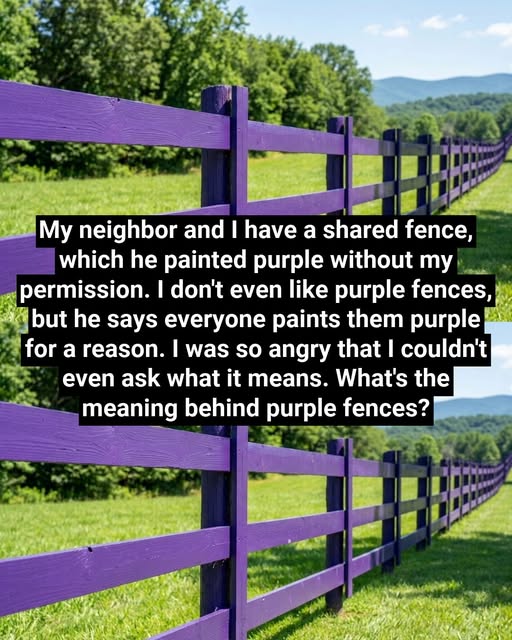
Have you ever walked past a glowing purple fence and felt, for a fleeting moment, that something was off? Not charming, not whimsical—wrong. That color, that unnatural hue against the backdrop of rustling cornfields or dense woodlands, isn’t random. It carries a quiet, almost invisible authority. In much of rural America, purple paint is a silent warning, one that can be supported by law. There’s no need for bold metal signs, barking dogs, or flashing lights—just a deliberate streak of pigment, applied carefully and methodically, that quietly communicates a line you are not meant to cross. Most passersby don’t realize it, but that small, inconspicuous stripe has a history rooted in property rights, personal safety, and the often contentious dance between private landowners and the public who traverse their lands.
For decades, purple paint has served as a legal shortcut for landowners who want to protect their property without erecting intrusive signage. Hunters, hikers, and wandering travelers are often oblivious to the fact that these painted warnings carry the same legal weight as a traditional “No Trespassing” sign. Vertical purple stripes—usually about an inch wide, eight inches long, positioned three to five feet above the ground, and repeated roughly every hundred feet along the perimeter—send a clear, standardized message: this land is private. Crossing it isn’t merely a casual stroll; it is trespassing in the eyes of the law. Those who ignore the paint may find themselves facing fines, legal action, or worse, depending on local statutes and the vigilance of the landowner. In rural areas where law enforcement cannot be everywhere at once, these streaks of purple are the first—and sometimes only—line of defense.
Yet the system is patchy. Not all states recognize purple paint as a legal warning, and among those that do, the specifics vary widely. Some states require precise dimensions and spacing, while others offer more leeway. That’s why anyone considering trading metal signs for a simple paintbrush must do their homework, checking local regulations before believing a swath of purple is enough to protect their property. When it is applied legally, however, purple paint is remarkably effective: it doesn’t blow away in the wind like paper notices, it resists fading more reliably than spray-on letters, and it doesn’t mar the natural beauty of open fields or forested tracts. It’s a subtle yet firm assertion of ownership, blending practicality with quiet aesthetics.
So the next time you wander down a gravel road or hike through a forest and notice an oddly bright purple stripe on a fence post, tree, or even a rock, take it seriously. It’s not an eccentric decoration, nor a relic of some artistic impulse. It’s a coded message, a legal marker, a clear boundary drawn in paint. Turn back while it’s still just color, and respect the unspoken rules that govern rural spaces. Those purple lines are more than mere pigment—they are a language of property, a protective shield, and a quiet assertion that some spaces are meant to remain private.