The call from my lawyer came as I navigated the winding mountain roads of North Carolina, heading toward the property I had inherited from my grandmother six months earlier. Michael Turner’s voice carried an urgency I had never heard before—sharp, anxious, almost panicked.
“Madison, we have a serious problem. There are people living in your house. Strangers. They’ve changed the locks and are acting like they own the place. You need to get here immediately and call the police.”
I slammed on the brakes so hard my tires screamed against the asphalt, kicking up gravel and leaving dark streaks on the road. My heart pounded in my chest as I processed what he had just said. The A-frame house deep in the mountains near Asheville was supposed to be empty—vacant and waiting for a final inspection before listing it for sale. I had sent Michael ahead to handle the walkthrough since I was tied up with other properties in my portfolio.
“What do you mean people are living there? The house should be locked,” I said, my voice higher than intended.
“They replaced the deadbolt with their own lock. When I tried to use the spare key, a man answered the door and told me I was trespassing. Madison, they’re sitting on your grandmother’s sofa, drinking wine, watching television—completely settled in, like they’ve been there for months. This isn’t a typical squatter situation—they have furniture, electronics, everything set up. You need to see this yourself.”
With shaking hands, I ended the call and immediately dialed 911, explaining the situation while pressing the accelerator to the floor. The mountain road blurred past as I navigated curves I had known since childhood, when my grandmother, Elellaner, would bring me here for summer weekends filled with hiking and porch stories.
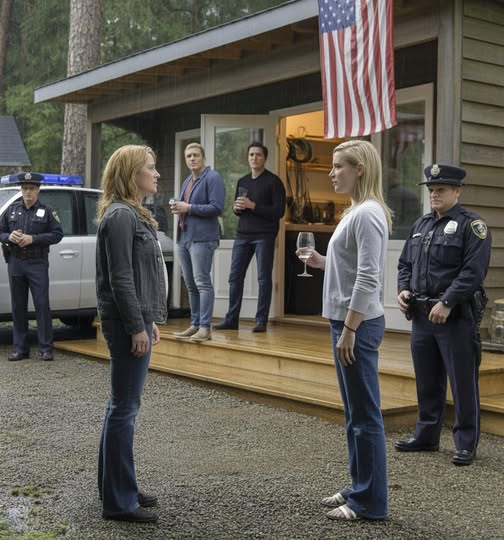
When I finally pulled into the gravel driveway forty minutes later, the scene that greeted me was surreal. My lawyer, Michael, stood near the front door clutching a folder of documents, his usual composure replaced by visible confusion. Two police officers flanked the entrance, arms crossed, skepticism etched across their faces.
And standing in my grandmother’s doorway as if they had every right to be there were my younger sister Jasmine and her husband, Ryan.
When Jasmine saw me, instead of showing even a hint of embarrassment, she let out an exaggerated sigh of irritation. “Seriously, Madison? Calling the cops over this is way too dramatic, even for you. We were finally enjoying some peaceful couple time, and you ruined it. Can’t you respect your sister’s privacy?”
She spoke with the casual entitlement of someone who truly believed she had done nothing wrong, swirling a crystal wine glass in her manicured hand. I immediately recognized it—it was from the antique set my grandfather had given my grandmother decades ago, one of only a few complete sets left in the world.
“Privacy? This is my property, Jasmine. You changed the locks and moved in without asking. That’s not borrowing—that’s illegal occupation.” My voice rang louder than intended, echoing through the trees around the house.
Ryan snorted beside her, leaning casually against the doorframe. “Illegal occupation? Don’t be so harsh, Madison. We’re just making practical use of family assets. You have, what, five properties now? This one was sitting empty, collecting dust. Isn’t it natural to let your sister and brother-in-law stay here when we can’t afford rent? Hoarding real estate while family struggles isn’t exactly admirable.”
“I never said you could stay here. What happened to your apartment?” I asked.
“Oh, that place? We canceled the lease last month. The air is better here, and it’s free. We’re actually in the process of changing our mailing address to this property. You got a problem with that?” Jasmine’s tone dared me to object.
I felt dizzy listening to how casually they had abandoned their own plans and moved into my property without permission, clearly intending to settle permanently. One of the officers, a weathered man in his fifties with sharp, observant eyes, scanned the interior and addressed me directly.
“Ma’am, just to confirm—you did not give these individuals permission to live here?”
“Absolutely not. And please, look at what they’ve done to the living room.”
Through the wide-open front door, I saw a scene that made my stomach churn. The once-elegant living room my grandmother had maintained with care was now lined with crude metal shelving units. Dozens of laptops sat open on makeshift desks, their screens glowing with what looked like spreadsheets and databases. Thick bundles of cables snaked across the floor, and someone had duct-taped soundproofing foam to the windows in a clumsy attempt at privacy.
“Jasmine, what the hell is all this equipment?” I gestured at the transformation of my grandmother’s peaceful retreat into what looked like an illegal call center.
“It’s work, Madison. Not all of us can make money from lucky real estate investments like you. Some of us actually have to work for a living.” Her tone dripped with resentment.
“Pack this mess up and get out. Now.” My fury built, but I kept my voice controlled.
Jasmine leaned back on the sofa with infuriating confidence. “No way. This is our office space. Or should I sue you for harassment? We have rights as occupants. We moved all our belongings in yesterday, and possession is nine-tenths of the law. If you try to physically remove us, I’ll claim a violation of tenant rights.”
What Jasmine didn’t realize—what her arrogance had blinded her to—was that this was North Carolina. When the rightful owner is present with documentation, when there is clear evidence of unauthorized business use and property damage, and when the police are already called, the law does not side with squatters who have only been in residence for a day.
The veteran officer’s voice dropped to an absolute command. “This is your final warning. The property owner demands that you vacate immediately. You cannot present a valid lease agreement, which makes this criminal trespassing. Stand up and prepare to leave the premises.”
Ryan’s face turned crimson. “Don’t mess with us,” he snarled—and then made a disastrous mistake: he shoved the officer hard in the chest with both hands.
The room seemed to ignite.
“You’re under arrest for assault on a law enforcement officer and obstruction of justice. Do not resist.” The officer moved with practiced precision, spinning Ryan around and forcing him face-down onto my grandmother’s hardwood floor. The metallic click of handcuffs echoed through the sudden silence.
“Let me go! This is police brutality! Jasmine, help me!” Ryan’s shouting dissolved into frantic panic.
Jasmine, instead of calming down, lunged at the second officer who had stepped in to assist, her fingernails raking across his forearm and leaving angry red welts. “Get out of our house, you fascist thugs!”
“Ma’am, you are also under arrest for obstruction. Calm down and cooperate.” Within seconds, Jasmine too was on the floor, handcuffed.
“Madison, this is your fault!” she screamed as they hauled her toward the door. “Turning your own family over to the police like criminals! I hope you’re happy! I’ll curse you for this!”
“The only criminals here are the ones who turned my grandmother’s home into an illegal operation,” I said coldly. “Take them away and make sure they never step foot on this property again.”
They were shoved into the back of the patrol car, still hurling threats and insults, their voices fading as the vehicle disappeared down the mountain road. The silence afterward felt profound—like the eerie calm after a storm, when shock keeps you rooted in place.
Michael approached cautiously, his face a mix of concern and professional focus. “Madison, we need to document the damage before we do anything else. This is going to significantly affect the property value.”
Together, we began a methodical inspection. The first floor was a disaster—holes drilled into the original hardwood for unauthorized wiring, soundproofing materials leaving adhesive damage on the walls, scuff marks and scratches everywhere. But as we climbed to the second floor, a memory of something my grandmother had said before she died suddenly resurfaced with startling clarity.
I had been sitting beside her hospital bed in her final week, holding her thin hand as morphine dulled the pain of the cancer consuming her body. She gripped my fingers with surprising strength and whispered, barely above a breath:
“Madison, if a storm comes and you lose sight of everything around you, look for that secret place where we used to play when you were small. There’s a light hidden there to protect you—something Jasmine will never find because she never cared about what mattered.”
At the time, I had assumed it was delirium, the rambling of a dying mind. But standing in the violated house, surrounded by evidence of my sister’s betrayal, those words suddenly felt like a map.
“Michael, we need to check the attic,” I said abruptly.
He looked puzzled. “The attic? Honestly, that was the only part of the house that seemed untouched. No wiring, just old dust and forgotten storage. Your sister clearly never bothered with it.”
“Exactly. That’s why we need to look.”
We climbed the narrow ladder-like stairs to the small attic tucked under the A-frame’s peaked roof. Unlike the chaos below, this space was pristine—thick layers of undisturbed dust, old blankets folded in corners, a broken wooden rocking horse I remembered from childhood, and cobwebs suggesting no one had been up here for months.
But in one corner, partially hidden behind old insulation, a section of drywall looked newer than the rest. The color was slightly off, the texture mismatched with the aged patina surrounding it.
I hooked my fingers into a gap in the wall and pulled. The panel came away with a sharp crack, revealing pink insulation—and nestled behind it like a secret, a heavy matte-black digital safe.
“This is it,” I breathed. “Grandmother really did hide something.”
Michael adjusted his glasses, staring at the safe with professional curiosity. “That’s impressive detective work, but we don’t have the password. We could call a locksmith, though that might damage—”
“I know the password,” I interrupted, already moving toward the keypad. “It’s a number only Grandmother and I would know.”
It was her maiden name converted into numbers—our secret code from childhood, when we played spies during summer visits. I entered the digits steadily, and after a moment, the safe clicked. The lock disengaged.
I lifted the heavy lid slowly, revealing stacks of neatly organized documents and folders. I pulled out the top folder and opened it under the beam of my phone’s flashlight.
What I saw made my blood run cold.
“These are client lists,” Michael said, peering over my shoulder. “Investment fund clients—mostly elderly, judging by these addresses and account types. Madison… every fraudulent transfer here is linked to accounts under your name, your Social Security number, even forged versions of your signature.”
I felt the blood drain from my face as I flipped rapidly through page after page. This wasn’t just random documentation. This was a complete record of an organized fraud scheme—and someone had gone to extraordinary lengths to make it look like I was the mastermind.
The files detailed painful realities: elderly victims convinced to invest their retirement savings, their children’s inheritance, their carefully hoarded emergency funds. Over $800,000 stolen from people who could least afford it. And every transaction had been funneled through accounts in my name, complete with forged IDs that would fool any bank.
Then we found the smoking gun—a handwritten note in Jasmine’s distinctive looping script, hidden between folders as though she had been keeping score:
“Madison has plenty of assets, so a little money moving through her accounts will blend right in. Even if authorities investigate, the evidence will point to her as the ringleader operating out of this house. If we testify that we were merely helping manage her ‘investment business,’ we’re protected. Let the rich fulfill their social obligations while we get what we deserve.”
I felt sick. My own sister hadn’t just stolen my identity—she had meticulously crafted a scheme to frame me for federal crimes while she walked away free.
At the bottom of the stack, beneath all evidence of crime and betrayal, was one final document: my grandmother’s real will. Handwritten, notarized, and entirely different from the simple version filed with the court.
“To my beloved Madison,” it read in her careful handwriting, “I discovered that Jasmine and Ryan stole my old client lists and have been using your identity to commit fraud. I’ve been collecting evidence in this safe, but I know my time is short and I will not be here to protect you. I leave not a single asset to Jasmine—she has forfeited any claim through her actions. I entrust everything to you. Please reveal the truth. Never forgive the monsters who wear the skin of family simply because they share your blood.”
My hands shook. Until her last days, my grandmother had worked in this dusty attic, gathering evidence and protecting me from a threat I hadn’t even known existed.
“Thank you, Grandma,” I whispered.
I looked at Michael, and something in my expression made him step back slightly. “Before we contact the FBI and the IRS,” I said quietly, “there’s something I want to do first. I want to make sure they can never hurt anyone again.”
The next morning, I sat across from Daniel Morales in a quiet corner booth at a downtown Asheville café. Daniel, an old college friend, had become a special investigator with the IRS Criminal Investigation Division—the kind of relentless investigator who built a career exposing complex financial crimes and catching people who thought they were untouchable.
He had reviewed everything overnight: forged documents, client lists, victim statements, money trails, my grandmother’s evidence. When he looked up, his expression was grim.
“This is worse than I imagined, Madison. They weren’t just running a scam—they built an escape plan using you as the fall guy. The evidence shows systematic exploitation of elderly victims, aggravated identity theft, wire fraud across state lines, and conspiracy. This is federal prison time, no question.”
He slid a preliminary report across the table. “They hid stolen money in accounts under your name, then splurged on luxury items—Bahamas cruise, designer handbags, a brand new Tesla—all charged to credit cards in your name. Your credit score has collapsed. You’re flagged in multiple databases as a fraud suspect. If we don’t act fast, your assets could be frozen while they investigate you as the perpetrator.”
I felt cold despite the warm coffee. My sister had systematically destroyed my financial reputation, funding her lavish lifestyle with my identity, all while elderly victims realized their life savings had vanished into “safe investments.”
“Daniel, tell me how to finish them completely. I want them to face consequences so severe they can’t manipulate their way out, can’t ever do this to anyone again.”
His expression turned calculating. He placed a compact, high-performance recording device on the table. “North Carolina is a one-party consent state for recordings. We lure them back to that house one more time. We tell them you found evidence of a second hidden trust fund your grandmother left—something valuable that requires all family signatures. They’re greedy and arrogant enough to fall for it. We let them brag, confess, and trap themselves with their own words.”
I nodded slowly, understanding the strategy. “I’ll set the stage. I’ll make them think I’m willing to cooperate to avoid family embarrassment. And I’ll record every word.”
Daniel smiled—a cold, professional smile. “Then we hand them a one-way ticket to federal prison, delivered by their own mouths.”
I sent a message to Jasmine that afternoon—she’d been released on bail pending charges for assaulting a police officer. My hands trembled slightly as I typed:
“I’m sorry things got so heated yesterday. My lawyer found evidence of another account Grandmother left. It’s substantial, and you have a right to part of it as family. Let’s meet tomorrow at the house and discuss this properly. I’m inviting Mom too so we can handle this together.”
The next morning, I arrived at the mountain house early and carefully staged everything. Daniel and Michael had prepared convincing fake trust documents, detailed enough to withstand casual scrutiny. I spread them across the dining table, positioned the hidden recording device in my jacket, and waited.
The crunch of tires on gravel announced their arrival. Jasmine and Ryan stepped out of a rental car, wearing designer sunglasses and carrying the swagger of people who thought they’d already won. My mother followed, her expression oddly eager—I realized with a sinking feeling she was excited about the prospect of unexpected money.
“Madison, I’m glad you came to your senses,” Jasmine said as she sank onto the sofa. “Calling the police was completely insane, but obviously you were just stressed. Now, about this hidden account Grandmother supposedly left—let’s talk details.”
I kept my tone calm and cooperative. “To access the funds, we need to clear an IRS investigation. Because accounts were opened in my name without my knowledge, there are now money laundering flags. If we don’t resolve this, the entire inheritance could be seized.”
Jasmine’s face paled. “Seized? After everything we’ve—” She caught herself. “After everything you’ve been through?”
“Exactly. So I need complete honesty. Tell me every detail—when money was moved, from whom, how much. I’ll file amended returns claiming it was business income I managed privately. That will legitimize everything and prevent seizure. But I need the full story.”
My mother leaned forward eagerly. “That makes perfect sense. Jasmine, just tell her everything. Madison’s offering to take the fall legally—that’s the safest path for all of us.”
The word “fall” hung in the air, but Jasmine was too focused on money to notice. The hidden recorder captured every word as she began speaking, her voice full of pride describing a successful venture.
“Fine, I’ll be completely honest. We started opening accounts in your name about two years ago. It was actually pretty easy—we had your Social Security number from old family documents, and enough personal information to answer security questions.”
She warmed to the confession, thinking she was speaking as a co-conspirator. “Old people are shockingly easy to scam once they trust you. We filtered Grandma’s client list for wealthy individuals living alone, people whose judgment had declined. Then we contacted them using a very professional-sounding name: ‘Madison Burke Real Estate Investment Advisory.’”
Ryan jumped in, eager to boast. “Your name is well-known and respected, which made you the perfect front. Nobody questioned it. We opened accounts using your Social Security number and forged signature—they became perfect money-laundering vehicles. Victims wired savings to what they thought were investments, the money flowed through your accounts, then into cryptocurrency wallets and overseas accounts. Even if police investigated, all evidence pointed to you. Brilliant—a rich sister taking the fall for her struggling family. Nobody would believe you didn’t know what was happening in accounts bearing your name.”
They laughed, and my stomach turned.
“Getting $800,000 must have been challenging,” I prompted neutrally.
Jasmine snorted. “Not really. Mrs. Collins was easiest—she cried tears of joy when we offered a ‘guaranteed investment’ for her grandson’s college fund. Signed everything immediately. That poor woman had no idea her money was funding our Bahamas cruise and designer handbags. In the end, money belongs to those smart enough to take it, not the naive.”
Ryan nodded. “Using your house as a base saved office rent, and using your credit let us make large purchases without raising flags. Your name was perfect camouflage. As for this trust fund—I think you can keep maybe 10% as a finder’s fee. Call it a family discount.”
I rose slowly, removing my sunglasses, and fixed them both with a cold stare. “Thank you for being so thorough. That’s exactly what I needed to hear.”
Jasmine’s smile faltered. “What do you mean? Hurry up and sign the papers so we can access—”
I pulled out my phone and said clearly, “You heard everything. Come in now.”
The front door exploded inward with a thunderous crash. Federal agents in tactical vests stormed in, weapons drawn, faces set in professional intensity. Leading them was Daniel, badge held high, expression cold and satisfied.
“FBI and IRS Criminal Investigation. Nobody move. Hands where we can see them.”
Jasmine went white, then red. Her mouth opened and closed soundlessly. Ryan dropped his whiskey glass, amber liquid spreading across my grandmother’s carpet.
“What is this? Madison, what did you do?” Jasmine shrieked.
Daniel stepped forward, holding up the recording device I’d been wearing. “Every word of your confession was transmitted in real time to the tactical team. Jasmine Burke and Ryan Burke, you’re under arrest for violations of the Elder Abuse Prevention Act, wire fraud, aggravated identity theft, and conspiracy to commit fraud. You have the right to remain silent—though you just waived that spectacularly.”
Jasmine lunged at me, but a female agent intercepted, twisting her arm behind her back and forcing her face-down onto the table.
“I had nothing to do with this! Ryan planned everything!” she screamed.
“Don’t lie—you brought the client lists! This was your idea!” Ryan shouted back.
Their bragging dissolved into mutual accusation as handcuffs clicked shut.
My mother collapsed into a corner chair, face ashen. “Agent, please—this is a family matter. There’s been a misunderstanding. Madison, stop this before you destroy the Burke family name.”
I looked at her clearly. “Mom, they bragged about stealing from grandmothers and framing me. The family name was destroyed by their choices, not mine.”
The agents dragged Jasmine and Ryan out. I watched the patrol cars disappear down the mountain road, lights flashing red and blue through the trees, and felt a rare, quiet peace settle in my chest.
Months later, I sat in the federal courthouse for the sentencing hearing. Jasmine and Ryan, dressed in cheap courtroom suits after months in detention, had lost all traces of their former arrogance. They had claimed to be “helping family,” but the recording Daniel had played destroyed any sympathy.
The judge’s voice was cold and precise. “Jasmine Burke, you are the principal offender in a scheme targeting elderly individuals who trusted you with their life savings. You stole over $800,000 and attempted to frame your sister. You are sentenced to five years in federal prison, followed by supervised release, with full restitution to victims.”
“Ryan Burke, as an active participant, you are sentenced to eighteen months in federal prison, supervised release, and joint liability for restitution.”
“Five years?” Jasmine’s voice cracked. “We only moved money around! I don’t deserve prison!”
But the law showed no mercy. Their assets—the Tesla, designer handbags, and expensive watches purchased with stolen funds—were seized by the U.S. Marshals and sold at auction. Proceeds went to victims who had thought their savings lost forever.
Weeks later, I visited Mrs. Sophia Collins. Tears in her eyes, she pulled me into a hug.
“Madison, thank you. My grandson’s college fund came back—not all of it, but enough. I’d given up hope. Now he can still chase his dreams.”
Holding her hands, I knew that uncovering the truth in that mountain house had been the most important thing I’d ever done.
But the story wasn’t finished.
My mother tried one final manipulation, filing a will contest claiming my grandmother lacked capacity when writing the real will found in the safe. The hearing was brief. The judge reviewed the meticulous documentation, video explanation, and medical records proving her sound mind—then dismissed the contest with prejudice and referred my mother to authorities for investigation into potential knowledge of the fraud.
I never spoke to my mother again. I blocked all contact, sent legal notices prohibiting future communication, and moved forward with my life.
The A-frame house eventually sold to a young couple who fell in love with the “secret study” in the attic—the space that had held my grandmother’s final gift to me. I used the proceeds to establish the Elellaner Fund, a nonprofit providing fraud education and legal assistance to elderly individuals, helping others avoid becoming victims of schemes like the one my sister had run.
Years later, I received word that Jasmine was serving her sentence in federal prison, Ryan had violated probation and been sent back to serve additional time, and my mother lived alone, isolated by the scandal that had destroyed her carefully cultivated social position.
I felt no triumph in their downfall—only a quiet acknowledgment that consequences exist even for those who believe family loyalty excuses any crime.
In my new home, I keep my grandmother’s leather notebook on my bookshelf—the personal journal she’d hidden in the safe alongside all the legal evidence. On difficult days, I open it and read her handwritten words:
“Sometimes the people who share your blood will hurt you worse than strangers ever could. When that happens, remember that family is not determined by genetics but by who stands beside you when the storm comes. Protect yourself fiercely. Choose your real family wisely. And never apologize for refusing to bleed quietly while predators wear the mask of love.”
Above my fireplace hangs a photo of my grandmother, smiling in front of the mountain house during happier times. I sometimes whisper to that photo, thanking her for the light she hid in the attic—not just the evidence that saved me, but the lesson that survival sometimes requires seeing your family clearly, even when the truth breaks your heart.
Because my grandmother had taught me the most valuable lesson of all: that love without boundaries isn’t love—it’s permission for those closest to you to destroy you while calling it family loyalty.
And I would never forget that truth again.