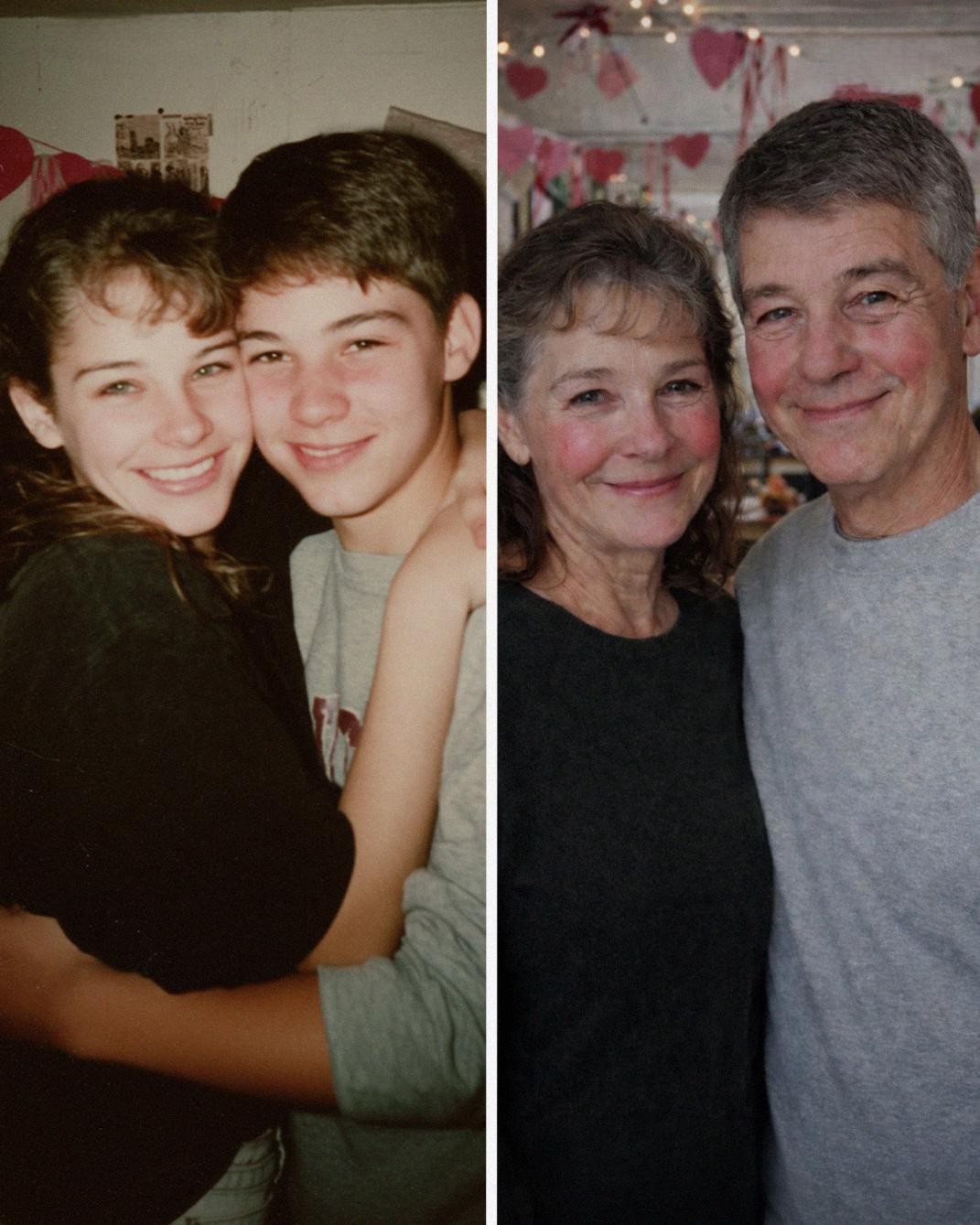
I am sixty-four years old, and for most of my life, I have perfected the art of keeping busy. It’s not that I enjoy it, exactly, but it has become the only way to outrun the heavy silence inside me. My daughter, Melissa, calls it “productive denial.” She says it with a knowing smile, as if she has figured out the underlying truth of who I am. My son, Jordan, watches me with a quiet, observant intensity, as though trying to calculate how much longer I can keep up this façade before it all collapses. He’s seen me fill the house with activity, from food drives to coat collections, and even church suppers—all of which I volunteer for. Keeping my hands busy, I believe, is the only way to keep my heart from wandering back to the places it has been broken, the memories I have buried so deeply. Helping strangers has always felt like a safe harbor: it requires empathy but no real vulnerability. It is far easier to care for others than to sit in a quiet room and face the reflection of my own unhealed wounds.
As Valentine’s Day neared, I found myself volunteering at Cedar Grove, a local assisted living facility. The task was simple enough: write cards for the residents who rarely had visitors. The activity room was alive with the buzz of people cutting red construction paper and gluing lace doilies on cards, all with the faint, burnt aroma of communal coffee hanging in the air. Marla, the coordinator, handed me a clipboard with a list of names. “Some of these folks haven’t had a piece of mail in years,” she said quietly, her voice filled with a compassion I admired. “Your words might be the only kindness they see today.”
I scanned the list with the detached efficiency of someone checking off items on a grocery list, moving quickly through the names, until my eyes landed on one. Richard. The surname was the same. The middle initial—an echo of a name that had once meant everything to me—was unmistakable. My hand froze, and for a moment, the room felt suffocating. Richard. Forty-six years had passed since he had been my first love, the boy who swore he would never leave. Then, one summer night, he simply disappeared. No goodbyes. No explanations. Just an absence that weighed on me for decades.
At nineteen, I worked at my aunt’s hair salon, dreaming of the future Richard and I had planned. We would conquer the world together, of that I was certain. The night he was supposed to meet me at the Maple Street diner, the place where we had shared so many laughs and promises, I waited and waited. The coffee grew cold, and the waitress stopped offering refills. When I finally called his house, his mother simply said, “He’s not here,” and hung up. That was it. No further explanation. Just the ringing silence that followed.
Weeks later, in a clinic with peeling wallpaper, I found out I was pregnant. I didn’t tell Richard because I couldn’t find him. I didn’t tell my parents because I was terrified of the judgment. In time, I married a man for the sake of stability. He gave me Melissa and Jordan, but our marriage eventually dissolved in a quiet relief. And now, decades later, here I was, standing in Cedar Grove, staring at Richard’s name on the list, the ghost of him resurfacing in Room 402.
I wrote a generic card—Wishing you a happy day. You matter. Warmly, Claire—but something inside me told me I couldn’t just leave it in the basket. I had to deliver it myself. I asked Marla if it would be alright, and though she didn’t question it, I saw a flicker of concern in her eyes. With heavy legs, I made my way toward the common area. Kim, the nurse, pointed him out. He was sitting by the window, the winter sun casting shadows on a face that had aged but whose eyes were still the same deep, steady blue.
“Richard?” I whispered, my voice barely a breath.
He looked up, and for a moment, the years between us melted away. He whispered my name as though it was a prayer he had forgotten. We moved to the quiet of the library, where the smell of old books and lemon cleaner clung to the air. He read my card slowly, his lips trembling. “I never get mail,” he confessed, his voice hoarse, cracked.
The truth came out in fragmented pieces, each one unraveling the years I had spent in uncertainty. Richard hadn’t abandoned me by choice. His father—a man with an iron will and a terrifying temper—had found out about us. He had confiscated Richard’s keys, intercepted our letters, and sent him to live with an uncle across the country, under threat of disinheritance. Richard had been told I had moved on with my life, that I was married and happy. He had spent years believing he was the one who had been forgotten.
I left Cedar Grove in a daze, my hands white-knuckling the steering wheel. I didn’t call Melissa. I didn’t call anyone. I went home, sat in the dark, and let the memories of the clinic and my lonely years of early motherhood wash over me. By midnight, I knew the truth: while Richard’s absence had shaped my past, it would no longer have the power to define my future. If there was to be a reckoning, it would be on my terms.
The next morning, I called Jordan. He arrived within the hour, practical and alert. I told him about Richard, about the past, and then, finally, I said the words I had buried for nearly four decades: “When Richard left, I was pregnant. Jordan… he is your father.”
Jordan didn’t flinch. He didn’t ask why I had waited. He simply took my hand and said, “Let’s go see him. I’m coming with you.”
When we returned to Cedar Grove, everything felt different. The air was sharper, cleaner. We found Richard in his usual spot, and when I introduced Jordan, the color drained from his face. He looked at my son—a man who shared his brow, his height, his steady hands—and the years of lost moments began to break down in front of us.
“How old are you?” Richard asked, his voice trembling.
“Thirty-nine,” Jordan replied, his voice calm and respectful, yet distant.
Richard crumpled in front of us, tears flowing freely, a lifetime of missed opportunities and regrets flooding him. “I didn’t know,” he sobbed. “Claire, I swear, I didn’t know.” He explained that doctors had told him in his twenties he was sterile, a lie likely planted by his family to keep him isolated and dependent. He had lived his life believing he could never have children, that he would never leave a legacy.
I didn’t offer him the comfort of forgiveness. “You left,” I said firmly. “And I raised him alone. I’m not here for an apology, Richard. I’m here for the truth.”
We moved to the library again, the three of us, and Richard accepted the weight of his history. He acknowledged that by allowing his father to control his life, he had also controlled mine, and in doing so, had stolen both our futures. The silence that followed wasn’t empty; it was a space for the truth to finally breathe.
To my own surprise, I invited him to dinner. Not as a romantic gesture, but as an acknowledgment of the past we had shared and the future that was still within reach. “No more secrets,” I said, my voice steady. “No more disappearing. If you want to be part of our lives, you walk through the front door as yourself.”
Richard nodded, his hands shaking as he gripped his cane. He refused the wheelchair, choosing to walk out of the facility under his own power, supported by the woman he had once loved and the son he had never known. As the cold Arizona air hit my face, I realized that for the first time in sixty-four years, the quiet didn’t feel like an enemy. It felt like a new beginning.