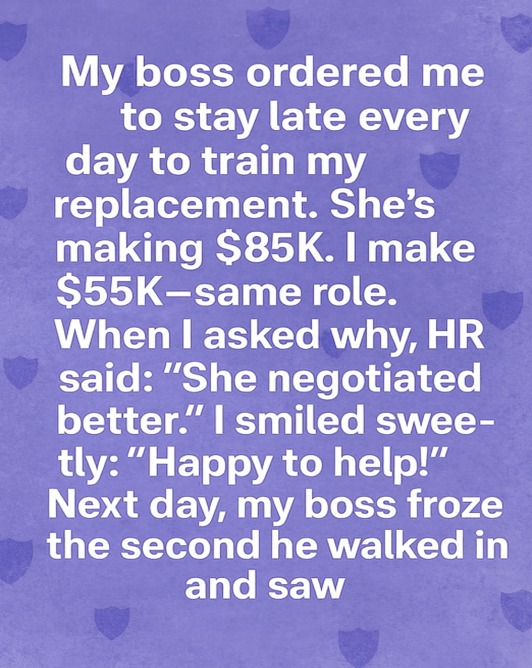
They didn’t even bother to hide it. Not even the slightest attempt at subtlety. One week I was quietly, dutifully training “extra help,” walking them through every nuance of my day-to-day responsibilities, explaining shortcuts I’d invented, and sharing the countless little hacks that made the impossible manageable. I smiled as I showed them how to navigate systems that management had never bothered to fix properly, offered tips on calming upset clients, and subtly coached them on how to keep up appearances in meetings. All of this, I did while knowing it was unpaid, unacknowledged labor—the invisible backbone of the department.
And then came the next week. HR called me into their bland, fluorescent-lit office, smiling like nothing was wrong, as though they had no idea what they were about to drop on me. I should have felt shock. I should have felt anger, maybe betrayal so sharp it cut through everything I’d built. Instead, there was just this hollow recognition: she, the person I had spent countless hours training, coaching, mentoring, was now officially earning $30,000 more than I ever did—for my exact job. Not a promotion. Not a raise. No acknowledgment of my contributions, of my loyalty, of my expertise. Just proof—proof that I had been quietly underpaid and overused, proof that my hard work had been quietly exploited while others got to cash in. And in that moment, I smiled. Not because I was happy, not because I was amused, but because I realized I had a choice. They thought I was still trapped in their system. They thought I’d continue to perform invisible labor for invisible credit. They were about to learn exactly what I had learned: that being taken for granted has a cost, and it’s not mine to bear anymore.
I treated that final week like an exit interview they didn’t even realize they were having. I arrived each day fully aware of the power shift that had just occurred in my mind. Every action, every decision, every conversation became intentional. By consciously separating my official duties from the mountain of invisible work I’d been quietly absorbing for years, I forced management to confront how deeply they had relied on my silence, how much they had taken for granted that I would continue to keep the machine running without complaint. Every time I said, “That’s not in my job description,” it landed with a precision I had never allowed before—a mirror reflecting their dependence, their oversight, and their entitlement. Their panic was palpable, even if unspoken. It radiated in frantic emails, rushed meetings, and whispered questions behind closed doors. And the beauty of it was that none of that panic was my problem anymore. The consequences of their choices were theirs alone to bear.
I became conscious of every little act that management had relied upon my invisibility to sustain. The way I had stayed late, recalibrating spreadsheets no one asked for; the way I had mediated conflicts quietly, without acknowledgment; the way I had created training materials for new hires, only for them to benefit from my labor without ever recognizing the depth of my work. Each day, I gave them a small glimpse of what running things without me would look like. I slowed down, documented every process meticulously, pointed out inefficiencies I had patched, and let them stumble slightly in the gaps they had assumed I would fill automatically. It wasn’t revenge—it was clarity. It was the final, undeniable proof that my work mattered, and that my absence had value.
Walking out the door that last day, I felt a clarity I hadn’t known for years. Loyalty without respect, I realized, is not virtue; it is exploitation dressed up as gratitude. That loyalty—my willingness to go above and beyond without acknowledgment, to silently carry the weight of systems that weren’t designed to sustain themselves—had been rewarded with invisibility and underpayment. But the lesson had finally crystallized: my time, energy, and expertise were my currency, and I could choose where to spend it. I no longer had to invest in a system that didn’t recognize my worth.
The role I accepted afterward didn’t just come with a higher salary—it came with boundaries, with clear recognition of my skills, and with the rare kind of calm that comes from knowing that you no longer have to beg to be seen. Every project I take on now has its limits; every request for overtime comes with the confidence to say yes or no without fear of repercussion. I am valued, visible, and properly compensated, and that changes everything about the way I approach my work. Sometimes the most powerful negotiation isn’t about asking for more—it’s about refusing to stay where you are worth less, refusing to participate in a system that doesn’t honor your contributions, and stepping into a space that does.
Now, months later, I look back on that final week not with anger, but with gratitude for the moment that forced my reckoning. The smile I wore that week was not naive—it was defiance and clarity combined. Every day I had poured myself into invisible labor had prepared me for the moment I chose myself over their assumptions, my worth over their oversight, my future over their shortsightedness. That week was my liberation, my classroom, and my final act of quiet power. And the truth is, once you step away from being taken for granted, the world suddenly expands. Opportunities appear where none seemed possible, boundaries protect your energy, and recognition finally catches up with your effort.
Sometimes, the system fails to see you, underestimates your patience, and undervalues your work. And sometimes, that’s the exact moment you discover how much strength, strategy, and clarity you have when you finally stop playing by their rules.