The Silent Man
Recounted by his granddaughter
My grandfather was always the quietest presence in any room he stepped into. He wasn’t shy, nor withdrawn, nor awkward in the way people often describe quiet men to make it sound kinder. He was simply someone who had, at some point in his life, decided that most things did not need to be said. He lived by that decision so completely that by the time I came to know him, his silence felt like part of his structure, as natural as his hands or his eyes.
He lived in a modest, aging house on the outskirts of a quiet town in Ohio. He drove a truck that had already grown old before I was born, kept a bird feeder in the yard, and could fix nearly anything mechanical using tools he had owned for decades. He never displayed medals or photographs from his years of service. Whenever I asked him about his past, he would smile gently, with the patience of someone who has been asked the wrong questions too many times to expect the right ones anymore.
“That was a long time ago, sweetheart,” he would say, and then shift the conversation so smoothly that, before you realized it, you were discussing something entirely different, unable to pinpoint when the change had occurred.
My parents found this deeply frustrating. My father often described my grandfather as difficult, saying it with the confidence of someone who believed that not expressing one’s own importance was a flaw. My mother handled her feelings with a kind of restrained politeness, like someone tolerating a recurring inconvenience she thought beneath her. He was rarely invited to holidays unless I insisted. He was never asked for input on family matters.
One Thanksgiving, my brother joked that Grandpa’s greatest accomplishment was simply never getting arrested. Everyone laughed except me. I watched my grandfather from across the room as he accepted the joke with quiet patience, just as he accepted everything else. Something tightened inside my chest, though I didn’t yet have the words to explain it.
During those gatherings, I would often leave the table and sit with him outside on the porch. He would sip black coffee and look out at the trees in the distance. Sometimes we talked about small things—the birds, the neighbors, my studies—and sometimes we just sat in silence, something he did better than anyone I’ve ever known.
He always told me I didn’t have to stay. I always told him I wanted to. His eyes would soften slightly, and he would nod. There was always something behind that softness, something heavier than simple sadness, something I could feel but not yet understand.
He wore a ring every single day. It was plain metal, slightly worn, with a small symbol engraved inside—not a name or a date, but something I couldn’t recognize. When I asked him about it at sixteen, he simply said, “It reminds me who I am,” and left it at that. I learned not to push further.
I was stationed two states away, serving as a Marine Corps officer, when I received the call. A neighbor said Grandpa had collapsed in his kitchen and was now in the county hospital. No one else had come. I requested emergency leave that same night, drove through the darkness, and arrived to find him already fading—surrounded by tubes, machines, and that strange hospital silence that feels like everything and nothing happening at once.
He smiled when he saw me. It was the smile of someone who had been waiting, unsure if that wait would be rewarded.
“Guess you’re the only one who remembered me,” he said.
I told him not to talk like that. I told him my parents would come.
“They won’t,” he replied softly. “But that’s okay.”
He passed away two days later. Quietly, just as he had lived. One breath—and then none.
When I told my mother, she simply sighed and said at least he wasn’t suffering anymore. That was all. No one offered help. No one asked what he would have wanted. I arranged everything myself: a simple service, a wooden coffin, five people in attendance—the priest, the neighbor who had called me, an elderly man who said he had once served with my grandfather but didn’t say where or when, and me.
That man’s face carried a careful kind of grief—something deeper than the situation seemed to warrant, something too large for a small funeral for a man most people had forgotten. My parents didn’t come. My brother sent a message: sorry, busy week.
I stood alone by the grave, listening to the soil fall, feeling something settle inside me that I couldn’t yet name. It wasn’t anger—at least not yet. It was the quiet sorrow of realizing, too late and too fully, that someone you loved had always been more than you were ever allowed to see.
Afterward, I returned to his house to gather his belongings. Most of it was ordinary: old clothes, war movies on VHS, a toolbox filled with tools he had kept clean and sharp. In his bedroom drawer, wrapped in a faded handkerchief, I found the ring. I took it—because it was his, because no one else would want it, and because the faint scent on the cloth reminded me of being small, safe, and held. That feeling seemed worth preserving, even if I couldn’t explain why.
My parents sold his house within three weeks. They didn’t ask if I wanted anything else. My father said he didn’t need it anymore—the house, everything in it, perhaps even my grandfather himself.
I wore the ring when I returned to base. At first, out of habit. Then because taking it off felt like something I wasn’t ready to do. It became a quiet presence—steady, unobtrusive—just like him.
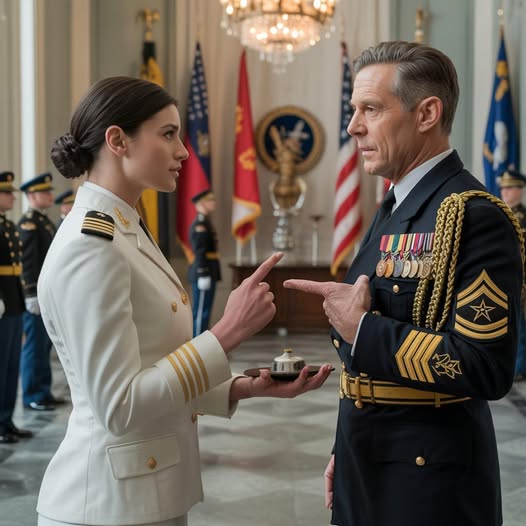
Weeks later, I attended a formal military commemoration for veterans. There were flags, speeches, honor guards—the carefully arranged display of institutional gratitude. I wore my dress uniform, polished and precise, and the ring without thinking. The room was filled with decorated officers, aging veterans, and their families. I moved through it with practiced composure, shaking hands, exchanging the usual words.
I noticed the general before he noticed me. Gray-haired, solidly built, the kind of man who seemed to draw attention naturally—people subtly turning toward him without realizing it. He was speaking to someone when his gaze shifted to my hand.
He stopped mid-sentence. Not abruptly, not dramatically—just stopped, the way someone does when something unexpected demands their full attention. He stepped closer, his focus fixed not on my face, nor my rank, but on the ring.
“Excuse me,” he said.
I turned toward him and gave the customary greeting for the occasion, but he didn’t respond. His gaze remained fixed on my hand. The symbol inside the ring caught the light between us.
“Where did you get that?” he asked.
His voice was low—neither harsh nor accusing—but it carried the tone of someone who had just encountered something completely unexpected, something that didn’t belong in this room, or perhaps even in this time. It was the voice of someone who needed answers before deciding how to react.
“It belonged to my grandfather,” I replied. “He passed away last month.”
His jaw shifted slightly. “What was his name?”
“Thomas Hail.”
Something changed in his expression—not surprise, but recognition. And behind that recognition, something deeper that I couldn’t quite interpret. He swallowed once.
“We should speak in private,” he said. “When you’re available.”
He handed me a card and stepped away. I remained standing there, surrounded by polite applause and quiet conversations, staring down at the ring on my hand, realizing for the first time that I might be carrying something I didn’t truly understand.
That night, I called my mother.
“A general recognized Grandpa’s ring,” I told her. “He acted like it was important.”
She gave a soft, dismissive laugh—the kind she used when something felt mildly embarrassing to her. “You’re overthinking it. Your grandfather always liked to believe he was more important than he really was.”
That phrase—liked to believe. Reducing an entire life to a self-invented illusion.
“He was a Navy SEAL,” I said. “That’s documented.”
“In some small unit,” she replied. “A long time ago. It doesn’t matter anymore.”
“It mattered to him.”
“Well,” she said, with a tone that shut the subject down completely, “it shouldn’t matter to you. Focus on your own future.”
My father was worse. When I brought it up, he sighed heavily, the kind of exaggerated frustration he reserved for things he found pointless. He said my grandfather had always been secretive, always acting like he knew things he couldn’t share. He said it had been exhausting.
When I told him Grandpa had saved lives, he shrugged and said many people do that, and it doesn’t automatically make someone a hero.
I sat there, looking at the man who had gone about his life while his own father died alone in a hospital room, and something finally became clear to me—something I had been approaching for years without fully understanding it.
My family hadn’t simply overlooked my grandfather. They had made a choice. Repeatedly. Consistently. A choice not to see him. Not to ask. Not to care enough to understand the man who had been right in front of them for decades—waiting with quiet patience, the kind that comes from knowing that waiting is all you’re allowed to do.
General Robert Whitmore’s office was in a modest building near a veterans center—not a military base, not a headquarters. Just a quiet place with a small flag outside. The receptionist recognized my name immediately and led me into a simple room with two chairs, a desk, and a single faded photograph of young men in outdated uniforms.
The general was already there. He gestured for me to sit.
“I owe you an apology,” he said. “I shouldn’t have reacted like that at the ceremony.”
“You recognized the ring,” I said.
“Yes. And I wasn’t expecting to see it on someone your age.”
I told him it had belonged to my grandfather. He nodded, and the way he said the name Thomas Hail—slowly, with weight—made something tighten in my chest.
“You served with him?” I asked.
“In a sense,” he said. “We were part of the same operational group.”
He paused, studying my expression, deciding how much he was willing to reveal.
“There are units within the military that don’t exist in official records,” he began. “They are created for missions that require plausible deniability. No public acknowledgment. No medals. No recognition. No history. If a mission succeeds, it never happened. If it fails, it never happened either.”
“So he was invisible,” I said. “On purpose.”
“Yes.”
I thought about my father’s words—how he had described my grandfather as secretive, as if it had been a flaw rather than a requirement.
“That ring isn’t a medal,” the general continued. “It’s a verification marker. Used internally to identify individuals cleared for operations that officially don’t exist. Most were destroyed after service. The fact that your grandfather kept his… that says something about him.”
“What does it say?” I asked.
He was silent for a moment. “That he understood the importance of remembering what he had done, even when the world was instructed to forget it.” He paused. “You said he told you the ring reminded him who he was.”
“Yes.”
“That’s not a small thing,” he said. “For someone in his position, the pressure to become no one was constant. Deliberate. That ring was how he held on to himself—the version of him that his work required him to erase for everyone else.”
I looked down at my hands.
“My family treated him like he failed at everything,” I said quietly.
The general’s expression hardened slightly. “That’s often what happens with this kind of service,” he said. “There are no parades. No ceremonies. No official records for family members to look at. There’s only the man—and the man has been told not to explain himself. So the people around him fill that silence with whatever story is easiest for them to believe.”
I drove back to base in silence, the radio off. I wasn’t exactly thinking—I was processing. Trying to reconcile the man I had known with the one I was now beginning to understand.
The man who fixed my bike. Who made burnt pancakes on Sunday mornings. Who fell asleep in his chair with the television on.
The man who sat on the porch, watching the trees, his eyes always a little tired—tired in a way that now made sense.
Tired from carrying something heavy. Something most people never come close to experiencing. Carrying it without complaint. Without recognition. Without ever being able to say: this is what I did. This is why I had to be silent. This is who I really am.
In the folder I had taken after the funeral, I found a letter I had never opened. It was tucked behind his discharge papers and a faded photograph of him in uniform. It wasn’t sealed—just folded, waiting.
If you’re reading this, then I’m gone, he had written. And if you found the ring, then you’re the only one who cared enough to look.
My throat tightened.
There are parts of my life I was never allowed to explain. Not to your parents. Not to anyone. That was the agreement. But I want you to know this: I never regretted what I did. I only regretted what it cost the people around me. If someone important ever asks about the ring, tell them the truth. That it was mine. That I trusted you with it. That’s all you need to say.
He had known.
He had known that one day someone would recognize the ring. And he had known that I would be the one holding it when that moment came. He had written the letter and left it there—not hidden, not locked away—just waiting.
The same way he had always waited for me, certain that I would come when no one else did.
I met the general one last time at the veterans center. It was a private room, and two older men were there as well—introduced only by their first names. They moved with the quiet efficiency of men who had once worn uniforms and never quite stopped being those men.
I brought with me a small metal box I had discovered taped behind a row of jackets in my grandfather’s closet. Inside was a folded flag, a list of handwritten names, and a thin black notebook filled with dates, numbers, and coded entries. In the margins, scattered unevenly, was the same symbol etched inside the ring.
The men examined the notebook in silence for several minutes. Finally, one of them exhaled.
“He kept better records than most,” he said.
“What do these numbers mean?” I asked.
The general closed the notebook carefully.
“Operational timelines,” he said. “Your grandfather documented events that officially never happened.”
“Why?”
“Because someone should,” the other man replied simply. His voice carried the weight of long reflection. “Even if it never becomes public. Even if no one looks at it for decades. There should be some record that it happened—that the people involved were real.”
The general leaned slightly forward. “There are people alive today who have never heard your grandfather’s name,” he said. “They are alive because of him. During the Cold War, he carried out operations that extracted intelligence assets from situations where extraction should have been impossible. He did it more than once. In internal documents, his commanding officers referred to him as the primary operative. That term appears repeatedly in the files that have been partially declassified.”
“And he got nothing,” I said. It wasn’t a question.
“Receiving anything would have confirmed those operations existed,” the general replied. “So no—no recognition, no ceremonies, no official record. He came home, lived quietly in Ohio, repaired things, fed birds, and was overlooked by his own family, while the people whose lives he saved continued on without ever knowing his name.”
I sat with that for a long time. I thought about my brother’s joke at Thanksgiving. I thought about my mother’s dismissive tone on the phone—he liked to think he was special. I thought about the folder that had sat untouched for decades, empty of proof, empty of recognition, because that proof had been deliberately erased.
I thought about his tired eyes on the porch, and for the first time, I understood them fully—not the tiredness of age or defeat, but the accumulated weight of a life lived in intentional obscurity, for reasons he could never explain to the people who needed to understand the most.
He hadn’t been invisible. He had been unseen. And those are not the same thing. Invisibility is a condition. Being unseen is a decision others make about you—and it is far harder to carry.
That weekend, I went to my parents’ house. I sat across from my father at the kitchen table and placed the letter, the notebook, and copies of the documents in front of him. I watched him read.
About two-thirds of the way through, his hands began to tremble. By the time he finished, he no longer looked like the man I had grown up watching dismiss my grandfather so easily. He looked smaller. More real.
“This… this can’t be true,” he said quietly.
“A general confirmed it,” I replied. “Multiple retired officers recognized his work. The records exist.”
My mother hadn’t spoken. She was staring at the letter, one hand covering her mouth.
“Why didn’t he tell us?” she asked.
I had prepared a gentle answer for that question. I chose not to use it.
“Because you never wanted to hear it,” I said. “Every time he tried to touch on his past, you made it clear it was inconvenient. He spent decades following orders—and then came home and followed another kind of order from his own family: be nothing, take up no space, have no story worth asking about.”
My father stared down at the floor. My mother began to cry. My brother, sitting at the end of the table, admitted quietly that once he had told Grandpa he was too busy to help him—and he said it with the voice of someone who had carried that small, specific regret for years without knowing how to name it.
“You let him die alone,” I said. There was no anger left in my voice—only sorrow. “And he never blamed you for it. That’s who he was.”
My father looked up. “We didn’t deserve him,” he said.
I didn’t argue. It was the truest thing he had ever said about his father, and it deserved to remain exactly as it was.
A few weeks later, my parents asked if we could hold a second service. Not a military ceremony, not an official recognition—just a proper goodbye. The kind that should have happened the first time.
We invited neighbors who remembered him, veterans from the center, the older man who had stood quietly at the first service. The general came as well, standing in the back without introducing himself.
There were no speeches about heroism. No medals.
There were stories.
Stories about the man who fixed things without ever asking for payment. The man who brought soup to sick neighbors and left it on their porch before they could answer the door. The man who sat at the veterans center and listened—really listened—without interrupting, without drawing attention to himself.
Small stories. Ordinary ones. The kind that only matter when you understand the life behind them.
My father stood at the grave. His voice shook.
“I spent my life judging people by what they showed,” he said. “And I missed the best part of my own father.” He paused, staring at the headstone. “I’m sorry. I should have asked better questions.”
I stood a few steps away, holding the ring, thinking about a line from one of the letters the general had given me—letters written by men whose names I didn’t know, thanking my grandfather for things they couldn’t fully describe:
You taught us that the hardest missions are the ones where no one ever knows you were there.
He understood that. Not just as part of his work, but as a truth of his life. He lived it—not with bitterness, not with resignation, but with a quiet acceptance that came from believing in what he had chosen, even when the cost was greater than expected.
The cost of secrecy is isolation.
He paid it. Every year. Every holiday. Every dinner where his silence was mistaken for emptiness instead of discipline. Every moment my parents dismissed him. Every joke my brother made that he accepted without reaction.
He paid it—and never complained.
And I think, somewhere inside, he held onto a small hope that one of us would eventually ask the right question. Not demand answers. Not push. Just ask—with genuine curiosity, with the belief that the answer mattered.
He waited a long time for that.
I had come closest, but I was young, and he had been trained to deflect, and the habit of not asking had settled quietly into me.
He left me the ring because he understood something: the ring itself was the question. Not an explanation—but an invitation. Something that would eventually find the right person, at the right moment, and start the conversation he could no longer have.
He had planned for that moment with the same patience he brought to everything else. And it worked.
I followed that invitation.
And there we were, standing at his grave in the late afternoon light—my family finally present, finally aware—and something shifted. Something unspoken, but real. The feeling of a truth that had been suspended for years finally finding where it belonged.
In the months that followed, my parents changed—not suddenly, not dramatically, but slowly, the way real change happens.
My father visited the veterans center one afternoon and sat with the older men, listening to their stories. My mother returned to my grandfather’s neighborhood, apologized to the neighbor who had called me from the hospital, brought flowers, stayed for an hour, and asked about him—who he had been, how he had lived.
They donated the money from selling his house to a veterans’ support fund, quietly, without attaching his name to it—exactly the way he would have done it.
And they began to speak about him differently.
Not as a disappointment. Not as an inconvenience.
But as a lesson.
And that difference changed everything.