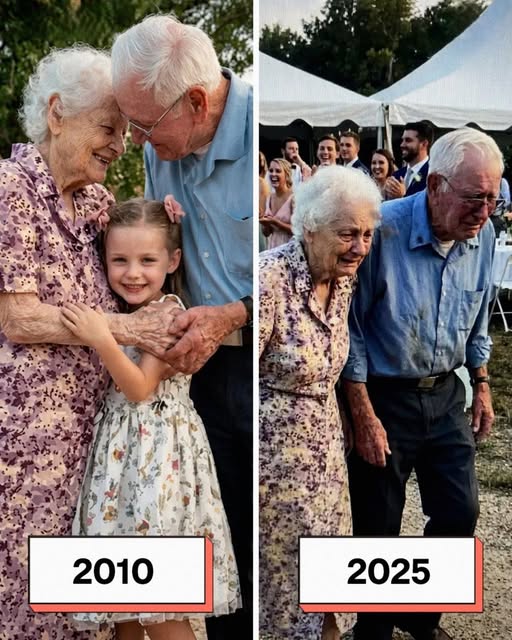
The human heart has a frightening ability to divide itself, to hide the most sacred parts of its past in order to create a more convenient present. For most of my life, my story was one of sacrifice and survival, written into the tired faces of Nana and Papa. When my biological parents disappeared into addiction and instability, they were the ones who stepped forward. My childhood unfolded in a modest home with creaking floors and the sharp scent of Pine-Sol—a home built not on comfort or money, but on the stubborn love of two people who chose a child over themselves.
Nana and Papa shaped my future with their hands and their backs. Papa worked as a janitor, forcing his aching knees and failing spine through long shifts, while Nana cleaned the homes of the wealthy until bleach burned her skin raw. Yet they never allowed me to feel the weight of their struggle. They called me their “miracle,” carefully hiding the truth that every school trip, every notebook, came from money taken out of their grocery budget. “Enough is a blessing,” Nana would say, words that became the foundation of our lives. For eighteen years, they climbed uphill so that I could one day stand somewhere they never would.
That world, when I finally reached it, was colder than I expected. At university, where I studied on a scholarship, I was surrounded by students who spoke casually about trust funds and international travel. Compared to them, my truth felt like a weakness. Slowly, I built a new version of myself, supported by small but deliberate lies. I said my parents were gone—which was true—but allowed people to believe I had been raised by distant, wealthy relatives. I softened my accent, corrected my posture, and learned to imitate confidence. I erased the girl who had once worn shoes held together with duct tape.
By the time I met Andrew, the lie had become part of my identity. He was everything I thought I wanted—wealthy, secure, and certain of his place in the world. He admired my “strength,” believing it came from a polished but tragic upbringing. I never corrected him. I let him believe I had money saved, a comfortable background, and as our relationship moved toward an extravagant wedding, the truth became something monstrous I refused to face. I kept Nana and Papa at a distance, offering vague excuses, terrified that their presence would shatter the image I had created.
The lie collapsed on my wedding day. Through social media and small-town connections, Nana and Papa learned about the ceremony. They didn’t come to confront me—they came out of love. They arrived in their best clothes: Papa in his carefully pressed, decades-old suit, Nana in her floral church dress, holding the same worn cloth bag they had carried for years. They stood out immediately, like remnants of a past I had tried to bury, in a place that was never meant for people like them.
Andrew saw them not as family, but as strangers disrupting his perfect day. Because I had never told him the truth, he acted with cold authority and had them removed. I stood nearby in silk and lace, watching silently as the people who raised me were pushed away. Nana looked around the room until her eyes found mine—and in that moment, she understood I would not step forward. I remained frozen, afraid of embarrassment, afraid of losing status. I let them leave. I turned back to the music and the celebration, pretending my heart had not just shattered.
The reality of what I had done didn’t fully hit until weeks later. After returning from our honeymoon, where I tried to drown my guilt in sunlight and blue water, a package arrived at my office. Inside was the familiar cloth bag. There was a note from Papa, written in unsteady handwriting. Nana was gone.
The world tilted. I collapsed at home and finally opened the bag Andrew had dismissed so easily. Inside were envelopes—dozens of them—each carefully labeled in Nana’s neat handwriting: For books. For emergencies. For when she feels alone. When I opened them, small bills spilled out—money folded and refolded over years. These were the sacrifices they had made quietly: meals skipped, repairs postponed, comfort denied. While I was ashamed of them, they were preparing for my future. Every envelope was proof of a love I had been too blind to honor.
When I confronted Andrew, I told him everything. I laid the envelopes between us and explained the truth I had hidden for years. He was devastated to realize he had unknowingly played a role in such cruelty, but the fault was mine alone. I had allowed his ignorance to protect my pride.
I returned to my hometown and found Papa sitting on the porch, older and smaller than I remembered. I dropped to my knees and begged for forgiveness I did not deserve. In the same quiet grace that defined his life, he held me and whispered, “I forgive you. And she would have too.”
I walked back into that house not as the woman I had pretended to be, but as the girl who knew that enough is a blessing. The money in the cloth bag remains untouched—a sacred reminder of real love. I learned that the most expensive dress means nothing if it hides an empty soul, and that the only true inheritance is found in the worn, hardworking hands of those who never let you fall. I finally stepped out of my lies and into the painful, honest light of the life they sacrificed to give me.