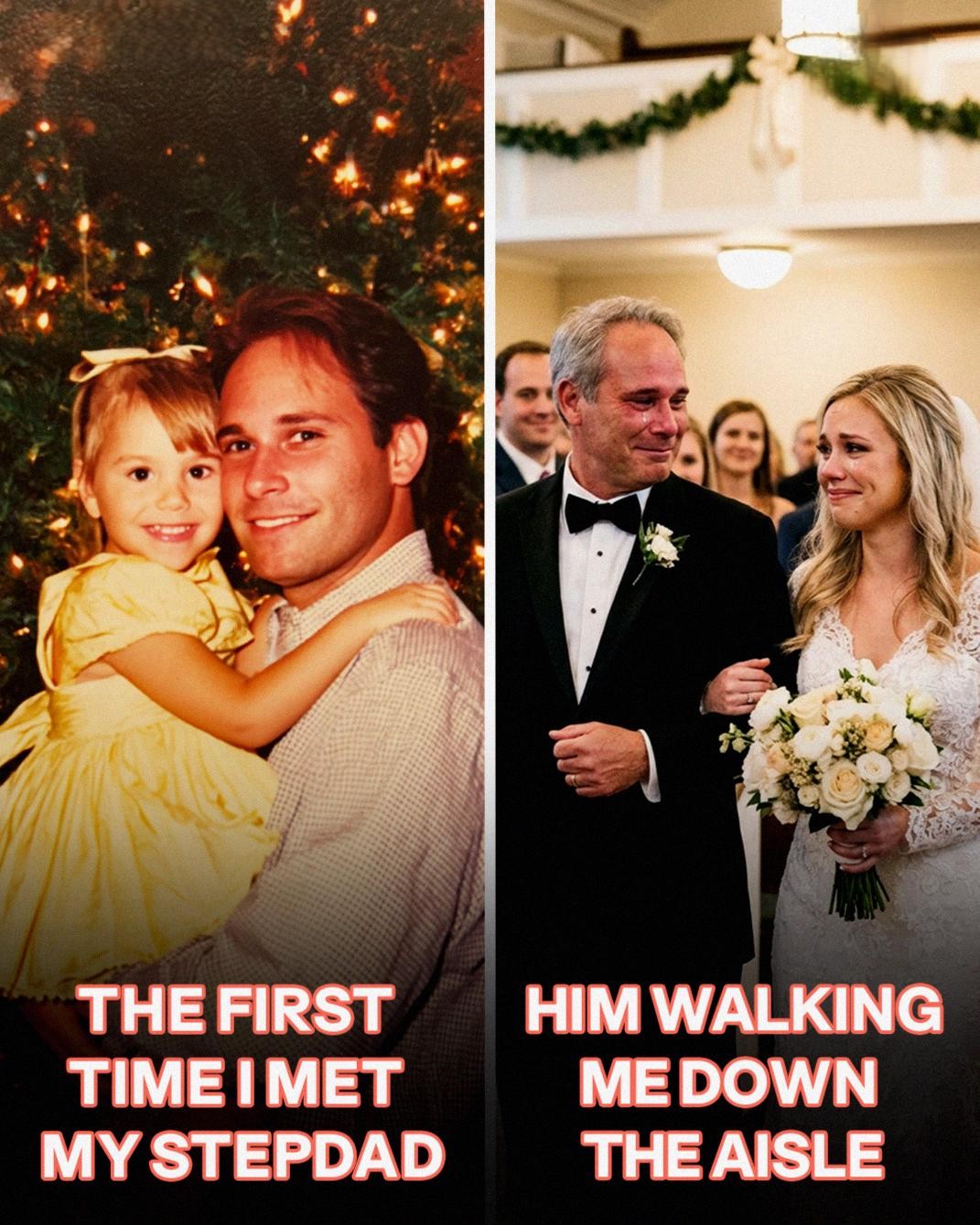
I spent my childhood believing my father died when I was eight. There was no funeral to attend, no headstone to visit, no familiar jacket hanging in a closet carrying his scent. Instead, there was one quiet afternoon when my mother sat across from me, her voice steady in a way that felt rehearsed, and told me simply, “He’s gone, Stephanie. You need to let him go.” That was all. No explanations, no memories shared, no room for questions. Just a clean ending.
I accepted it without protest. That’s what children do when adults speak with confidence. When teachers asked about my family, I said my father was dead. When classmates compared losses as if they were badges, I repeated the same word. Dead. It sounded complete. My mother kept no photos of him, marked no dates, spoke his name never. She said remembering hurt too much, and I learned quickly that silence was safer than wondering.
Then, a year later, Dan appeared in our lives.
He didn’t try to replace anyone. He didn’t demand affection or manufacture closeness. He just stayed. He drove me to school, waited in stiff chairs outside exam rooms, fixed things quietly before they became problems. He slipped me money when I needed it and never asked why. For years, I resisted him out of loyalty to a man I barely knew, convinced that accepting Dan meant betraying my father’s memory.
Once, as a teenager, I snapped at him for trying too hard. To my surprise, he agreed. “I know,” he said softly. “I’m not your dad.” Then he paused. “But you feel like my daughter.” That moment didn’t explode into anything dramatic. It simply settled, like something finally clicking into place.
Years later, when Noah proposed, I never questioned who would walk me down the aisle. I asked Dan. He looked stunned, as though I’d handed him something delicate and priceless. I mistook the look in his eyes for pride. I didn’t yet recognize it as guilt.
On my wedding day, everything buzzed with nervous joy. Dresses whispered. Brushes clinked. My mother moved sharply, restless. Dan stood by the window, adjusting his cufflinks over and over. When I teased him about being nervous, he smiled and said he just didn’t want to ruin anything. I told him he never had.
Just before the music began, he took my arm. His hand rested at my wrist, grounding me. He leaned close and said, “There’s something you should know.” I laughed, assuming it was emotion talking. Before he could continue, a scream sliced through the room.
The doors stood open. A man I didn’t know stepped inside.
He looked nothing like the ghost I’d imagined. Older. Worn. His face carried something heavier than time. When his eyes locked onto mine, my mother let out a sound I’d never heard—raw, animal. She told me not to look. Dan instinctively stepped in front of me.
The man spoke calmly. “You’ve been lied to for fifteen years,” he said. “And you deserve the truth.”
My chest went hollow. I already knew. “My name is Nigel,” he said. “I’m your father.”
The ceremony dissolved. Guests were ushered away. Noah stayed beside me, silent and steady, letting me lead. I wanted answers immediately.
That night, in a stripped-down hall still faintly scented with flowers, Dan told me everything. Nigel hadn’t died. He’d gone to prison for corporate fraud. My mother chose absence over waiting, lies over complexity. Nigel wrote letters every year—birthdays, holidays—letters I never received. Dan knew. He stayed silent, believing he was protecting me.
I met Nigel a week later in a roadside diner, over bitter coffee and cracked booths. He watched me like someone afraid I might disappear. He told me he never stopped thinking about me. That he came to the wedding because he couldn’t bear being erased any longer. I believed his regret. But belief didn’t turn him into my father. He was still a stranger, just one with familiar eyes.
The next day, I confronted my mother. She acted unfazed, stirring blueberries into a bowl as if nothing had shifted. When I told her I was done, she seemed more annoyed than devastated. She said she did what she had to do. I told her she did what was easiest. That she erased a man and taught me silence instead of honesty. I left without waiting for a response.
Noah and I married weeks later in his parents’ backyard. Quiet. Simple. No audience waiting for disruption. Dan walked me down the aisle again. His hands trembled; his smile held firm. When he placed my hand in Noah’s, he whispered that I had a good heart and not to let anyone harden it.
Nigel attended, staying in the back. We speak now carefully, like people learning a language without a guide. I don’t know what role he’ll have in my life, if any. What I do know is this: love isn’t proven by blood or dramatic entrances. It’s proven by showing up. By staying. By choosing someone again and again when it’s inconvenient.
For most of my life, I believed my father was dead. The truth is, he was absent. And the man who stayed—the one who showed up quietly and imperfectly—was the one who earned the place beside me.
We don’t get to choose how our story begins. But we do choose how it continues. I choose peace. I choose honesty. And I choose the people who never left.