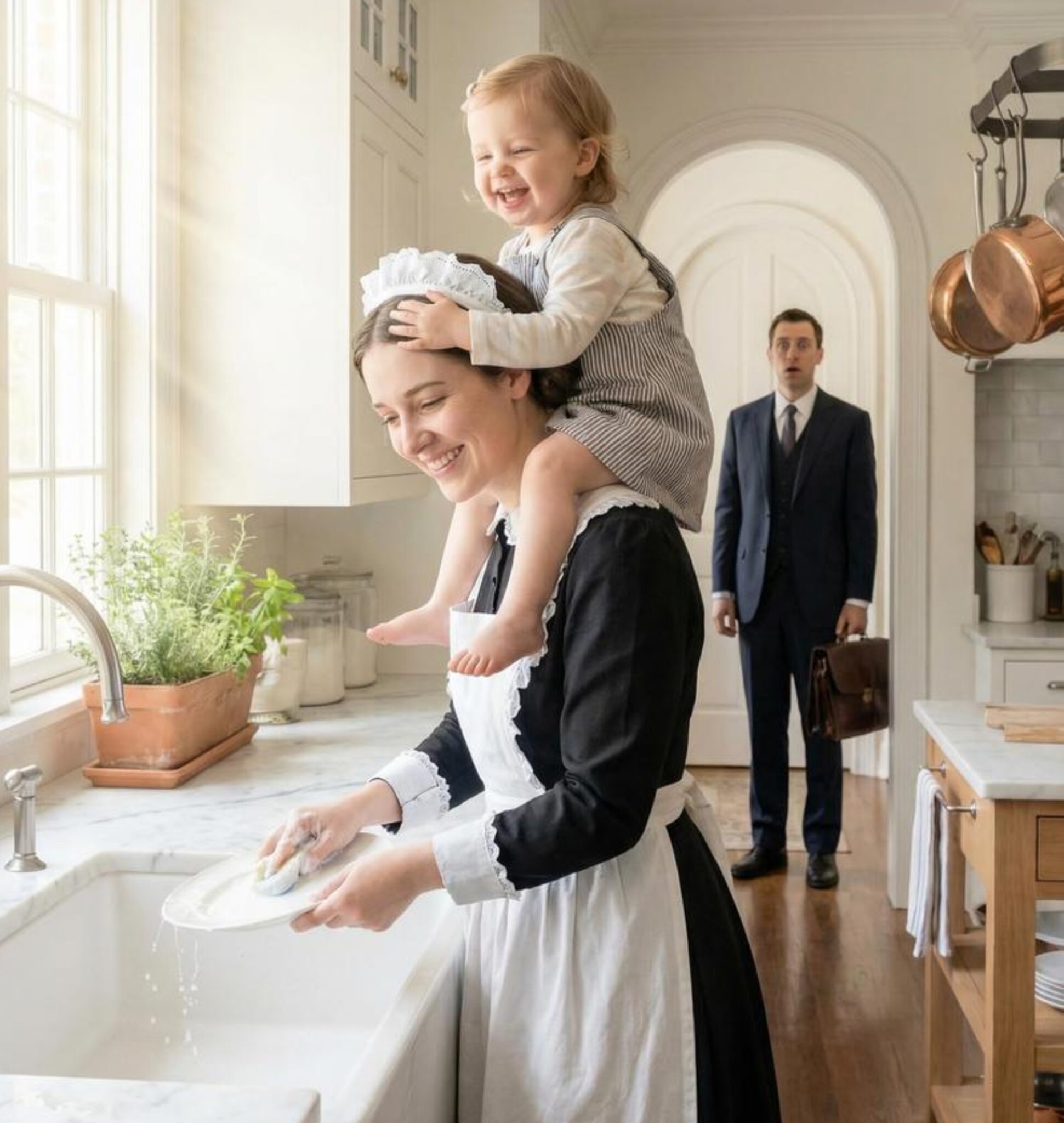
I came home early that afternoon because the meeting in Zurich had been canceled without warning. For once, I didn’t call ahead. No assistant. No driver waiting outside. Just me, my briefcase, and the quiet, almost trembling thought that I might surprise my family.
For illustrative purposes only
I remember thinking, Maybe this is what normal fathers do. They just… come home without warning, without schedules, without being announced—just appear, ready to be present.
The house was too quiet when I stepped inside. Not peaceful—empty.
Sunlight poured through the tall windows, bouncing off marble floors that had cost more than my first apartment. Somewhere in the distance, water was running. I followed the sound toward the kitchen, each step heavier than the last, my chest tightening with anticipation.
That was when my legs almost gave out.
At the sink stood Anna, our housemaid, washing dishes. That alone wouldn’t have shaken me. She’d been in our lives for years, a steady presence. But what shattered me was the little girl perched on her shoulders.
My daughter.
Barefoot. Laughing so hard she could barely breathe. Her small hands tangled in Anna’s hair as she squealed with delight, bouncing slightly every time Anna shifted her weight. Anna laughed too—soft, warm, completely unguarded—one hand scrubbing a plate, the other holding my daughter’s leg as if it were the most natural thing in the world.
For a moment, I couldn’t move.
Because I had never seen my daughter look that happy. Not with me. Not with her mother. Not with all the toys, tutors, and carefully planned playdates money could buy.
My heart started racing. Questions flooded my mind: Why is my child with the maid? Where is my wife? Why does this feel like I’m intruding on something real?
Anna whispered something playful. “Careful, princess. You’ll make me dizzy.”
My daughter giggled and pressed her cheek against Anna’s head.
That was when my vision blurred. I cleared my throat.
Anna turned around, startled. My daughter spotted me instantly.
“Daddy!” she shouted.
I waited for her to reach out to me.
She didn’t.
Instead, she looked down at Anna first—as if asking permission. Something inside me cracked.
My wife appeared in the doorway moments later. When she saw me, the color drained from her face.
“You’re home early,” she said quietly.
“Yes,” I replied. “Apparently.”
No one spoke. The silence felt heavier than any boardroom standoff I’d ever survived.
Finally, I asked the question that had been burning through my chest.
“How long?”
My wife’s shoulders slumped. “A while.”
“A while since when?” I pressed.
She swallowed. “Since I couldn’t do it anymore.”
For illustrative purposes only
I looked at Anna, who immediately lowered her gaze. “Sir, I’m sorry. I never meant—”
“This isn’t about you,” I said, my voice unsteady. “It’s about me.”
I turned back to my wife. “Where were you this afternoon?”
She hesitated, then whispered, “In bed. I couldn’t get up. Some days I can’t even breathe properly. The doctors say it’s postpartum depression.”
The words landed softly—but they destroyed me.
Because suddenly, everything made sense.
The distant smiles.
The missed moments.
The way my daughter sometimes cried when I held her, but calmed instantly in Anna’s arms.
Anna spoke again, her voice trembling. “She cries when she wakes from naps. She calls for her mother… but when no one comes, I stay with her.”
Calls for her mother.
I felt my chest tighten.
I crouched down and held out my arms. “Sweetheart, come to Daddy.”
My daughter hesitated. Just a second. Then Anna carefully lifted her down and placed her in my arms. She hugged me—but her body was stiff, unsure.
That night, I didn’t go back to my office. I didn’t open my laptop or answer a single email. I sat on the nursery floor while my daughter slept, watching her tiny fingers curl around nothing, replaying the image of her laughter on someone else’s shoulders.
I had built empires. But I had missed my child’s childhood—one quiet afternoon at a time.
The next morning, I did something no one expected.
I canceled three projects. Sold one company. Cleared my calendar.
I hired professionals—not to replace Anna, but to help my wife heal. Therapy. Medical support. Time without guilt.
And Anna? I asked her to sit down with us at the table.
“I owe you more than a salary,” I told her. “You didn’t just clean this house. You held our family together when we were falling apart.”
She cried.
We changed her role—not as “the help,” but as our daughter’s caregiver, with clear boundaries, respect, and a voice. She became someone my daughter could love without secrecy or shame.
Months passed.
One afternoon, I came home again—early. This time, my daughter ran straight toward me.
“Daddy!” she screamed, arms wide open.
She didn’t look back for permission. She didn’t hesitate. She chose me.
And in that moment, I understood something no business school ever taught me:
Success isn’t about what you earn. It’s about what you almost lose—and choose to fight for before it’s too late.
For illustrative purposes only
The memory of that first afternoon—the one where I almost missed her entirely—stayed with me forever. Every late-night meeting, every skipped dinner, every urgent email reminded me that time with her could never be replaced. Every hug, every laugh, every bedtime story became sacred. I learned that even when life demands everything, showing up for the people who truly matter is the measure of achievement.
Note: This story is a work of fiction inspired by real events. Names, characters, and details have been altered. Any resemblance is coincidental. The author and publisher disclaim accuracy, liability, and responsibility for interpretations or reliance. All images are for illustration purposes only.