We had been in Maine only a few weeks when the woods behind our rented cottage changed everything I thought I knew about myself.
After sixteen years in Texas, the move felt like a fresh start. The air was sharper, cleaner. The silence had weight, not noise. My wife, Lily, said the place smelled like winter mornings and pine. Our eight-year-old son, Ryan, ran ahead of us everywhere, thrilled by the endless-looking forest. Even our Doberman, Brandy, moved differently here—more alert, more alive.
That Saturday felt ordinary in the best way. We went into the woods to look for mushrooms—nothing dangerous, just something Lily could cook later, while Ryan boasted about being a “real forager.” Light filtered through tall pines, and the ground was soft with moss and fallen needles. It felt like the kind of day that quietly settles into memory.
Then Brandy’s bark changed.
It dropped low, sharp with warning. My stomach tightened immediately. I looked around.
Ryan was gone.
“Ryan?” I called, forcing calm into my voice. “Hey buddy… this isn’t funny.”
No answer.
Brandy ran ahead, barking urgently, not aggressively but with purpose. I pushed after her, branches scraping my arms, roots catching my boots. The air grew colder the deeper I went, and the forest felt strange and silent.
Then I heard it—Ryan’s laughter.
Relief hit me so hard my knees went weak. I broke into a clearing and froze.
Headstones.
Not many, but enough to make the place heavy and strange. Old stones, weathered, some surrounded by dried bouquets tied with faded ribbons. Someone had been visiting here for years.
“Daddy!” Ryan called. “Look! I found a picture of you!”
My chest tightened. “What do you mean a picture of me?”
He was crouched by a small stone tucked between two trees, tracing something with his finger. As I stepped closer, the world tilted.
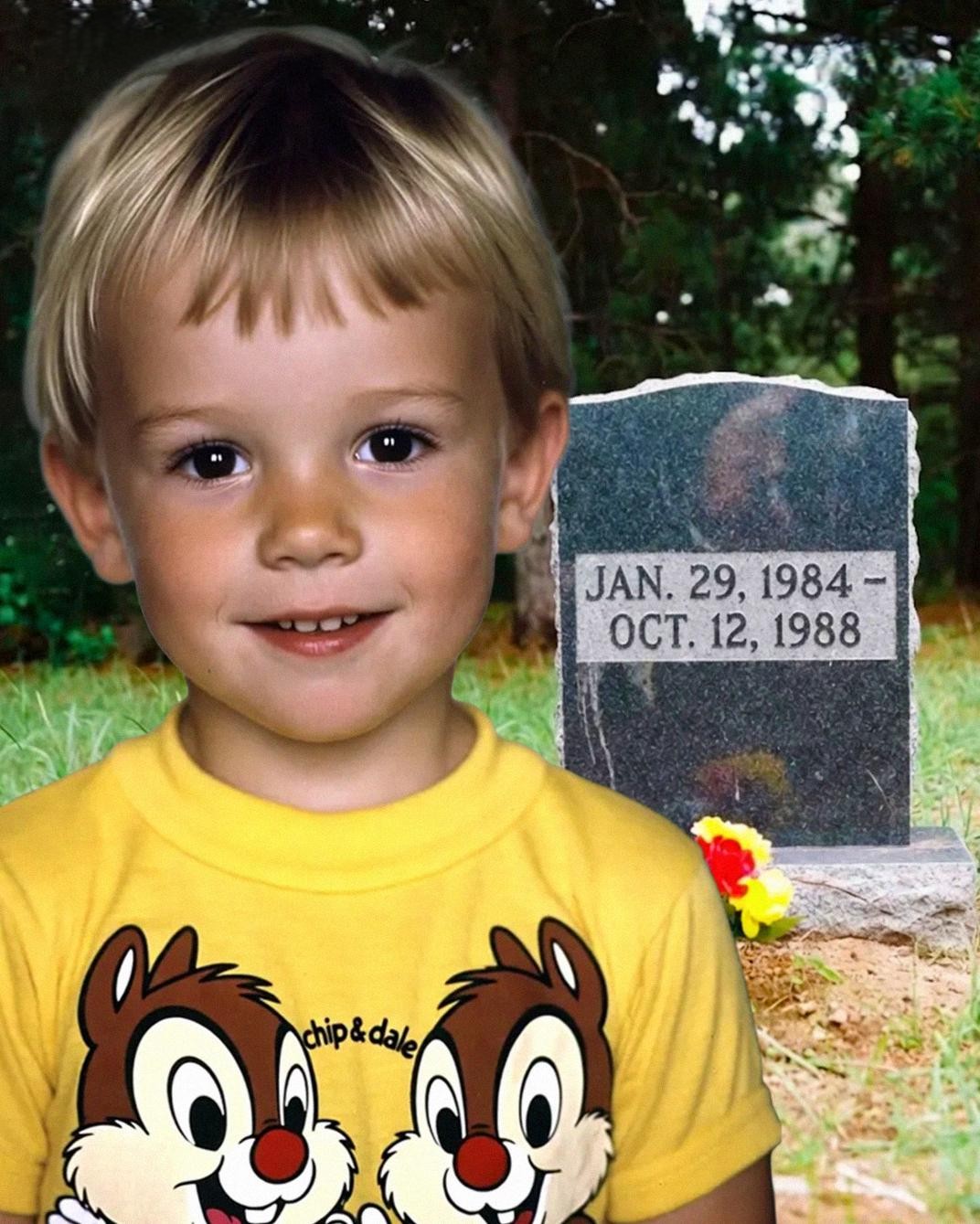
Set into the stone was a ceramic photograph.
It was me.
Four years old, maybe. Hair a little too long, a yellow shirt I barely remembered. A face looking back at me, unfamiliar and yet strangely known.
Below it was a date: January 29, 1984.
Lily grabbed my arm. “Travis, this isn’t right. We need to go.”
But I knelt anyway, touching the cold edge of the frame. Something inside me shifted—not panic, not fear, but recognition. A door opened in a place I didn’t know existed.
That night, after Ryan was asleep, I stared at the photo on my phone. I knew I had been adopted at four. A firefighter had found me outside a burning house in Texas. No parents. No records. Just a note pinned to my shirt with my name.
Lily asked quietly, “Did your mom ever mention Maine?”
“No,” I said. “She said she didn’t know anything before the fire.”
The next day I went to the local library. The woman at the desk frowned when I described the clearing.
“There used to be a cabin back there,” she said. “It burned down. The family died. People don’t talk about it anymore.”
She hesitated, then added, “Try Clara M. She’s almost ninety. Lives near the market. She remembers everything.”
Clara opened the door and stared at me as if she’d seen a ghost.
“You’re Travis,” she said. Not as a question.
Inside, the house smelled of cedar and apple tea. I showed her the photo. She studied it for a long time, hands trembling.
“That was taken by your father,” she said softly. “The day after your and your brother’s fourth birthdays.”
“My brother?” My voice cracked. “I had a brother?”
“A twin,” she said.
I sank into a chair. My heart pounded.
She told me about the fire, the cabin, my parents. Three bodies were found; one child was missing. Everyone assumed the worst.
“Your Uncle Tom never did,” she said. “He placed the stone. He always believed one of you might have survived.”
Tom still lived on the edge of town.
When he opened the door, he looked at me for a long moment before stepping aside. The house was warm, quiet, filled with books and the smell of soup.
“You look just like your father,” he said.
He showed me old boxes—charred drawings, birthday cards addressed “To Our Boys.” At the bottom, a small yellow shirt, scorched on one sleeve. I took it home.
A week later, we returned to the clearing. I placed the card at the base of the stone.
“Are we visiting your brother?” Ryan asked.
“Yes,” I said. “His name was Caleb.”
“I wish I could have met him.”
“So do I,” I said.
As the wind moved through the trees, I realized something I had never allowed myself to feel: I hadn’t been abandoned. I had been lost. And somehow, despite fire, silence, and decades of unanswered questions, I had found my way back.
Not to a grave—but to a story.