I never told my son the full truth about how I paid his college enrollment deposit.
I told Jack I had savings. I told him I had it handled. That’s what parents say when they don’t want their child to feel the panic behind the curtain—before the first class, before the first textbook, before the future they’ve been building has even begun.
He never pressed for details. Maybe he trusted me completely. Maybe he sensed that asking would only add a burden he wasn’t ready to carry.
The truth was simpler and heavier than anything I ever said out loud.
I sold the last real thing I had left from my marriage.
My wedding ring.
The Night He Came Into the Kitchen With the Acceptance Letter
Jack had earned his place. Scholarships covered part of it. Loans covered another part. He had done everything right—the exhausting applications, the essays, the waiting, all of it.
But there was still a gap. Not a dramatic one. Just the first payment. The enrollment deposit. The small but decisive number that turns acceptance into reality.
He came into the kitchen one Wednesday evening holding the acceptance packet in one hand and the cost sheet in the other.
“I got in,” he said.
I dropped the dish towel and pulled him into a hug before he could even finish the sentence.
“Mom… air,” he laughed against my shoulder.
Then he handed me the second page.
The smile faded from his face first. Mine followed right after.
He saw it happen and immediately went into the way good kids do—trying to protect you from the weight they’re about to carry.
“I can say no,” he said quickly. “I can go local. It’s fine. There are good programs here.”
“No,” I said.
“Mom, look at the number.”
“I am looking.”
“We don’t have that.”
I folded the paper and set it down like that could soften it.
“We will,” I said.
He stared at me. “How?”
“I’ll figure it out.”
Three days later, I stood under bright, unforgiving lights in a jewelry store while a man behind the counter examined my ring with professional detachment. When he gave me a price, I didn’t argue. I didn’t hesitate. I just nodded.
Because that number on the paper was real. The deadline was real. And my son’s future mattered more than anything I was wearing.
That ring had once meant a promise. Then it meant a life I thought I would have. By the end, it meant one seat in a classroom with my son’s name on it.
That was enough.
Jack never asked how I made it work. I never told him. That was our quiet agreement.
The Four Years That Followed
People talk about college as something kids do. But for every student, there is usually someone at home doing impossible math in silence—stretching time, money, and themselves into shapes nobody sees.
Jack called often.
“Mom, I think I failed accounting.”
“You say that every semester.”
“This time I mean it.”
“You’re calling me before the grade is even posted. That tells me everything.”
Or later:
“I got the internship.”
“I knew you would.”
“You didn’t know that.”
“I absolutely did.”
“That’s not how knowing works.”
“It is when it’s you.”
Or quietly, when he was exhausted:
“Did you eat today?”
“That’s supposed to be my question.”
“I asked first.”
“Yes. Peanut butter counts.”
“Good.”
Those calls were everything. They were proof that he was becoming himself.
And while he grew, I worked. I adjusted. I gave up comforts I didn’t talk about and called it “just life.”
I didn’t mind the sacrifice. What I minded was the idea of him ever feeling like he should have carried it.
Then came graduation.
The Morning He Texted Me
Don’t be late.
I texted back: I raised you. That’s rude.
Also sit near the front, he added.
Bossy.
Learned from the best.
The auditorium was full of flowers, cameras, and families pretending not to cry too early. I found my seat and waited.
When they called his name, I stood like everyone else, trying to see through the blur in my eyes.
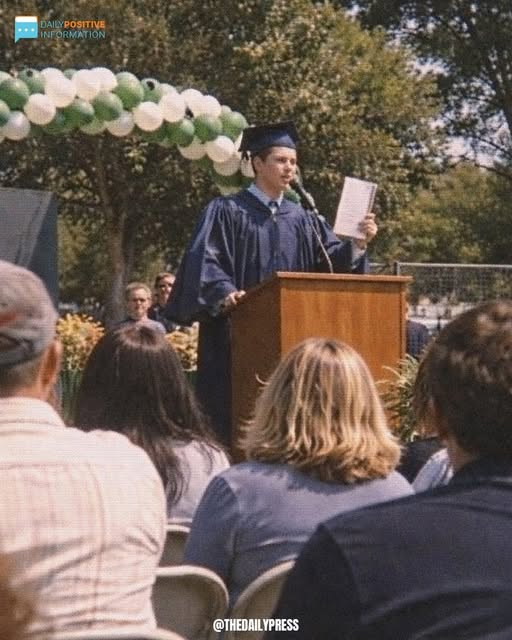
Then he walked to the podium.
At first, everything was standard—thanks, jokes, professors, the usual rhythm of graduation speeches.
Then he paused.
Something shifted.
“I have one more person to thank,” he said.
He looked at me.
“Mom… come up here.”
I didn’t move.
He lowered his voice slightly. “Please.”
So I stood.
Every step felt louder than it should have in a room that size. When I reached him, he took my hand briefly—just enough to steady both of us.
Then he spoke into the microphone.
“This speech is for my mom,” he said. “Because everything I am standing here with started with what she did when nobody was watching.”
Then he handed me a folded letter.
My hands went cold the moment I saw the handwriting.
It was my ex-husband’s.
The Letter
Jack leaned in. “You don’t have to read it. I can.”
“What is this?” I whispered.
“He died two months ago,” he said quietly. “Aunt Sara had this. He left it for me.”
The word died didn’t fully land. Not yet. There was no space for it.
The room was silent now. Not the polite kind—the kind that knows something real is happening.
Jack continued, voice steady but low:
“I found out weeks ago. I didn’t tell you because I knew you’d make it smaller than it was. And this day exists because of what you did.”
I opened the letter.
Evan’s Letter
Mara,
If Jack is giving you this, then he didn’t wait as long as I told him to. That sounds like him.
I saw you outside the jewelry store. I recognized your coat. I knew what you were doing before you even went inside.
I didn’t stop you. I should have. I told myself I was respecting your choice. That’s what I call cowardice when I don’t want to admit I was too late.
You sold your ring.
And I understood something I should have understood years ago—you were still carrying everything I had dropped.
I’m not writing this to fix anything. I can’t. I just want you to know I saw it, even if I didn’t deserve to.
Jack became who he is because you never stopped choosing him, even when it cost you things you never replaced.
I’m sorry.
—Evan
I went to graduation thinking I was there to watch my son receive his degree.
I thought I understood the day. I thought I knew what it would mean, how it would unfold, and what would come after it.
I didn’t know Jack had been carrying something for weeks. I didn’t know there was a letter. I didn’t know there was a plan taking shape quietly, carefully, in the background of his life while I assumed everything had already been said.
When he stepped up to the podium with me beside him, I still believed I was only witnessing an ending—a ceremony, a milestone, a proud moment we would fold into memory and move on from.
But he didn’t treat it like an ending.
He faced the auditorium again, and I stood there next to him—still trying to hold myself together, which I mostly failed at, and which, somewhere beneath the embarrassment, I understood was exactly as it needed to be.
“I wanted to tell her privately,” Jack said into the microphone. “I thought about it for weeks. But this campus, this degree, this moment—it all exists because of what she carried for me. I couldn’t let it stay hidden behind a simpler version of the story.”
My hand went to my mouth almost instinctively. I was already crying in a way I couldn’t control anymore.
He looked at me when he spoke again.
“I used to think my mom was just… good at handling things,” he said. “That she was strong in a way that made everything around her easier. Like problems just didn’t reach her the same way they reached everyone else.”
“Jack…” I whispered, but he kept going.
“They didn’t reach her because she dealt with them first,” he said. “With time. With sleep. With money. With pieces of herself she never told me she was losing. And once, with a ring that should have stayed on her hand.”
The room didn’t react loudly. It went still in a different way—the kind of silence that happens when people recognize something real is being said.
“I’m not saying this to embarrass her,” he continued. “I’m saying it because I’m standing here in a gown she made sure I never had to give up on, and because I never thanked her for it while I still had the chance in front of everyone who matters.”
Then he turned fully toward me.
“Mom,” he said, softer now. “Everything good that came from this degree started with what you gave up to make it possible.”
That was when I broke. Not neatly. Not gracefully. Not in any way I could have prepared for.
Jack stepped forward and held me before I could even think about stopping him. Against my shoulder, I heard him whisper, “I’m sorry I didn’t know.”
And I answered the only truth I had left in that moment.
“You weren’t supposed to.”
Somewhere in the auditorium, people began to stand. Then more. I tried to find a way to compose myself enough to walk off that stage without completely falling apart, and I mostly managed it—but only just.
Afterwards, there was noise again. Photos, congratulations, the scattered chaos of families finding each other in crowds. Eventually, Jack and I drifted away from it all and ended up on a bench beneath a large oak tree near the edge of campus.
For a while, neither of us spoke. We didn’t need to. Silence between us had never felt empty.
Then he finally asked, “Are you angry?”
“No,” I said. “Not angry. Just… overwhelmed.”
He nodded slowly. “I kept hearing your voice in my head telling me I was making a scene.”
“That does sound like something I would say.”
That got a small smile out of him—the one he’s had since he was a child.
Then he reached into his pocket and took out a small box.
“Jack,” I said immediately.
“Just listen,” he replied.
Inside was a simple gold band. No stones. No decoration. Just a clean circle with an engraving inside.
For everything you carried.
I stared at it for a long moment without speaking.
“I used part of what he left,” he said. “The rest went to the loan. Aunt Sara said that’s what he wanted anyway—something meaningful, not just practical.”
He hesitated, then added, “I found an old ring you used to wear in your jewelry tray. I had it sized.”
Of course he had.
“It’s not about him,” he said quickly. “And it’s not about replacing anything. It’s about recognizing what you already did.”
I looked at him through eyes that wouldn’t cooperate anymore.
“The first ring was a promise someone else made,” he said. “This one is for the promise you kept.”
I laughed and cried at the same time, which is apparently what happens when something inside you finally gives up pretending to be in control.
“You really planned to completely ruin me today, didn’t you?” I said.
“Worth it,” he said simply.
When I slipped the ring on, it fit perfectly.
Because he had made sure it would.
We stayed there a while longer under the oak tree, shoulder to shoulder, watching the campus move around us as if it belonged to someone else’s day now.
For years, I had thought of selling that wedding ring as an ending. A quiet closure. A transaction that turned memory into necessity.
But sitting there with my son beside me, I understood it differently.
It hadn’t been an ending.
It had been the first step in a longer story I hadn’t realized I was still building.
Not because of the ring.
Not because of the money.
But because of what it made possible—and because of what my son had grown into without ever being told the full weight of how he got there.
I went to graduation to watch Jack receive his degree.
I didn’t know he was going to give me back my own story in the middle of it.
And I didn’t know I would finally be allowed to see it not as loss—
but as something that had carried us both forward.