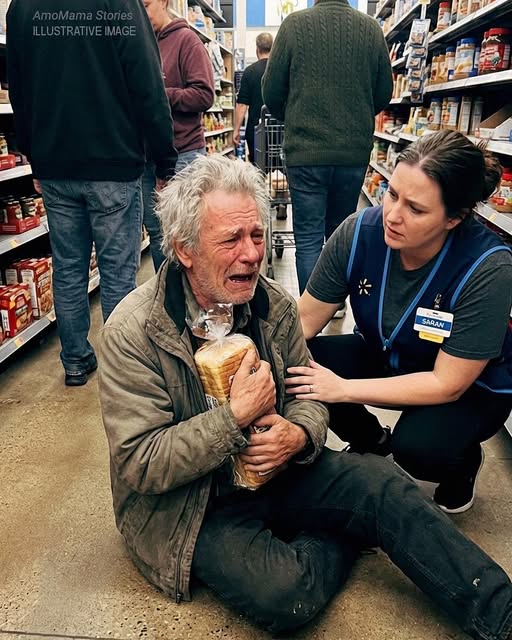
I work as a cashier, and over time you start noticing things most people miss. The small habits, the nervous glances, the way someone moves when they think no one is paying attention. I’ve seen people hide items in sleeves, slip things into bags, or quietly change price tags when they think they won’t get caught. It becomes second nature to read those moments.
But in all the time I’ve worked there, I had never seen something like that day—an old man standing there, quietly crying over a loaf of bread.
That single moment ended up costing me most of the money I had left until payday. At the time, I thought that was the end of the story. I thought I had simply made a difficult but decent choice and would just deal with the consequences.
What showed up at my door the very next morning proved how wrong I was.
The banging started early—seven in the morning, sharp and heavy, the kind that doesn’t belong to a casual visitor. It pulled me out of sleep so suddenly that I sat straight up in bed, disoriented, my heart racing as I tried to figure out where I was.
For a few seconds, everything felt blurry. Then the knocking came again, louder this time.
I stumbled out of bed and went straight to the window, pushing the curtain aside just enough to see outside.
What I saw made me freeze completely.
Three official vehicles were already parked along the street. A fourth one was slowly pulling into my driveway. The engines were still running, and several uniformed officers were stepping out, moving with purpose toward my house.
My stomach dropped.
Across the street, my neighbor, Mrs. Callahan, stood by her mailbox in her robe, holding a coffee cup. She was pretending to check her mail, but it was obvious she was watching everything.
I grabbed my jacket from the chair by the door, my hands moving faster than my thoughts, and opened the door before they had a chance to knock again.
“Miss Rebecca?” the officer at the front asked, his voice calm but firm.
“Yes,” I said, trying to keep my voice steady even though my chest felt tight.
“This is about the elderly man you helped at the grocery store yesterday,” he continued. “We need to speak with you.”
For a second, my mind went completely blank.
Helped him? That was all I had done. Helped him.
The officer reached into his coat and pulled out a small wooden box. It looked old but carefully kept, like something that had been passed down or held onto for a long time. He placed it gently into my hands, as if it were something fragile or important.
“I was instructed to make sure you received this personally, Ma’am.”
My fingers were already trembling as I lifted the lid.
The moment I saw what was inside, I stopped breathing for a second.
A ring.
A simple gold band with a single round stone set in the center. It wasn’t flashy, but it carried a kind of weight—like it meant something.
Attached to it was a small folded note.
My hands shook as I opened it.
“If you are willing, I would like you to meet my son, Walter.”
I stared at the words, trying to make sense of them.
Then I looked back up at the officer.
“Oh God… what is this?” I whispered.
To understand any of this, I have to go back to the day before.
It was just a normal afternoon shift at the grocery store. Nothing unusual. The kind of day where hours pass slowly and everything feels routine.
That’s when I noticed him.
An older man, maybe in his early seventies, wearing a brown coat that looked slightly too big for him. It hung off his shoulders like it didn’t quite belong, like it had seen better years.
There was something else too—the way he stood, the way he moved. I had been working long enough to recognize that subtle tension.
And then I saw it.
The small bulge in his coat pocket.
I had seen that before too.
People trying to take something without paying, hoping no one would notice.
But there was something different about him.
He didn’t look nervous in the usual way. He looked… tired. And there was a faint smell of cold air around him, like he had been walking outside for a long time before coming in.
I approached him slowly.
The moment he noticed me, he froze completely.
“Ma’am,” he said quickly, before I could even speak, “I’ve never done anything like this before. My pension ran out four days ago. I have nothing left until next week. I’m so sorry.”
His voice shook. His hands shook.
And in that moment, he reminded me so much of my grandfather that it caught me off guard.
I had to take a breath before I could respond.
“Sir,” I said gently, “you’ve got it all wrong. You don’t need to hide anything. I just want to treat you.”
He stared at me like he didn’t understand what I was saying.
Slowly, hesitantly, he reached into his pocket and pulled out the loaf of bread.
I didn’t say anything else. I just took his arm lightly, grabbed a basket, and walked with him through the store.
We moved slowly down the aisles.
A fresh loaf of bread went in first.
Then milk.
Then a small pack of ground beef.
A box of cereal.
A can of soup.
Simple things, but enough to get through a few days.
The entire time, he kept insisting it was too much, that he couldn’t accept it, that I didn’t have to do this.
I didn’t argue.
At the end of the aisle, I grabbed a chocolate bar and added it to the basket.
“Everyone needs one sweet thing,” I said with a small smile.
That’s when he started crying.
Not loudly. Not dramatically. Just quiet tears that came from somewhere deep—somewhere that hadn’t felt kindness in a long time.
“My name is Walter,” he said softly. “I’ve never done anything like this in my seventy-two years. I’m ashamed… and grateful… and sorry.”
“You have nothing to be sorry for, Walter,” I told him.
At the register, the total came to $103.
I had $200 left until payday.
As I paid, a small voice in my head reminded me of rent, bills, everything waiting for me at the end of the month.
But another voice—quieter, steadier—told me I had done the right thing.
And that mattered more in that moment.
At the door, Walter turned to me.
He asked where I lived, and without thinking much about it, I told him. He seemed harmless, just an old man who had cried over a chocolate bar.
“You are a very good person, Rebecca,” he said.
“Take care of yourself, Walter,” I replied.
And that was it.
Or at least, I thought it was.
That evening, I went home, made myself a simple bowl of pasta, and sat at the kitchen table going over my budget again and again, trying to figure out how I’d stretch what I had left.
It wasn’t easy.
But there was a kind of quiet peace in me.
The kind that comes when you know you did something right, even if it makes things harder.
I went to bed telling myself that it was worth it.
And now, standing at my front door the next morning, holding that wooden box with the ring inside, I knew that story hadn’t ended at all.
It had only just begun.
“What is this?” I asked again, my voice unsteady.
“Ma’am,” the officer said, “we’d like you to come with us. Walter was very clear that you should see this in person.”
I glanced past him. Mrs. Callahan wasn’t even pretending anymore—she was fully watching.
“Am I in trouble?” I asked. “I just helped him…”
“No, Ma’am,” he said calmly. “You’re not in trouble. But he asked for you specifically.”
I looked down at the ring one more time.
Then I made a decision.
I stepped back inside, put on my shoes, grabbed my keys, and followed them out.
The drive lasted about forty minutes.
I asked questions. A lot of them.
But every single time, the answer was the same:
“You’ll understand when we get there.”
I watched the road pass by, my thoughts racing. Twice, I almost asked them to turn around.
Twice, I stopped myself.
Then the car slowed.
And when I looked up, everything I had been thinking disappeared.
We were in front of a gated property on the edge of town. Not just a house—a place. The kind that feels distant from everything else. Quiet. Controlled.
The gates opened before we even stopped.
As we drove in, I saw wide, perfectly kept grounds stretching out around us. Everything looked calm, almost too calm.
When the car finally stopped, I stepped out slowly.
And as I walked toward the entrance hall, I felt something shift inside me.
Because whatever this was…
It was far bigger than a loaf of bread.