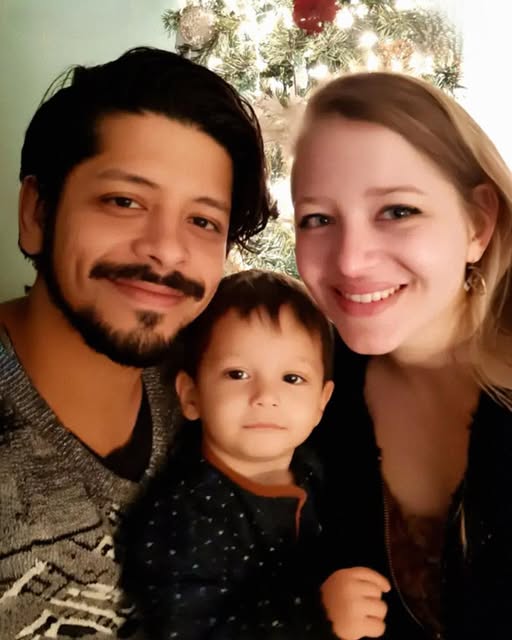
For years, I let my in-laws live under the arrogant illusion that I was linguistically isolated. I endured countless family dinners, holiday gatherings, and Sunday brunches, smiling politely while my husband’s parents wielded their native Spanish like a weapon of exclusion. Behind the shield of a language they assumed I didn’t understand, they dissected my life with ruthless precision. They critiqued how I seasoned my food, my “soft” American approach to parenting, and even the changes in my body after giving birth to our son, Mateo. I absorbed every insult, every micro-aggression, every dismissive laugh, deliberately keeping my fluency in Spanish a secret. At first, it was a strategy—a way to see who they truly were when they thought no one was listening. But over time, it became a heavy, exhausting burden.
The breaking point came on a quiet afternoon, when the holiday cheer felt hollow. I was at the top of the stairs, holding Mateo’s baby monitor, when I heard my mother-in-law’s voice from the living room. She whispered sharply in Spanish, conspiratorial: “She still doesn’t know, does she? About the baby.” My heart didn’t just skip a beat—it stopped. My father-in-law’s low, guttural chuckle sent chills down my spine. “No! Luis promised not to tell her. She can’t know the truth yet. And it won’t be considered a crime.”
Suddenly, the petty criticisms about my cooking or accent vanished. This was something far worse—they were speaking about my son as if he were a secret to manage, a liability, a case study.
When Luis came home that evening, the usual warmth was absent. I didn’t greet him with a kiss or ask about his day. I stood in the kitchen, arms crossed, radiating silence that demanded answers. I led him upstairs, closed the bedroom door, and faced him directly: “What are you and your family hiding from me about Mateo?”
Panic washed over him. When he stammered, “How did you…?” I revealed my truth: I had always understood Spanish. I had heard every cruel word his mother had spoken about me. Most importantly, I had heard the whispered secret at the bottom of the stairs.
Luis collapsed onto the bed, head in hands, and the story poured out. His parents, driven by suspicion and prejudice, had secretly conducted a DNA test on Mateo. Because our son had my light hair and blue eyes rather than the dark features of the Luis family, they convinced themselves I had been unfaithful. They had taken hair samples from Mateo without our knowledge, violating the sanctity of our child to satisfy their own biases.
The cruelest part was Luis’s reaction. He had known since Thanksgiving. He held the “official” proof that he was Mateo’s father and chose to protect his parents’ feelings over defending me, over protecting the integrity of our marriage. I had spent a month at their table, smiling while they treated me like a criminal and our son like a curiosity.
I stood over him, not with anger, but with cold clarity. I told him that the hierarchy of our lives had to change immediately. From that moment on, the family we built—me, him, and Mateo—would be his only priority.
Luis wept, promising to change, promising to be the man I needed. But trust, once fractured by such deep betrayal, cannot be repaired overnight.
When his parents left two days later, I did not confront them. I offered the same polite, vacant smile I had used for years—but now it was different. I had seen them clearly. Confronting them would give them power; instead, I chose irrelevance.
In the following weeks, Luis began the difficult work of reclaiming his place in our family. He set firm boundaries with his parents: they would never again be welcome if they doubted the sanctity of our marriage or our son. It was a start, but as I told him, “Sorry” does not equal trust, and it doesn’t erase the betrayal.
I learned that silence is not protection—it is invisibility. For years, I had made myself invisible in my own home. No longer. My son will grow up knowing he is loved, not because of a lab report, but because I am the architect of his world. Marriage is the act of choosing your partner every day, even when it’s hard, and especially when it means standing up to the people who raised you.
I may never tell my in-laws that I understood every word of their vitriol. Perhaps that secret will remain mine forever. But next time they speak, thinking they are safe behind a language barrier, I will not seek their approval. I will decide what deserves forgiveness—and what deserves a fight. And I will never again let anyone make me a stranger in my own life.