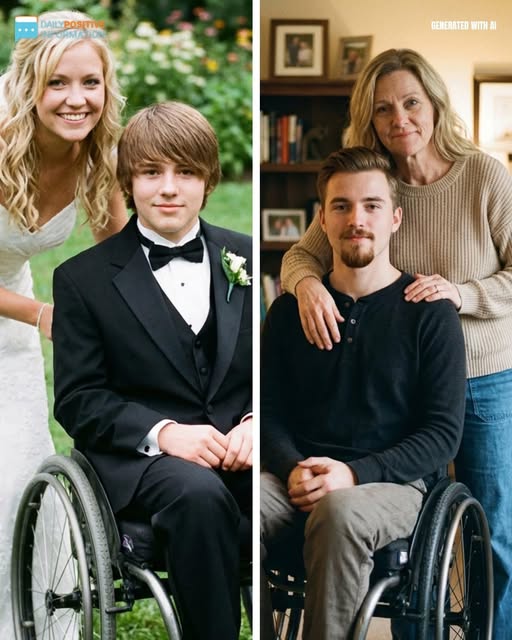
I met my husband in our senior year of high school, back when life still felt both simple and endless—when the future looked like an open highway stretching far beyond what we could see, and we truly believed that love alone could carry us through anything.
We were both seventeen, living in a mid-sized town in Pennsylvania where everyone knew everyone else’s business. We were young enough to believe wholeheartedly that love was enough, yet old enough to start making plans that felt permanent. We talked about applying to the same colleges, about tiny studio apartments with broken plumbing that we somehow romanticized, about careers we didn’t really understand but spoke about as if they were already decided.
His name was Michael, and he was my first love—the kind that stays with you forever, setting the standard for every relationship that follows. I was his first love too, at least that’s what he always told me. When he smiled at me across the crowded cafeteria or took my hand between classes in the hallway, everything in the world felt right, safe, and certain.
Then, just a week before Christmas during our senior year, everything we had built in that teenage world shattered in an instant.
The accident that changed everything
Michael was driving to his grandparents’ house on a snowy December evening to drop off Christmas gifts. It was one of those dangerous winter nights where a brief thaw turns into black ice without warning. A rural road, a hidden patch of ice, and an oncoming truck whose driver couldn’t stop in time. The exact details were always hard to piece together, but the outcome was unmistakable.
The crash left Michael paralyzed from the waist down. A complete spinal cord injury. No movement, no feeling below his torso.
I still remember the hospital smell even now—the sharp, sterile mix of disinfectant and antiseptic that clings to everything. I remember the steady beeping of the machines. I remember holding his hand and feeling how cold it was despite the warmth of the room. And I remember the doctor’s voice, calm in a way that felt unbearable, as he delivered the news that changed everything.
“I’m very sorry, but the damage to his spinal cord is extensive and complete. He will never walk again.”
The words felt like they stopped time. Michael went completely still. His mother cried quietly. His father tightened his jaw, staring forward as if trying to process a future that had just collapsed.
I was still trying to understand what I had just heard when my parents arrived about an hour later.
They stood at the end of Michael’s hospital bed, polite but distant, offering sympathy that already felt conditional. I could see it in their expressions—the quiet calculations, the reassessments, the way they were already rewriting the future without him in it.
On the drive home that night in their expensive car, they didn’t ask what Michael needed or how he was coping. Instead, they told me what I needed to do.
“This is not what you need in your life,” my mother said from the passenger seat, her tone controlled but final. “Not at your age. Not with your future ahead of you.”
“You’re only seventeen,” my father added, looking at me through the rearview mirror. “You can meet someone else. Someone healthy. Someone with prospects. Someone who can give you a normal life. Don’t throw your future away over this.”
My parents were both successful attorneys—people who valued reputation, stability, and image above everything else. To them, Michael had instantly become something inconvenient, something that no longer fit the life they had planned for me.
I told them I loved him. That love meant staying, not leaving when things became difficult.
They told me I was being naive. That I would understand when I was older.
When I refused to leave Michael’s side—when I kept visiting him every day in rehabilitation—they followed through on their threats.
They cut me off financially, completely and without hesitation. My college fund was gone. My access to their support was gone. The doors they controlled were shut one by one.
And then they made it clear: I was not to contact them again until I “came to my senses.”
I packed a single duffel bag with a few clothes and precious belongings, left my parents’ expensive house in the nice neighborhood, and went straight to Michael.
The family that took me in when mine turned away
Michael’s parents—hardworking, middle-class people living in a modest split-level home—welcomed me without hesitation. They gave me their spare room, the one that had once belonged to Michael’s older sister before she moved out. Not once did they treat me like a burden or make me feel like I owed them for their kindness.
In those early months, I helped care for Michael—learning how to safely transfer him from his wheelchair, how to assist with physical therapy, and how to handle the many daily tasks that now required adjustment. I learned how to stay strong when he broke down at night, overwhelmed by the permanence of everything.
I worked part-time at a grocery store, taking evening and weekend shifts. I studied for my GED after leaving traditional school behind. I quickly learned how to stretch every dollar, how to survive without any safety net.
When prom season came that spring, I convinced Michael we should go.
People stared when we walked into the decorated gym. Some whispered, some looked away, unsure how to react. I didn’t care. To me, Michael was still the same person I loved—the one who made me laugh, who believed in me when others had walked away.
We married young—I was nineteen, he was twenty. It was a small courthouse ceremony with just his parents and a few close friends. No family from my side. No big celebration. No childhood dream wedding.
Still, we built a life together. Slowly, imperfectly, but honestly. We had a daughter when I was twenty-three—a beautiful girl with Michael’s eyes and my stubbornness. I waited, at first, thinking my parents might eventually reach out. Maybe a card. A call. Something for their granddaughter.
Nothing came. The silence stayed unbroken.
Fifteen years passed like that—fifteen years of holidays without them, milestones without them, a life built entirely without my family of origin.
And through it all, I truly believed Michael and I were unshakable. We had survived the worst life had thrown at us. I thought nothing could break what we had.
Until one ordinary afternoon destroyed that belief completely.
The revelation that destroyed everything I thought I knew
I came home early from work that day. I was managing a small medical office by then, and we had closed early because of a power outage. Michael, my husband, was working from home as a software developer—a career he had built despite his physical limitations, something I had always been deeply proud of.
As I walked through the front door, I heard raised voices coming from the kitchen. One was Michael’s—defensive, panicked. The other voice was one I hadn’t heard in fifteen years, yet I would have recognized it anywhere.
My mother.
She was standing in our kitchen—my mother, who hadn’t spoken to me since I was seventeen—red-faced, shaking with anger, forcefully shoving a thick stack of papers toward my husband.
“How could you do this to her?!” she shouted, her voice raw. “How could you lie to my daughter for all these years? How could you steal her entire life from her?”
I froze in the doorway, my work bag still on my shoulder, unable to comprehend what I was seeing.
“Mom?” I whispered. “What are you doing here? How did you even find us?”
She turned sharply toward me, her eyes burning with something I couldn’t fully read—anger, yes, but also something like guilt.
“Sit down,” she said firmly, pointing to a chair. “You need to know who this man really is. You need to know what he’s been hiding from you.”
Michael had gone completely pale. His hands were gripping the edge of the table so tightly his knuckles were white.
“Please,” he said, his voice shaking. “Please let me explain. Please forgive me.”
My heart pounded as I took the stack of papers from my mother, my hands trembling. At first, I couldn’t understand what I was looking at.
Medical records. Legal documents. Specialist reports. Insurance files. Rehabilitation assessments.
Then I saw it—one line buried deep in a neurologist’s report that felt like it shattered everything:
The paralysis had never been permanent.
I read it again and again, my mind refusing to accept it. According to these documents, Michael had regained partial movement and sensation less than two years after the accident. With surgery and intensive rehabilitation, multiple doctors had determined he could walk again—perhaps not perfectly, but independently.
I slowly looked up at him, tears blurring my vision as my entire world collapsed.
“You told me,” I whispered, “that you would never walk again. That there was no hope. That the doctors said it was impossible.”
He broke down instantly.
“I was scared,” he cried. “I was terrified you would leave me. Your parents already hated me. I thought if you knew there was a chance, you’d stay out of obligation and end up resenting me if it failed—or worse, leave me to live a normal life with someone else.”
“So you lied?” I said, my voice rising. “For fifteen years? While I worked myself to exhaustion? While I sacrificed everything?”
He nodded, unable to meet my eyes.
My mother slammed her hand on the table.
“He contacted us,” she said coldly. “Two years after the accident. He asked us to help fund the surgery that could have helped him walk again—but only if we agreed never to tell you.”
I stared at her, stunned.
“You knew?” I whispered. “All this time?”
She looked away.
“We thought you were trapped,” she said quietly. “We thought we were protecting you—from him, and from your loyalty to him.”
The room felt smaller, suffocating. Every sacrifice I had made—every double shift, every defense of him, every moment of devotion—suddenly felt built on something I could no longer trust.
“I loved you,” I said to Michael, shaking. “I chose you when everyone else walked away. I gave up everything for you.”
“I love you,” he cried. “I never stopped.”
“But you didn’t trust me,” I said. “You didn’t trust me enough to tell me the truth.”
The aftermath that changed everything again
That night, I didn’t scream or break anything. I simply packed a bag—the same kind of bag I had packed fifteen years earlier—and left with our twelve-year-old daughter to stay with a friend.
The divorce was quiet, but devastating. Michael eventually admitted everything. The truth was undeniable.
Then something unexpected happened.
My parents reached out again—but this time, differently. No control, no demands, no judgment. Just regret. For the first time in over fifteen years, they apologized—not for their intentions, but for taking away my choice and deciding my life for me.
I didn’t forgive them immediately. Some wounds take time. But slowly, carefully, we began rebuilding something fragile but real.
Now, years later, I’ve built a new life—one grounded in honesty, independence, and truth. I don’t regret loving Michael. Those years taught me strength, loyalty, and resilience.
But I learned something far more important.
Love cannot survive without truth.
And sacrifice means nothing when it is built on lies.