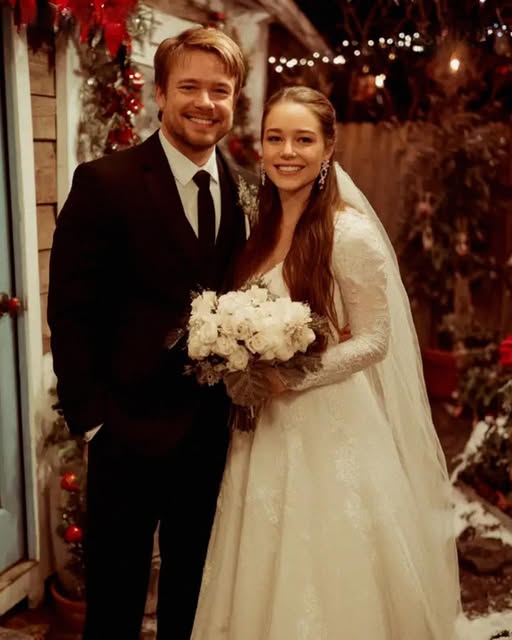
I married Matthew in the very house he had once shared with his late wife. I kept telling myself it didn’t bother me—that love could repaint old memories, that I could create something new within walls that had already absorbed another life before mine. But on our wedding night, while the house was hushed and Matthew was tucking his daughter into bed, I opened the nightstand drawer and noticed an envelope taped underneath the top panel. The paper was yellowed, the handwriting elegant, and the first sentence sent a shiver straight through me:
“If you’re reading this, he didn’t tell you the truth.”
For a moment, it felt as if the entire room tilted.
I had met Matthew the previous spring at a backyard cookout. My attraction to him was immediate and disarming. He was gentle, deeply present, and carried his grief with the kind of quiet strength that comes from learning how to walk with pain instead of drowning in it. Early on, he told me his wife had died in a car accident. He said it softly, like he hated the sound of those words, and I had felt my heart fold for him. He talked about his daughter, Mia, five years old, with so much tenderness it made me fall even harder.
Our relationship grew steady, natural, unforced. He didn’t pretend he was healed. He didn’t hide that some days hurt in ways he couldn’t explain. And when he finally confessed he was falling in love with me, I was already there.
The first time I walked beside him and Mia, she slipped her tiny hand into mine. That simple gesture painted a future in my mind—messy, imperfect, but real. When Matthew proposed, I said yes without hesitation. And now, standing in the bedroom we were meant to share, I held a letter written by the woman who had lived this life with him before me.
I eased the note open.
“I know my time is running out,” it began. “And if Matthew has remarried, I hope you find this before he hides the rest of what happened to me.”
Time running out?
Matthew had always said her death was sudden. A crash. No time to prepare. My stomach knotted. I read on, but before I reached the next paragraph, a loud crash shattered the quiet—glass breaking, Mia crying, Matthew calling my name.
I shoved the letter back, hands trembling, and ran.
The kitchen floor sparkled with shards.
“It’s okay,” I said, forcing my voice steady. “I’ll clean it up.”
But even as I swept the pieces away, my thoughts pulled back upstairs—to that hidden letter hinting that Matthew had rewritten the past.
When everything was calm, I hurried back to the bedroom.
The drawer was closed.
I knew I hadn’t closed it.
And when I opened it again, the letter was gone.
A cold wave slid through me. Matthew must’ve gone in while I was cleaning—found the letter—and silently removed it. No explanation. No questions. Nothing.
The next morning, the air in the house felt heavy, thick with something unsaid. Matthew barely touched his breakfast, giving me tight smiles that didn’t match his eyes. Mia was even quieter, staring at her cereal bowl, shoulders stiff.
After Matthew left for work, I stood alone in the quiet kitchen wondering if my marriage had been built on a story he had rewritten to survive his own pain. If I confronted him, could I believe anything he said?
Then Mia made a soft noise behind me.
She was coloring at the table. I walked over.
Her drawing showed a woman lying on a bed holding a rectangle—clearly a letter—and beside her stood a small child with an X scribbled over her mouth.
A chill gripped me.
“What’s this, sweetheart?” I asked carefully.
“It’s a secret,” she whispered.
My heart twisted. “Sweetie, secrets that make you sad aren’t the kind you should keep.”
Tears filled her eyes. “Daddy said not to tell. He said it makes his heart hurt. But… it makes my heart hurt too.”
I knelt beside her. “You can tell me. I promise.”
She took my hand silently and led me downstairs to the basement.
She pointed at a plain plastic storage bin. My hands shook as I opened it.
Inside were oxygen tubes, prescription bottles dated two years back, and a portable concentrator—equipment for someone who had been seriously ill for a long time.
Not a car accident.
“Mommy’s things,” Mia murmured. “Daddy said we’re not supposed to talk about it.”
Then she reached into the bin and pulled out something else—the letter.
“I took it. I didn’t want it to get lost.”
Tears blurred my vision.
She wasn’t hiding something malicious. She was trying to protect him.
I unfolded the letter and read it in full.
“If you’re reading this, Matthew couldn’t bring himself to tell you. I’ve been sick for over a year. He tried everything. He loved me fiercely, even when I knew the end was coming. I wrote this because I knew he would rewrite the story to survive his grief. Please don’t be angry with him. He protects people by pretending everything is okay. Even me. Take care of him. And take care of our little girl. He will love you with a wounded heart, but he will love you deeply.”
By the time I finished, I was sobbing.
This wasn’t a warning.
It was a message from a dying woman—one who loved him enough to worry about the woman who would come after.
That evening, when Matthew walked through the door, I was waiting in the living room. The bin sat open on the table. The letter lay folded beside it.
He froze. His breath hitched.
“You lied to me,” I said quietly.
His face crumpled, grief rushing through him like a wave he couldn’t outrun.
“Lila… I couldn’t say it again. I couldn’t relive it. I just wanted one part of my life to start clean. I didn’t want all that pain to follow us.”
I stepped to him and placed the letter gently in his hands.
“You don’t have to carry it alone anymore.”
He broke into tears—shaking, gasping—letting out years of buried hurt. Not a man caught in a lie, but a man who had been trying too hard to survive.
“I just wanted a fresh start,” he whispered.
“Then let’s start with the truth,” I said softly. “We can build from there.”
As he collapsed into my arms, his grief finally allowed to breathe, I understood something simple and profound:
He was finally letting me love him—every part of him, even the ones he had been too scared to show.